Fuel Pressure Check
Work Procedure
FUEL PRESSURE RELEASE
FUEL PRESSURE RELEASE
Remove fuel pump fuse.
Start engine.
After engine stalls, crank it two or three times to release all fuel pressure.
Ignition switch OFF.
Reinstall fuel pump fuse after servicing fuel system.
INSPECTION END
LOW FUEL PRESSURE CHECK
FUEL PRESSURE CHECK
Release fuel pressure to zero.
Prepare fuel hose for fuel pressure check (B) and fuel tube adapter [SST: KV10120000 (-)] (D), then connect fuel pressure gauge (commercial service tool) (A).

: To quick connector 
: To fuel tube (engine side) C : Clamp Remove fuel hose.
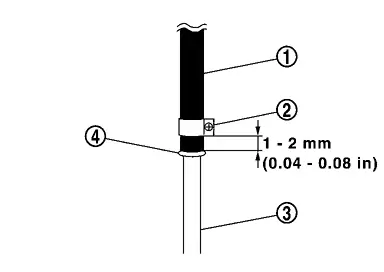
Connect fuel hose for fuel pressure check (1) to fuel tube (engine side) (3) with clamp (2) as shown in the figure.
Connect fuel tube adapter to quick connector.
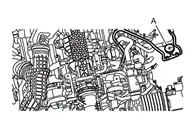
A :Fuel pressure gauge Ignition switch ON and check for fuel leakage.
Start engine and check for fuel leakage.
Stop the engine.
Ignition switch ON and read the indication of fuel pressure gauge.
At ignition switch ON : Approximately 500 kPa (5.0 bar, 5.1 kg/cm2, 72.5 psi)
Is the inspection result normal?
YES>>INSPECTION END
NO>>GO TO 2.
CHECK FUEL HOSES
Check the following.
Fuel hoses for clogging
Fuel filter for clogging
Low pressure fuel pump
Fuel pressure regulator for clogging
Is the inspection result normal?
YES>>Replace fuel pressure regulator.
NO>>Repair or replace error-detected parts.
HIGH FUEL PRESSURE CHECK
WITH CONSULT
Start engine.
Check “Fuel pressure sensor voltage” in “Data monitor” mode with CONSULT.
Monitor Item Condition Values/Status Fuel pressure sensor voltage Idle 1.6V 2,000 rpm 1.5-2.1V
 WITHOUT CONSULT
Start the engine.
Check fuel rail pressure sensor signal voltage.
| + | − | Condition | Value (Approx.) | |
|---|---|---|---|---|
| Fuel rail pressure sensor | ||||
| Connector | Terminal | |||
| F52 | 2 | Ground | Engine speed: idle | 1.6V |
| 2,000 rpm | 1.5-2.1V | |||