Driving advice, eco driving
Fuel consumption is approved in accordance with a standard, statutory method.
Identical for all manufacturers, it allows vehicles to be compared with one another. Real-world fuel consumption depends on the vehicle's conditions of use, its equipment and driving style. To optimise fuel consumption, refer to the advice below.
Depending on the vehicle, various functions are available to help you reduce fuel consumption:
- the rev counter;
- gear shift indicator;
- the driving style indicator;
- the trip summary and eco-advice via the multimedia display;
- ECO mode, activated with the ECO button.
Where fitted, the navigation system supplements this information.
Gear shift indicator 1
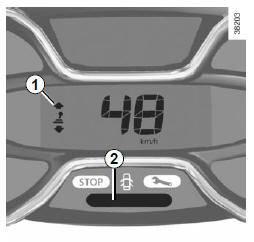
Depending on the vehicle, to optimise fuel consumption, a warning light on the instrument panel tells you the best moment to select a higher gear or a lower gear:
 Select a higher gear;
 Select a lower gear.
Driving style indicator 2
It informs you of your driving style in real time. You are alerted by the colour of indicator 2.
- Green: smooth, economical driving;
- Yellow: driving not smooth enough;
- Orange: driving too aggressive.
The driving style indicator is activated by default. If you wish to deactivate it, refer to the multimedia system user guide.
Trip summary
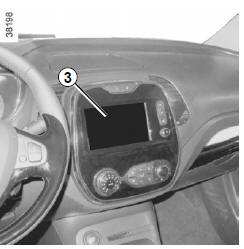
When the engine is switched off, the "trip summary" display on screen 3 provides information on your last journey.
It shows:
- Average consumption;
- Total consumption;
- the number of kilometres travelled;
- the number of kilometres saved.
An overall score from 0 to 100 is displayed, allowing you to assess your performance as an eco-driver. The higher the score, the lower the fuel consumption.
Eco-advice is given to help you improve your performance.
Storing your favourite journeys allows you to compare your performance.
For more information, refer to the multimedia system user guide.
Eco mode
Eco mode is a function that optimises fuel consumption.
It acts on all energy-consuming components (engine power, heating and/or air conditioning, etc.).
Activating the function
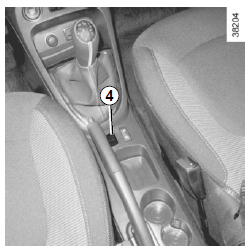
Press switch 4.
The warning light appears on the instrument panel
to confirm activation.
While driving, it is possible to temporarily leave eco mode to regain the engine's performance.
To do this, press the accelerator pedal firmly and fully down.
Eco mode reactivates as soon as you release the accelerator pedal.
Deactivating the function
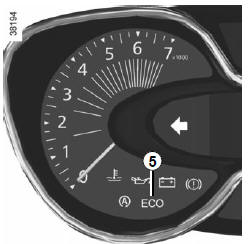
Press switch 4.
Indicator 5 goes off
on the instrument panel to confirm deactivation.
Driving advice and eco driving
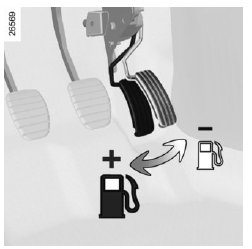
Behaviour
- Rather than warming the engine up while stationary, drive gently until it has reached its normal operating temperature.
- Speed is expensive.
- "Sporty" driving is expensive: prefer "smooth" driving.
- Do not push engine speed in the intermediate gears.
Therefore, always use the highest gear possible.
- Avoid sudden acceleration.
- Brake as little as possible. By anticipating obstacles or bends sufficiently in advance, you need only lift off the accelerator.
- When driving uphill, rather than trying to maintain your speed, do not press the accelerator any harder than on level ground. Preferably keep the same foot position on the accelerator pedal.
- Double declutching and blipping the accelerator before stopping the engine are no longer necessary on modern vehicles.
- Bad weather, flooded roads:
 Do not drive through water if its depth exceeds the lower edge of the wheel rims.
Driving discomfort
Driver's side: only use floor mats designed for the vehicle, which clip onto the pre-installed fasteners, and check their attachment regularly. Do not stack several mats.
Risk of pedal entrapment
Tyres
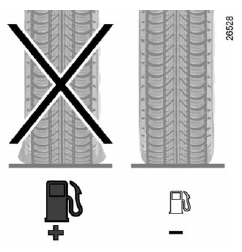
- Insufficient tyre pressure increases fuel consumption.
- Using tyres other than those recommended may increase fuel consumption.
Driving tips
- Use ECO mode whenever possible.
- Electricity is “like oil”: switch off any electrical equipment when it is no longer really needed. But (safety first), keep your lights on whenever visibility requires it (see and be seen).
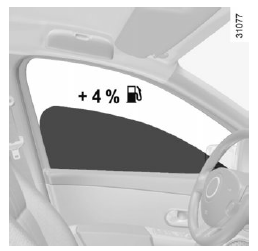
- Use the ventilation vents instead. Driving with the windows open at 100 km/h increases fuel consumption by 4%.
- Avoid filling the tank to the brim, as this prevents any overflow.
- On vehicles equipped with air conditioning, an increase in fuel consumption (especially in urban driving) while it is in use is normal.
On vehicles equipped with air conditioning without automatic mode, switch the system off when it is no longer needed.
Tips to minimise fuel consumption and thus help protect the environment:
If the vehicle has been parked in extreme heat or direct sunlight, ventilate it for a few minutes to expel the hot air before starting.
- Do not keep an empty roof rack fitted
- To transport bulky items, use a trailer instead.
- When towing a caravan, use an approved deflector and remember to adjust it.
- Avoid “door-to-door” use (short journeys interspersed with long stops): the engine never reaches its optimum temperature.
Test yourself
A quick Renault Captur quiz: every answer comes with an explanation and a link to the manual page.