Installing the child seat
CHILD SAFETY: choosing the child seat mounting
There are two ways to fix child seats: with the seat belt or with the ISOFIX system.
Fixing with the seat belt
The seat belt must be adjusted so that it performs its function in the event of sudden braking or an impact.
Follow the belt routing specified by the child seat manufacturer.
Always check that the seat belt is latched by pulling on it, then tighten it as much as possible while pressing down on the child seat.
Check that the seat is held firmly by moving it left/right and forward/backward: the seat must remain securely fixed.
Check that the child seat is not installed crooked and that it does not rest against a window.
Do not use a child seat that could unlatch the belt holding it: the base of the seat must not rest on the seat belt buckle tongue and/or buckle.
Before using an ISOFIX child seat that you have acquired for another vehicle, make sure that its installation is authorised.
Consult the list of vehicles that can accommodate the seat from the equipment manufacturer.
The seat belt must never be loosened or twisted. Never route it under the arm or behind the back.
Check that the belt is not damaged by sharp edges.
If the seat belt does not operate normally, it cannot protect the child.
Consult a brand representative. Do not use this seat position until the belt has been repaired.
ISOFIX system mounting
ISOFIX child seats approved under regulation ECE-R44 are permitted in one of the following three cases:
- ISOFIX universal, 3-point, forward-facing;
- ISOFIX semi-universal, 2-point;
- vehicle-specific.
For the last two types, check that your child seat can be installed by consulting the list of compatible vehicles.
Attach the child seat using the ISOFIX latches when it is equipped with them. The ISOFIX system provides easy, quick and secure fitting.
The ISOFIX system consists of 2 anchorages and, in some cases, a third anchorage.
No modifications must be made to the original system components: seat belts, ISOFIX and seats, as well as their mountings.

The two anchorages 1 are located between the backrest and the seat cushion and are marked by a label. Use the access guides 2 of the child seat to make it easier to position and latch it onto anchorages 1.
The third anchorage 4 or 5 is used to attach the top tether strap of certain child seats.
Rear seats

Remove the rear shelf to route strap 3 between the backrest and the rear shelf (refer to the "Rear shelf" section in chapter 3). Attach the hook to anchorage 4, identified by the symbol
at the rear of the seat in use and located under the movable floor.
ISOFIX anchorages have been designed exclusively for child seats with the ISOFIX system. Never attach other child seats, seat belts or other objects to these anchorages.
Make sure nothing obstructs the anchorage points.
If the vehicle has been involved in a road accident, have the ISOFIX anchorages checked and replace your child seat.
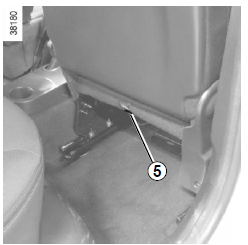
Front passenger seat
Attach the hook of strap 3 to anchorage 5.
All seating positions
Tighten strap 3 so that the backrest of the child seat is in contact with the vehicle seatback.
Make sure the backrest of the forward-facing child seat is in contact with the vehicle seatback.
In this case, the child seat does not always rest on the vehicle seat cushion.
Some seating positions are not approved for installing a child seat.
The diagram on the following page shows where to install a child seat.
The types of child seat mentioned may not be available. Before using another child seat, check with the manufacturer that it can be fitted.
Make sure the child seat or the child's feet do not prevent the front seat from locking correctly.
Refer to the "Front seat" section in chapter 1.
Make sure that installing the child seat in the vehicle cannot unlatch it from its base.
If you must remove the head restraint, make sure it is properly stowed so that it does not become a projectile in the event of hard braking or a collision.
Always secure the child seat to the vehicle, even when it is not in use, so that it does not become a projectile in the event of hard braking or a collision.
In the front passenger seat
Transporting a child in the front passenger seat is specific to each country.
Consult the regulations in force and follow the diagram on the following page.
Before installing a child seat in this position (if permitted):
- lower the seat belt as far as possible;
- move the seat fully back;
- tilt the backrest slightly from the vertical (approximately 25°);
- for vehicles so equipped, raise the seat cushion to its highest position.
In all cases, raise the seat head restraint to its highest position so that it does not interfere with the child seat (refer to the "Front head restraints" section in chapter 1).
After installing the child seat, if necessary, the seat can be moved forward (to leave enough room in the rear seats for passengers or other child seats). For a rear-facing child seat, do not allow it to touch the dashboard, and do not move the seat to its maximum forward position.
Do not change any other settings after installing the child seat.
RISK OF DEATH OR SERIOUS INJURY: before installing a child seat on the front passenger seat, make sure the airbag is deactivated (refer to the "Child safety: deactivating and activating the front passenger airbag" section in chapter 1).
In outer rear seat position
A carrycot is installed crosswise in the vehicle and occupies at least two seats.
Position the child's head on the side opposite the door.
Move the front seat forward as far as possible to install a rear-facing child seat, then move it back as far as possible without touching the child seat.
For the child's safety when facing forward, do not move the seat in front of the child rearward beyond the middle of the rail, do not recline the backrest too much (25° maximum) and raise the seat as much as possible.
In all cases, remove the rear head restraint of the seat on which the child seat is positioned (refer to the "Rear head restraints" section in chapter 3). This must be done before installing the child seat.
Make sure the forward-facing child seat is pressed against the vehicle seat backrest.
Preferably install the child seat on a rear seat.
Installing an ISOFIX seat in the rear outer left seat position makes the centre seat position unusable. The centre belt is no longer accessible or usable.
To install an ISOFIX seat in this position, move the centre belt out of the way by hand before engaging the latches.
Installation illustration
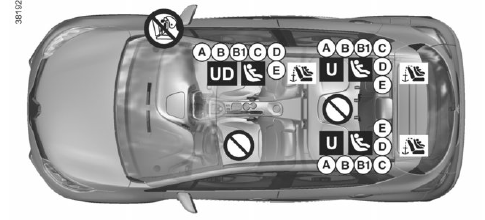
 Check the airbag status before
installing a passenger or a child seat.
RISK OF DEATH OR SERIOUS INJURY: before installing a child seat on the front passenger seat, make sure the airbag is deactivated (refer to the "Child safety: deactivating and activating the front passenger airbag" section in chapter 1).
Child seat secured with the belt
 Seat position allowing attachment
with the belt of a "Universal"-approved seat;
 Seat position allowing attachment by
belt only of a rear-facing "Universal"-approved seat.
Child seat secured with ISOFIX attachment
 Seat position allowing attachment of an
ISOFIX child seat.
 ISOFIX positions are fitted
with an anchorage allowing attachment of a forward-facing
universal ISOFIX child seat. The anchorages are located in the boot for the rear seats and on the seat backrest for the front seat.
The size of an ISOFIX child seat is indicated by a letter:
- A, B and B1: for forward-facing group 1 seats (9 to 18 kg);
- C and D: rear-facing infant carriers or seats of group 0+ (under 13 kg) or group 1 (9 to 18 kg);
- E: rear-facing infant carriers of group 0 (under 10 kg) or 0+ (under 13 kg);
- F and G: group 0 carrycots (under 10 kg).
Using a child restraint system not suitable for this vehicle will not properly protect the baby or child. They could be seriously or fatally injured.
The table below repeats the same information as the diagram on the previous page in order to comply with current regulations.

X = Seat position not approved for child seat installation.
U = Seat position allowing attachment by belt of a commercially available "Universal"-approved seat; check that it fits correctly.
IUF/IL = Seat position allowing, for vehicles so equipped, attachment by ISOFIX anchorage of a child seat approved as "Universal/semi-universal or vehicle-specific"; check that it fits correctly.
- Position the vehicle seat in its rearmost and highest position, and recline the backrest slightly (approximately 25°).
- A carrycot is installed crosswise in the vehicle and occupies at least two seats. Position the child's head on the side opposite the door.
- Move the front vehicle seat fully forward to install a rear-facing child seat, then move it fully rearward without touching the child seat.
- Forward-facing child seat: place the child seat backrest in contact with the vehicle seat backrest. In all cases, remove the rear head restraint of the seat on which the child seat is positioned. This must be done before installing the child seat.
Refer to the "Rear head restraints" section in chapter 3.
(5) RISK OF DEATH OR SERIOUS INJURY: before installing a child seat on the front passenger seat, make sure the airbag is deactivated (refer to the "Child safety: deactivating and activating the front passenger airbag" section in chapter 1).
Test yourself
A quick Renault Captur quiz: every answer comes with an explanation and a link to the manual page.