Engine and peripherals
Petrol injection ECU
In this manual: Engine and peripherals
~1min read
Essential equipment |
| diagnostic tool |
Tightening torques |
|
| battery tray | 2.1 daN.m |

REMOVAL
- Remove the engine covers.
- Disconnect the battery.
K4J
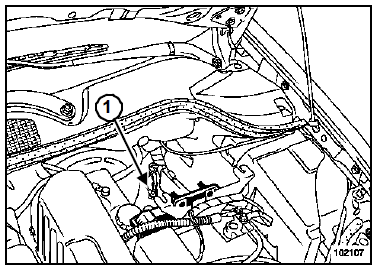
- Disconnect the connectors (1) from the injection ECU.
- Remove:
- the four ECU mounting screws on the bracket,
- the ECU.
F4R or K4M
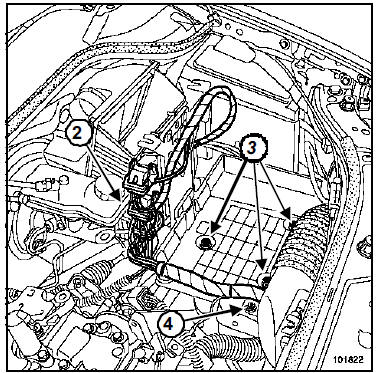
- Remove the battery.
- Disconnect the connectors (2) from the injection ECU.
- Remove:
- the three mounting bolts (3) of the battery tray,
- the clip (4) of the wiring harness.
- Unclip the wiring harnesses from the battery tray.
- Remove the battery tray.
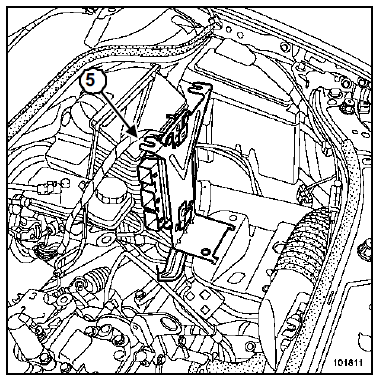
- Remove the injection ECU (5) with its bracket.
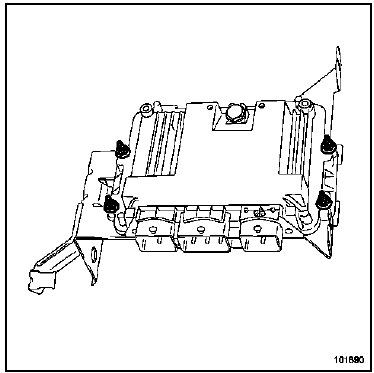
- Remove the four ECU mounting screws.
INSTALLATION
- Refit in the reverse order of removal.
- Tighten the battery tray to torque (2.1 daN.m).
Connect the battery; carry out the necessary re-learns (see Electrical Equipment chapter).
Note: When the ignition is switched on, the electronic throttle body must carry out a learning cycle of its minimum and maximum stops.- Use the diagnostic tool to check that this learning has been completed correctly: ET051: Throttle stop learning.
- Carry out flywheel target learning on a road test: perform two successive decelerations in third gear, from 4000 rpm down to the engine re-engagement speed.
Engine re-engagement is the point where, during a deceleration with the foot off the pedal and injection cut off, the ECU re-enables injection.
- Use the diagnostic tool to check that this learning has been completed correctly: ET089 "Flywheel target learning".
- Read the fault codes.
- Repair if necessary.
- Clear the fault codes.
- Make sure the vehicle operates correctly.
Test yourself
A quick Renault Megane quiz: every answer comes with an explanation and a link to the manual page.
Was this page helpful?