Camshaft phaser
B84 or C84
I - FEATURES
F4R or K4M
Its role is to modify the valve timing diagram.
To improve cylinder filling at all engine speeds, K4M and F4R engines are fitted with an intake camshaft phaser (
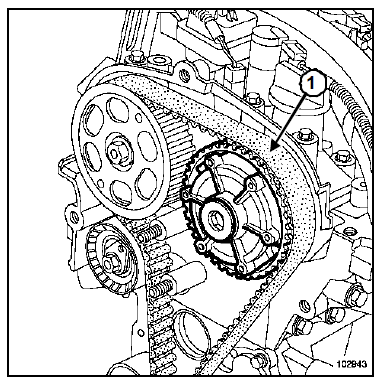
Phasing the closing moment of the intake valves optimises filling according to engine speed. Torque at mid-range and power at high speed are enhanced.
Indeed, keeping the intake valves open longer allows, at high speed, the mixture to continue entering thanks to its high velocity.
On the other hand, at lower speeds, gas inertia is low. It is therefore preferable to close the exhaust valves earlier to avoid poor filling and a loss of torque due to fresh gas being pushed back.
The higher the engine speed, the more the closing of the intake valves must be delayed.
II - OPERATION AND STRATEGIES
K4M
Oil is supplied to the phaser through a solenoid valve (2) located on the cylinder head.
Supply by a variable duty cycle signal (amplitude 12 V, frequency 250 Hz) distributes oil in the mechanism and thus modifies the phase angle.
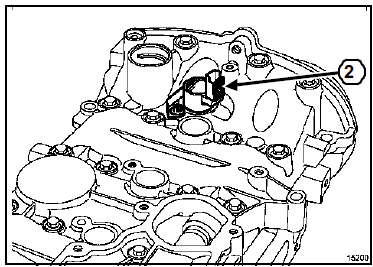
The camshaft phaser operates continuously variably.
The ECU supplies the solenoid valve with a variable duty cycle proportional to the desired phase shift.
The phase shift varies continuously from 0 to 43 crankshaft degrees.
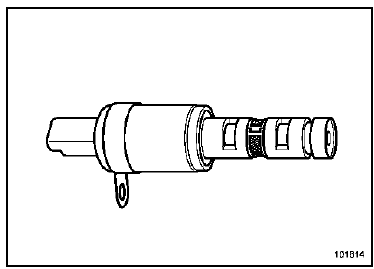
The camshaft phaser solenoid valve is activated when the following conditions are met:
- no engine speed sensor fault,
- no camshaft position sensor faults,
- no faults in the injection system,
- after the engine has started,
- outside idle speed and with the accelerator pedal released,
- threshold of a map depending on load and engine speed reached,
- coolant temperature between 10 and 120 C,
- engine oil temperature too high.
Limp-home modes:
- phaser returns to its initial position,
- zero phase shift.
A solenoid valve stuck open causes unstable idle, excessive manifold pressure at idle, and loud engine operating noise.
III - OPERATION AND STRATEGIES
F4R
The phaser is controlled on/off by the injection ECU through a solenoid valve (3) located on the rocker cover.
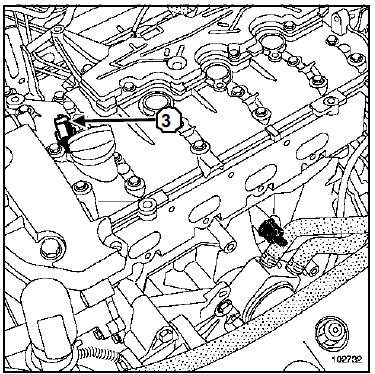
From 1500 to 4300 rpm, the ECU powers the solenoid valve.
Above 4300 rpm, the solenoid valve is no longer powered.
The position of the mechanism favours filling at high speed. In this position, a locking piston locks the mechanism
Note: Up to 1500 rpm, the solenoid valve is not powered.The mechanism is locked by the piston.
As soon as the solenoid valve is energised, with engine speed above 1500 rpm, oil pressure pushes back the locking piston and releases the mechanism.
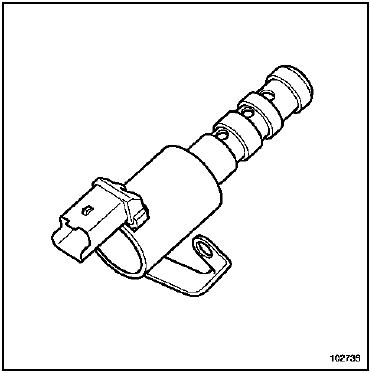
The solenoid valve is closed at rest. It allows oil to flow to control the camshaft phaser when the following conditions are met:
- no engine speed sensor fault,
- no camshaft position sensor faults,
- no faults in the injection system,
- after the engine has started,
- not at idle speed,
- battery voltage >11.4 V,
- coolant temperature above 30 °C,
- engine speed between 1500 and 4300 rpm,
- load >87% (approximately 900 mbar).
A solenoid valve stuck open causes unstable idle and intake manifold pressure at idle that is too high.
Test yourself
A quick Renault Megane quiz: every answer comes with an explanation and a link to the manual page.