General information
SPECIFICS OF THE SAGEM "S3000" MULTIPOINT INJECTION
1 - 128-pin ECU
It is a SAGEM "S3000" FLASH EEPROM type, controlling injection and ignition.
2 - Multipoint injection operating in sequential mode.
F4R or K4J
Without a cylinder no. 1 identification sensor on the camshaft.
For this reason, engine phasing is carried out by software from the top dead centre sensor. The engine starts in semi-sequential mode (for engine phasing), then switches to phased sequential mode.
K4M
With a cylinder no. 1 identification sensor on the camshaft.
For this reason, engine phasing (cylinder no. 1 recognition) is carried out using the signal from the cylinder identification sensor. The engine starts in semi-sequential mode (for engine phasing), then switches to phased sequential mode.
3 - Functional injection warning light on the instrument panel
A specific injection warning light (OBD "On Board Diagnostics" light) is fitted. Its presence is due to the fitting of the OBD "On Board Diagnostics" system.
4 - Special precautions relating to the immobiliser
A third-generation immobiliser is fitted, which requires a special procedure when replacing the ECU.
5 - Fuel circuit without return to tank
The pressure regulator is located on the "pump-gauge" assembly.
6 - Idle speed (engine warm)
Nominal idle speed
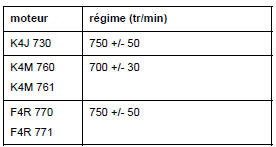
The idle speed is corrected according to:
- engine coolant temperature,
- battery voltage,
- air conditioning operation,
- engine oil pressure (K4M engine),
- position of the automatic gearbox selector lever (F4R engine).
7 - Maximum engine speed
a - Cold engine overspeed protection
K4J
When the coolant temperature is below 60 °C, or for 10 seconds after starting, the cut-off value is 5800 rpm.
K4M
When the coolant temperature is below 75 °C, or for 10 seconds after starting, the cut-off value is 5800 rpm.
F4R
When the coolant temperature is below 75 °C, or for a maximum of 17 minutes after starting, the cut-off value is 5900 rpm.
b - Engine overspeed protection when hot
Once the engine is hot, the cut-off returns to its normal value.
K4J or K4M
The fuel cut-off speed is 6500 rpm regardless of the gear engaged (manual or automatic gearbox).
F4R
The fuel cut-off speed is 6000 rpm regardless of the gear engaged (manual gearbox), and 6300 rpm (automatic gearbox).
8 - Camshaft actuator
K4M
It is continuously variable from 0 to 43 degrees of crankshaft rotation. It is controlled by a solenoid valve supplied with a variable duty-cycle signal from the injection computer.
F4R
It is controlled by a solenoid valve supplied on/off by the injection computer.
9 - Radiator fan and coolant temperature warning light control
The request is made by the injection computer via the multiplexed network (centralised coolant temperature management function). The radiator fan is powered by the protection and switching unit.
10 - Air conditioning compressor control
The request is made by the injection computer via the multiplexed network. The request depends on the air conditioning demand but also on the engine coolant temperature. The air conditioning compressor is powered by the protection and switching unit.
11 - Fuel pump control
The request is made by the injection computer.
It is powered through the protection and switching unit.
12 - Cruise control - speed limiter
The configuration of the cruise control / speed limiter and of the air conditioning is automatic.
13 - Oxygen sensor
Two oxygen sensors are used, located upstream and downstream of the catalytic converter.
14 - Throttle body
Air flow and idle speed are regulated by an electronic (motorised) throttle body.
15 - Protection and switching unit
It supplies power to:
- the ignition coils,
- the fuel pump,
- the air conditioning compressor,
- the cooling fan assembly,
- certain injection actuators (injectors, fuel vapour purge solenoid valve, etc.).
The protection and switching unit is located in the engine compartment, near the battery. It helps protect certain electrical components.
For this function, it includes:
- fuses,
- several internal relays, including:
- the "+ after ignition" relay,
- the fuel pump relay,
- the air conditioning compressor relay,
- the radiator fan relays,
- the starter relay (starter solenoid control).
These relays cannot be disassembled.
16 - Injection computer
It constantly receives, via the multiplexed network, information on the electrical power available from the alternator.
This prevents the vehicle's electrical consumption from exceeding the capacity of the alternator.
The objective is to give priority to recharging the battery.
17 - Accelerator pedal
Replacing the accelerator pedal does not present any particular difficulty.
The computer adopts the value read at ignition-on as the reference value for the pedal released position.
It is a dual potentiometer that informs the computer of the accelerator pedal position. It has two resistive tracks with different values.
The first track delivers a voltage (0 to 5 V) that is twice that of the second track (0 to 2.5 V). Comparing the two ensures that the signal delivered is consistent.
18 - Idle speed
It is increased by a maximum of 160 rpm if the battery voltage is below 12.7 V.
If a current or stored fault exists on the manifold pressure sensor, the idle speed setpoint is:
- 896 rpm (K4J and K4M engines),
- 1024 rpm (F4R engine).
Test yourself
A quick Renault Megane quiz: every answer comes with an explanation and a link to the manual page.