Operation
This chapter describes only the particular features of automatic climate control.
For any part not covered in this chapter, refer to the Air Conditioning chapter and the Manual Climate Control chapter.
I - POWER MODULE
With automatic climate control, there are eight fan speeds.
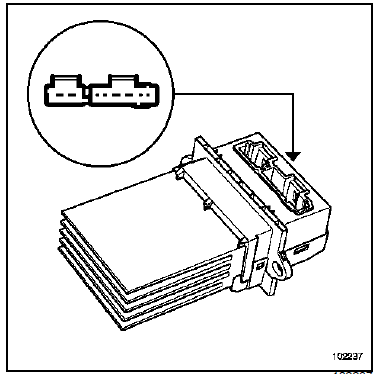
The fan unit power module is controlled by a control voltage modulated by the climate control computer.
This control voltage always remains at 12 V; it is the control signal (square wave) that varies:
- the amplitude and frequency do not change,
- the duty cycle changes.
II - FLAP CONTROL MOTORS
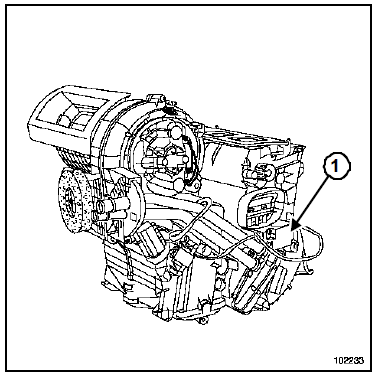
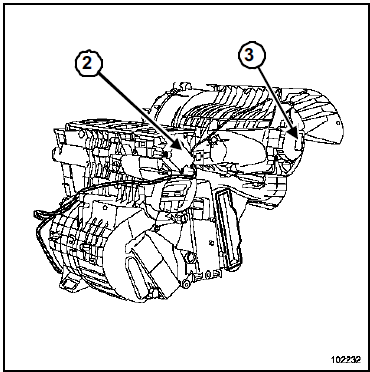
These motors are located on the climate control housing and operate various flaps to direct the airflow according to certain criteria:
- blend motor (1): mixes hot and cold air to reach the desired comfort level,
- distribution motor (2): directs the airflow into the cabin through the vents,
- recirculation motor (3): recirculates the air inside the cabin by isolating it from outside air.
III - CABIN TEMPERATURE SENSOR
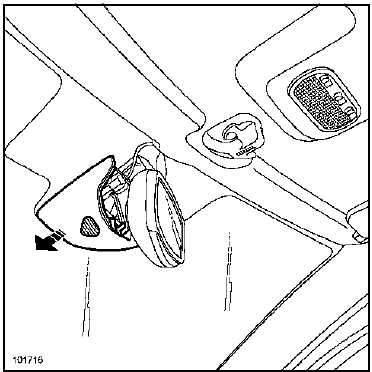
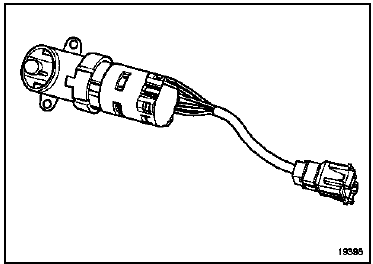
This sensor provides information on the interior temperature.
It is a negative temperature coefficient thermistor located behind the center rear-view mirror.
IV - AMBIENT TEMPERATURE SENSOR
This sensor provides information on the outside temperature.
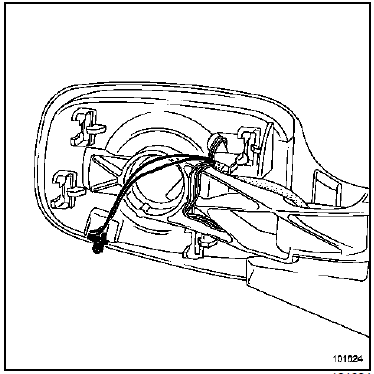
It is a negative temperature coefficient thermistor located in the right-hand rear-view mirror.
V - SUNLOAD SENSOR
This sensor informs the control unit of the intensity of solar radiation so that the airflow at the vents can be corrected.
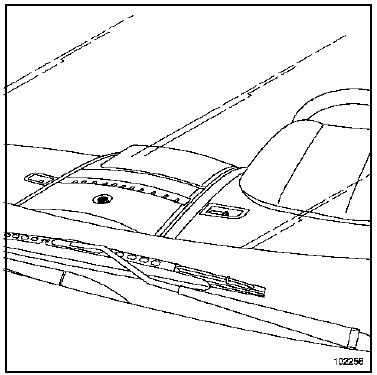
It is located in the center of the dashboard.
VI - HUMIDITY SENSOR
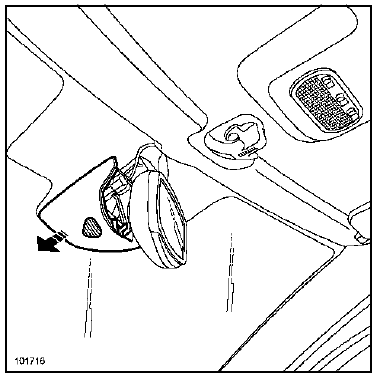
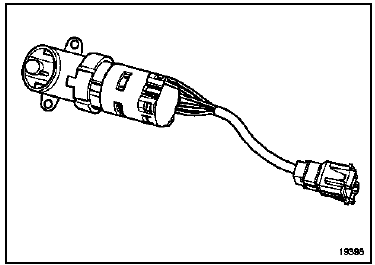
This sensor informs the control unit of the humidity level in the cabin so that the control unit can adjust the cabin comfort level.
Test yourself
A quick Renault Megane quiz: every answer comes with an explanation and a link to the manual page.