If your vehicle overheats
The following signs may indicate that your vehicle is overheating.
- The engine coolant temperature gauge needle is in the red zone, or you notice that the engine has lost power (for example, the vehicle cannot accelerate).
- Steam is escaping from under the hood.
Corrective procedures
1. Stop the vehicle in a safe place, turn off the air conditioning system, then stop the engine.
2. If you see steam: Carefully open the hood once the steam has dissipated.
If you do not see steam: Carefully open the hood.
3. Once the engine has cooled sufficiently, check for leaks at the hoses and radiator.
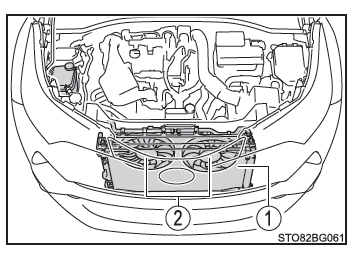
- Radiator
- Cooling fans
If you notice a significant coolant leak, contact a Toyota dealer, an authorized Toyota repairer, or any reliable repairer immediately.
4. The coolant level is satisfactory if it is between the "FULL" (max.) and "LOW" (min.) marks on the reserve tank.
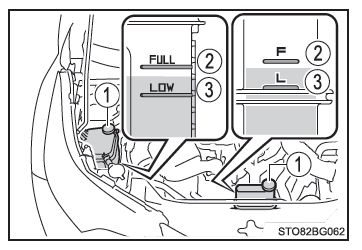
- Reserve tank
- "FULL" or "F"
- "LOW" or "L"
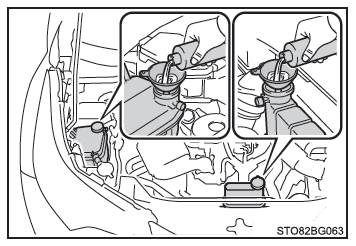
5. If necessary, add coolant.
If no coolant is available, you may use water as an emergency measure.
6. Start the engine and turn on the air conditioning system to check that the radiator cooling fans operate; check the radiator and hoses for coolant leaks.
The fans operate when the air conditioning system is turned on immediately after a cold start. Confirm that the fans have operated by checking that they make noise and blow air. If this is difficult to verify, turn the air conditioning system on and off several times in succession. (The fans may not operate if the outside temperature is below freezing.)
7. If the fans do not operate: Stop the engine immediately and contact a Toyota dealer, an authorized Toyota repairer, or any reliable repairer.
If the fans are operating: Have the vehicle inspected by the nearest Toyota dealer or authorized Toyota repairer, or any reliable repairer.
WARNING■ When inspecting under the hood Observe the following precautions.
Failure to do so may result in serious injury, including burns.
- If steam is escaping from under the hood, do not open the hood until the steam has dissipated. The engine compartment may be very hot.
- Keep your hands and clothing (especially ties, scarves or neck warmers) away from the fans and drive belts. Otherwise, your hands or clothing may be caught, resulting in serious injury.
- Do not open the coolant reservoir cap while the radiator and engine are hot.
Hot steam or coolant may spray out violently.
■ Adding coolant Add coolant slowly, in a thin stream, after the engine has cooled sufficiently. If you pour coolant (at ambient temperature) too quickly into a hot engine, you may damage the engine.
■ To prevent damage to the cooling system
Observe the following precautions:
- Prevent foreign matter (sand, dust, etc.) from contaminating the coolant.
- Do not use coolant additives.