If your vehicle needs to be towed
If your vehicle must be towed, we recommend having the operation performed by a Toyota dealer, a Toyota-authorized repairer, any reliable repairer, or a professional towing company, preferably using a sling-type or flatbed tow truck.
For all towing operations, use safety chains and observe local and state/provincial regulations. 2WD models: If you must tow your vehicle from the front with a sling-type tow truck, the vehicle's rear wheels and axles must be in good condition. If damage has been sustained, use tow dollies or a flatbed tow truck.4WD models: If you must tow your vehicle with a sling-type tow truck, use a tow dolly.
Situations in which you must contact a dealer before towing
The following symptoms may indicate a transmission problem. Contact a Toyota dealer, a Toyota-authorized repairer, any reliable repairer, or a professional towing company before towing.
- The engine is running, but the vehicle does not move.
- The vehicle makes an abnormal noise.
Towing with a wheel-lift tow truck
Do not tow with a wheel-lift tow truck, to avoid damaging the body.
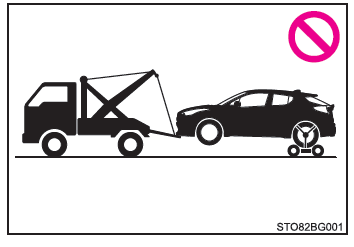
Towing with a sling-type tow truck
From the front (2WD models)

Release the parking brake.
From the front (4WD models)

Place a tow dolly under the rear wheels.
From the rear
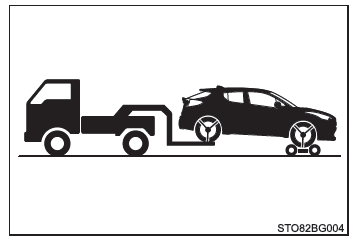
Place a tow dolly under the front wheels.
Using a flatbed tow truck
If your vehicle is transported on a flatbed tow truck, it must be secured at the points shown in the illustration.
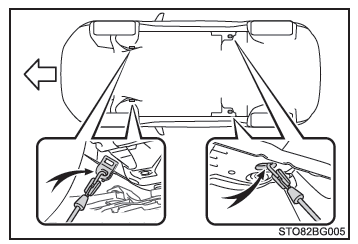
If you secure your vehicle with chains or cables, the angle they form with the bed must be 45°.
Do not overtighten the securing chains or cables, as this may damage the vehicle.

Emergency towing
If a tow truck is not available, you may temporarily tow your vehicle using chains or cables attached to its towing eyes. Do this only on good roads, for no more than 80 km (50 miles), and at speeds below 30 km/h.
A person must remain in the vehicle to steer and brake. The wheels, transmission, axles, steering and brakes of the vehicle must be in good condition.
On vehicles equipped with a Multidrive transmission, only the front towing eyes can be used.
Emergency towing procedure
1. Remove the towing eye.
2. Remove the towing eye cover with a flat-blade screwdriver.
To avoid scratching the body paint, protect the screwdriver with a cloth as shown in the illustration.
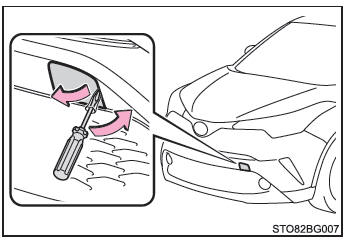
3. Screw the towing eye into its holder and tighten it by hand.
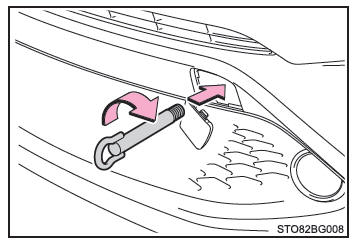
4. Fully tighten the towing eye with a wheel nut wrench* or a metal bar.
*: If the vehicle is not equipped with a wheel nut wrench, you can purchase one from a Toyota dealer, a Toyota-authorized repairer, or any reliable repairer.

5. Securely attach the cables or chains to the towing eye.
Take care not to damage the vehicle body.
6. Vehicles without a smart entry and start system: Get into the vehicle being towed and start the engine.
If the engine does not start, turn the ignition switch to "ON".
Vehicles equipped with a Stop & Start system: Before towing the vehicle, turn the ignition switch off once, then start the engine.
Vehicles equipped with a smart entry and start system: Get into the vehicle being towed and start the engine.
If the engine does not start, set the ignition switch to START mode.
Vehicles equipped with a Stop & Start system: Before towing the vehicle, turn the ignition switch off once, then start the engine.
7. Place the shift lever in N and release the parking brake.
For vehicles equipped with a Multidrive transmission, when the shift lever is locked.
■ While towing When the engine is off, steering and braking assistance is lost, making the vehicle much harder to steer and stop.
■ Wheel nut wrench Vehicles without a wheel nut wrench: You can purchase a wheel nut wrench from a Toyota dealer, a Toyota-authorized repairer, or any reliable repairer.
Vehicles equipped with a wheel nut wrench: The wheel nut wrench is stored in the luggage compartment.
WARNING Observe the following precautions.Failure to do so could result in serious or fatal injury.
■ When towing the vehicle
2WD models
Be sure to tow the vehicle with the front wheels raised or all four wheels off the ground. If the vehicle is towed with the front wheels on the ground, the transmission and related components may be damaged.

4WD models
Make sure the vehicle is transported with all four wheels off the ground. If the vehicle is towed with the tires in contact with the ground, the transmission or related components may be damaged, and the vehicle may come off the tow truck.
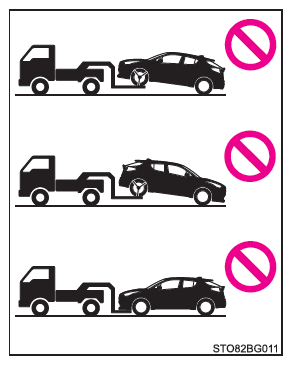
■ To avoid serious damage to the Stop & Start system when towing (vehicles equipped with a Stop & Start system) Never tow this vehicle with all 4 wheels on the ground. Use a flatbed tow truck, or tow the vehicle with the front or rear wheels off the ground, using a wheel-lift tow truck.
WARNING Observe the following precautions.Failure to do so could result in serious or fatal injury.
■ During towing
- When using cables or chains to tow, avoid sudden starts, etc. that place excessive stress on the towing eyes, cables or chains. The towing eyes, cables or chains may break, and debris may injure people and cause serious damage.
- Vehicles without a "smart" entry and start system: Do not set the anti-theft ignition switch to "LOCK".
The steering wheel may lock and may not be able to be turned.
- Vehicles equipped with a "smart" entry and start system: Do not set the start switch to OFF.
The steering wheel may lock and may not be able to be turned.
■ Installing the towing eyes on the vehicle Make sure the towing eyes are tightened securely.
If not tightened securely, the towing eyes may unscrew during towing.
NOTE■ To avoid damage to the vehicle when towing with a wheel-lift tow truck
- Vehicles without a "smart" entry and start system: Do not tow the vehicle from the rear with the key removed or the anti-theft ignition switch set to "LOCK".
The steering lock mechanism is not strong enough to hold the front wheels straight.
- Vehicles equipped with a "smart" entry and start system: Do not tow the vehicle from the rear with the start switch set to OFF. The steering lock mechanism is not strong enough to hold the front wheels straight.
- Once the wheels are lifted, check underneath the vehicle on the opposite side to make sure there is enough ground clearance for towing. Without sufficient ground clearance, the vehicle may be damaged during towing.
■ To avoid damage to the vehicle when towed by a winch-type tow truck Do not tow the vehicle with a winch-type tow truck, either from the front or from the rear.
■ To avoid damage to the vehicle during emergency towing Do not attach cables or chains to suspension components.
■ When towing a vehicle equipped with a Stop & Start system (on models so equipped) Vehicles without a "smart" entry and start system: When it is necessary to tow the vehicle with all 4 wheels in contact with the ground, perform the following procedure before towing to protect the system.
Set the start switch to OFF once, then start the engine. If the engine does not start, set the start switch to "ON".
Vehicles equipped with a "smart" entry and start system: When it is necessary to tow the vehicle with all 4 wheels in contact with the ground, perform the following procedure before towing to protect the system.
Set the start switch to OFF once, then start the engine. If the engine does not start, set the start switch to START mode.