Variable Intake Manifold
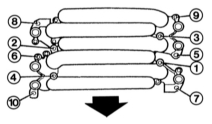
The intake manifold mounting bolts of the 2.6 L and 2.8 L 6-cylinder engines must be tightened in the specified sequence. This is the only way to prevent the intake manifold from distorting during installation.
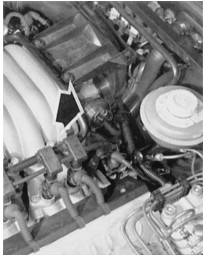
Left: the variable intake manifold flaps of the 2.8 L 6-cylinder engine are actuated by the diaphragm unit marked with an arrow.
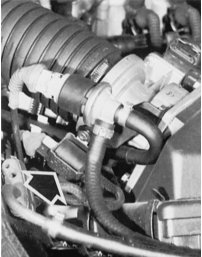
Right: this "sequential intake manifold switch valve" (arrow) determines whether vacuum can reach the diaphragm unit. The valve is located at the rear right of the engine compartment, next to the air mass meter.
Models with 2.8 L 6-Cylinder Engine
A long, small-diameter intake manifold provides high torque even at low engine speed. For high engine output at high speed, a short intake manifold with a large cross-section is required.
To combine both characteristics, Audi engineers developed a variable intake manifold. Depending on operating conditions, six flaps inside the manifold open and close. This provides each cylinder with an intake manifold of different length and cross-section: either a torque intake manifold (long tube with small diameter) or a power intake manifold (short tube with large cross-section). All six flaps are actuated by vacuum and controlled according to engine speed: up to 4000 rpm they remain closed for high torque. Above 4000 rpm they are fully open for high power. Below 4000 rpm, the torque intake manifold provides up to 30 N·m more torque than the power intake manifold.
The 2.8 L engine develops its maximum torque of 245 N·m at 3000 rpm when using AI-95 gasoline; with AI-98 the torque increases to 250 N·m. Torque of at least 220 N·m is developed over a wide range from 2000 rpm to 5500 rpm.
Test yourself
A quick Audi 80 quiz: every answer comes with an explanation and a link to the manual page.