Engine Repair Procedures
General Information
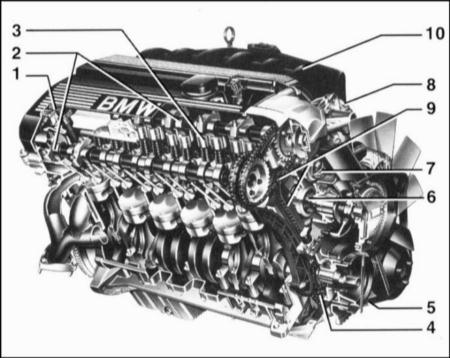
M52 Engine (520i, 523i, 528i) 1 — ignition coils
2 — camshafts
3 — hydraulic tappets
4 — oil pump
5 — drive belt
6 — coolant pump
7 — thermostat
8 — oil filter
9 — valve timing chains
10 — intake manifold
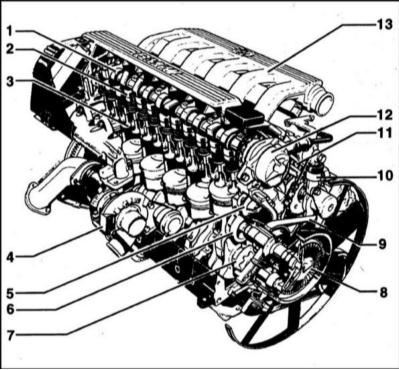
M51 Engine (525tds)
1 — camshaft
2 — hydraulic tappet
3 — valve
4 — turbocharger
5 — thermostat
6 — coolant pump
7 — oil pump
8 — viscous coupling
9 — drive belt
10 — tensioner
11 — valve timing chains
12 — vacuum pump
13 — intake manifold
The BMW 5 Series is equipped with three engine types: a 6-cylinder gasoline engine, a 6-cylinder turbodiesel, and a V8 engine. V8 engines (3.5 and 4 L displacement) are covered only in the section "Maintenance."
The power unit is installed lengthwise in the vehicle and can only be removed upward using a hoist.
The 6-cylinder gasoline engine is designated M52. Its cylinder head and cylinder block are cast from aluminum alloy. Unlike the traditionally used cast iron, aluminum alloy has higher thermal conductivity and lower weight. This promotes better cooling and lower fuel consumption. The cylinder head is 4-valve and has a variable intake camshaft timing (BMW designation - VANOS).
The 525tds model is equipped with the 6-cylinder turbodiesel M51 with a displacement of 2.5 L. The cylinder block is cast from iron, and the cylinder head is made of light alloy.
If cylinder walls show increased wear or scoring, they can be honed. After honing, oversize repair pistons must be installed.
All engines have a so-called cross-flow cylinder head. This means that the air-fuel mixture enters the combustion cylinders from one side, and the exhaust gases exit from the other side. This promotes faster gas exchange. The camshafts are located in the cylinder head. The diesel engine has only one camshaft. The 4-valve gasoline engines have two camshafts. One drives the intake valves, and the other drives the exhaust valves. The camshafts are driven by a roller chain. The valves are actuated through hydraulic lifters. Valve clearance adjustment is not required during maintenance.
The 6-cylinder gasoline engines have variable valve timing. In this system, the intake camshaft is rotated relative to the drive sprocket by an adjusting element depending on engine speed, so that the optimal valve opening timing is ensured. The adjustment is controlled by the control unit, which opens and closes the oil pressure control valve.
Oil is supplied to the lubrication system by the oil pump. On the 6-cylinder gasoline engine, the oil pump is located at the front of the oil pan and is driven by the crankshaft. On the diesel engine, the oil pump is located in the timing cover at the end of the crankshaft and is driven by a gear drive. Oil is drawn from the oil pan and, through passages and lines, is delivered to the crankshaft and camshaft bearings, as well as to the cylinder bearing surfaces.
The coolant pump is located at the front of the cylinder block. When the appropriate temperature is reached, the pump shaft drives the cooling fan through a viscous clutch. The pump is driven by a V-belt, which also drives the alternator. Note that the cooling system is filled year-round with a mixture of antifreeze, corrosion inhibitor, and low-lime water.
The air-fuel mixture is prepared by the fuel injection and electronic ignition system, which ensures stable exhaust emission values. The ignition system with ignition coils has no moving parts, which eliminates wear of its components. On the diesel engine, fuel distribution to the cylinders is controlled by the DDE (Digital Diesel Electronics) system.
Gasoline engines are designed to run on 95 RON gasoline. However, due to knock control, other fuel grades can also be used. If 98 RON gasoline is used, fuel consumption decreases and engine power increases under normal operating conditions. If 91 RON gasoline is used, engine power decreases and fuel consumption increases.
Test yourself
A quick BMW 1 quiz: every answer comes with an explanation and a link to the manual page.