Battery Inspection
Electrolyte Level Inspection
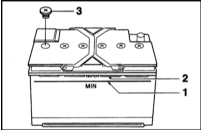
The electrolyte level in each cell must be between the MIN (1) and MAX (2) marks. If the level is low, remove the caps (3) and add distilled water.
Voltage Inspection
Voltage indicates the condition of the battery and is measured with a voltmeter between the battery terminals.
PROCEDURE
1. Disconnect the battery. Refer to Battery Removal and Installation.
2. Before testing, the battery must remain disconnected for at least 2 hours.
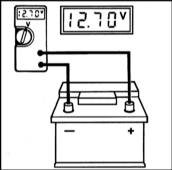
3. Connect the voltmeter to the battery terminals and measure the voltage. Refer to the accompanying illustration.
If the voltage is: 12.7 V or higher - the battery is in good condition
12.5 V - the battery is in fair condition
12.3 V or lower - the battery is in poor condition; recharge or replace it
4. Connect the battery. Refer to Battery Removal and Installation.
Battery Load Test
PROCEDURE
1. Connect a voltmeter to the battery terminals.
2. Start the engine and check the voltage.
3. When the engine is cranking with a fully charged battery, the voltage must not drop below 10 V (at an electrolyte temperature of about +20°C).
4. If the voltage drops sharply and the electrolyte specific gravity differs between cells, the battery is damaged and must be replaced.
Electrolyte Specific Gravity Inspection
(Not applicable to maintenance-free batteries)
Electrolyte specific gravity, together with voltage, indicates the state of charge of the battery.
PROCEDURE
1. Remove the caps from the battery.
2. Use a hydrometer to check the electrolyte specific gravity. The higher the electrolyte specific gravity, the higher the hydrometer float rises. The hydrometer scale shows the specific gravity in g/ml or degrees Baumé (°Be). Battery charge specifications are given in the Specifications.

Test yourself
A quick BMW 1 quiz: every answer comes with an explanation and a link to the manual page.