Starter
General Information
A small electric motor, the starter, is required to start the internal combustion engine. To start the engine, the starter must crank it to at least 300 rpm. This is possible only if the starter operates reliably and the battery is sufficiently charged.
The starter consists of the drive end, the field frame and the commutator end. The armature and commutator are located in the field frame and commutator end, together with the brush holder. The brushes are located in the brush holder and wear out over time. Excessive brush wear reduces starter reliability.
The drive pinion is located at the front of the starter housing. When voltage is applied to the starter through the ignition switch, the solenoid mounted on the starter housing engages the pinion, located on the starter shaft, with the ring gear of the engine flywheel. The starter can then crank the engine to the required speed. Once the engine starts, its speed exceeds the starter speed, and the starter disengages from the engine.
Starting the engine requires high current. Therefore, during maintenance, pay attention to secure cable connections. Remove any corrosion, and apply protective grease to the contacts.
* The starter may be sold as an exchange part. This means that the cost of the old starter may be credited when a new starter is purchased.

Starter
1 — housing
2 — brush holder
3 — brush set
4 — bushing
5 — housing
6 — field winding
7 — solenoid relay
8 — bushing
9 — front cover
10 — stop ring
11 — bushing
12 — lever
13 — pinion
14 — armature
15 — housing
Starter Removal and Installation
The starter is located on the side, at the joint between the cylinder block and the transmission.
REMOVAL
1. Disconnect the negative battery cable. The battery is located in the luggage compartment behind the right side trim.
* Disconnecting the battery erases the memory of electronic control modules, including engine fault codes. Refer to Battery Removal and Installation.
2. Tape the terminal of the cable connected to the negative battery terminal to prevent accidental contact.
3. Remove the rear lower engine compartment cover. Refer to Engine Compartment Lower Cover Removal and Installation.
4. Disconnect the following wires: 1 - terminal 30 from the positive battery terminal; 2 - terminal 50 from the ignition switch.
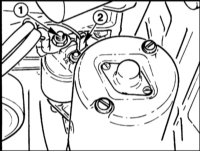
* Mark the wiring harness to avoid mistakes during installation.
5. Remove the starter mounting bolts on the transmission side using an extension.
6. Remove the starter.
INSTALLATION
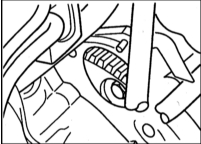
1. Inspect the starter drive pinion and the flywheel ring gear. Refer to the accompanying illustration.
2. Install the starter and tighten the mounting bolts to 50 N·m.
3. Tighten the wire at terminal 30 to 10 N·m, and at terminal 50 to 5 N·m.
* Route the wires according to the markings made during removal. Make sure they do not rub against adjacent components.
4. Install the rear lower engine compartment cover. Refer to Engine Compartment Lower Cover Removal and Installation.
5. Connect the negative battery cable. Set the clock and program the radio stations.
Test yourself
A quick BMW 1 quiz: every answer comes with an explanation and a link to the manual page.