Wheel Alignment Check and Adjustment
Achieving optimal driving characteristics of the vehicle and minimum tire wear is possible only with correct wheel positions. If tires show increased or uneven wear, or the vehicle moves unstably with the steering wheel in the straight-ahead position, or handling in corners is poor, a visual check of wheel alignment must be performed.
Wheel alignment cannot be checked without appropriate optical equipment. For this reason, this manual describes only the basic principles of wheel alignment checking.
Specifications for the basic wheel alignment angles are given in the Specifications.
Toe, camber, caster, steering axis inclination
Toe is the difference between the distances between the wheels, measured at the height of their axes between the rim edges. If the distance at the front is less than at the rear, it is toe-in; if the reverse, it is toe-out. Toe may be 0°5’ ± 10’ (E39).
Camber and steering axis inclination reduce the transmission of shocks from the road to the steering and at the same time reduce friction when cornering.
Camber is the angle of deviation of the wheel plane from vertical. Front wheels are thus set at an angle. With negative camber, for example, the distance between the wheels at the road contact point is greater than at the top.
Steering axis inclination is the angle between the steering axis of the wheel and the vertical line drawn through the wheel contact point, when viewing the vehicle from the front.
Camber and steering axis inclination bring the wheel contact point with the road closer to the steering axis. As a result, the so-called scrub radius is reduced. The smaller this radius, the easier the vehicle is to steer through a corner. In addition, the dynamic effect on the steering is significantly reduced.
Caster is the angle between the steering axis and the vertical line at the wheel contact point, when viewing the vehicle from the side. Caster significantly affects straight-line stability. Caster ensures the return of the steered wheels to the straight-ahead position, in particular when driving on poor roads and in crosswinds.
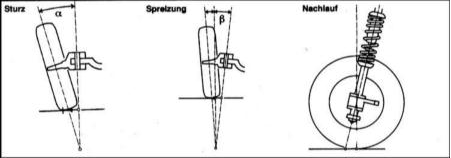
Wheel Alignment Inspection Conditions a) Front wheels are in the straight-ahead position
b) Tire pressure is as specified
c) Vehicle is loaded to normal condition:
• 2 x 68 kg in the front seats,
• 1 x 68 kg in the center of the rear seat,
• 1 x 21 kg in the center of the luggage compartment,
• fuel tank is full
d) Vehicle suspension has been bounced to settle it
e) Steering system is adjusted correctly
f) Play in the steering linkage joints is within specifications
g) Suspension play is within specifications
h) Vehicle ride height is as specified
Test yourself
A quick BMW 1 quiz: every answer comes with an explanation and a link to the manual page.