Towing a trailer
The BMW 5 (7th generation) is also very well prepared for towing a trailer. This chapter covers all safety-relevant aspects, from trailer stabilization and loading notes to the correct tire pressure. Technical details on the trailer hitch with swiveling ball head are also included. The instructions for using, supplying power to and securing the trailer are clearly structured and practical. A valuable aid for anyone towing a trailer who values comfort, performance and safety.
Vehicle equipment
This chapter describes all standard, country-specific and optional equipment offered in the model series. It therefore also describes equipment that is not available in a given vehicle, for example due to the selected optional equipment or country variant. This also applies to safety-related functions and systems. When using the corresponding functions and systems, observe the applicable laws and regulations.
Trailer Stability Control
Principle
The system helps to counteract trailer sway.
Trailer Stabilization Control detects trailer sway and automatically brakes the vehicle firmly to leave the critical speed range and stabilize the trailer combination.
General
If the trailer socket is occupied but no trailer is attached, the system can also take effect in extreme driving situations, e.g. with a bicycle carrier with lighting.
Requirements for function
- Towing a trailer.
- Speed from approx. 65 km/h.
- Trailer socket occupied.
System limitations
The system may not intervene, or intervene too late, for example in the following situations:
- If the trailer jackknifes immediately, e.g.
General
The permissible towing capacities, axle loads, drawbar noseweights and the permissible gross weight are specified in the technical data.
Options for increasing the loads can be obtained from a manufacturer's Service Partner, another qualified Service Partner or a specialist workshop.
The vehicle is equipped with reinforced rear suspension and, depending on the model, a more powerful cooling system.
Before driving
Drawbar noseweight
Avoid falling below the minimum drawbar noseweight of 25 kg and make full use of the maximum drawbar noseweight where possible.
The maximum payload of the towing vehicle is reduced by the weight of the towing bracket and the drawbar noseweight. The drawbar noseweight increases the vehicle weight. Do not exceed the permissible gross weight of the towing vehicle.
Loading
Distribute the load evenly across the loading area.
Stow the load as low as possible and close to the trailer axle. A low trailer center of gravity increases the driving safety of the entire combination.
Do not exceed the permissible gross weight of the trailer or the permissible towing capacity of the vehicle. The lower value applies.
Tire inflation pressure
Observe the tire inflation pressure of the vehicle and trailer.
For the vehicle, the tire inflation pressure for higher loads applies.
Information on tire inflation pressure.
For the trailer, the manufacturer's specifications apply.
Tire Puncture Warning
After correcting the tire inflation pressure and/or attaching or detaching a trailer, reinitialize the Tire Puncture Warning.
Tire Pressure Control
After correcting the tire inflation pressure and/or attaching or detaching a trailer, reinitialize the Tire Pressure Control.
Exterior mirrors
Legislation requires two outside mirrors that both bring the rear edges of the trailer into view. Such mirrors are available as special accessories from a manufacturer's Service Partner, another qualified
Service Partner or a specialist workshop.
Power consumption
Before starting the journey, check the function of the trailer rear lights.
The output of the trailer rear lights must not exceed the following values:
- Turn signals: 42 watts per side.
- Tail lights: 50 watts per side.
- Brake lights: 84 watts in total.
- Rear fog lights: 42 watts in total.
- Reversing lights: 42 watts in total.
Keep the switch-on times of power consumers short during caravan operation to protect the vehicle battery.
Driving with a trailer
Safety notes
WARNING From approx. 80 km/h, depending on design and load, trailers can start to sway. There is a risk of accident or damage to property.
Adjust your speed when driving with a trailer. In case of trailer sway, brake immediately and make any necessary steering corrections as carefully as possible. WARNING Due to the increased axle load when towing, the tire inflation pressure must be adjusted. Driving with too low tire inflation pressure can damage the tires. There is a risk of accident or damage to property.
Do not exceed a speed of 100 km/h. Increase the tire inflation pressure of the towing vehicle by 0.2 bar. Observe the maximum possible tire inflation pressure indicated on the tire.
Gradients
General
In the interest of safety and smooth traffic flow, towing is permitted on gradients of up to 12%.
If higher towing capacities have been subsequently approved, the limit is 8%.
Starting on gradients
The parking brake is released automatically when the accelerator pedal is pressed.
To prevent rolling back when starting off, use the parking brake.
 Briefly pull the switch shortly before starting off and release it.
Downhill driving
On downhill sections, the combination is more prone to trailer sway.
Before the downhill section, manually downshift to the next lower gear and drive slowly downhill.
High loads and outside temperature
NOTE On long journeys with high towing loads, high outside temperature and low fuel level, the fuel system may overheat, which reduces engine output.
There is a risk of property damage.
Refuel in good time. On long journeys with high towing loads and high outside temperature, make sure the fuel tank is more than 1/4 full.
Towing bracket with electrically swiveling ball head
General
The swiveling ball head is located on the underside of the vehicle.
LED lights green when the system is ready for operation.
Overview
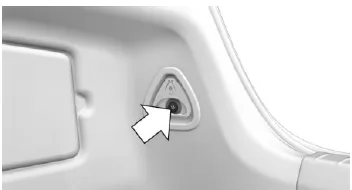
Button in the luggage compartment.
Swivel out the ball head
- Open the luggage compartment.
- Stand out of the swiveling range of the ball head behind the vehicle.
 Press the button in the luggage compartment.
Safety information
WARNING If the ball head is not locked, unstable driving conditions or accidents may occur. There is a risk of accident or damage to property. Before driving with a trailer or carrier, check that the ball head is correctly locked. The LED in the button lights red if the ball head is not correctly locked.
Swivel in the ball head
- Detach the trailer or carrier.
- Remove any attachments for trailer stabilization devices, if fitted.
- Pull the trailer power supply plug and any adapter out of the socket.
 Press the button in the luggage compartment.
Automatic interruption or reversal of the swing-out process
General
The swing-out process is interrupted automatically, reversed or not carried out if current limits are exceeded, e.g. at very low temperatures or due to mechanical resistance. The LED in the button lights up red.
Repeat the swing-out process with the engine running
- Start the engine using the Start/Stop button.
 Press and hold the button in the luggage compartment until the tow ball has fully swung out or in.
If necessary, repeat the swing-out process with the button pressed and the engine running.
The LED in the button lights up green when the tow ball has reached an end position.
If the problem occurs repeatedly, contact a manufacturer service partner, another qualified service partner or a specialist workshop.
Trailer socket
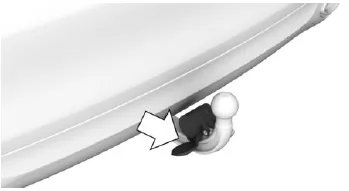
The trailer socket is located on the tow hitch.
Fold the cover down.
Safety cable eyelet
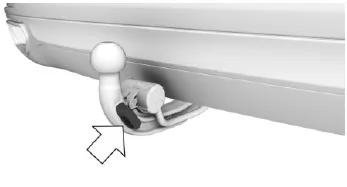
An eyelet for attaching the trailer safety cable is located on the tow hitch.
For increased safety, attach the trailer safety cable to the eyelet when driving with a trailer.
Make sure the safety cable has sufficient clearance to prevent it from dragging on the ground.
Towing a trailer with the BMW 5 G30/G31 is supported by numerous assistance systems and technical features that make driving with a trailer safer. Trailer Stability Control is a key element here, as it automatically counteracts dangerous snaking movements and thus reduces the risk of accidents.
Particularly noteworthy are the detailed instructions on loading and tire inflation pressure, which are decisive for the stability of the combination. The information on the nose weight and on the safe use of the tow hitch also helps to maximise safety when towing and to avoid damage to the vehicle.
FAQQuestion 1: What happens if the tow ball of the tow hitch is not locked correctly?
Answer: The vehicle may become unstable, and there is a risk of an accident. The LED in the button shows red if the tow ball is not locked.
Question 2: How should you proceed when driving downhill with a trailer?
Answer: Before the downhill section, shift to the next lower gear and carefully control your speed to avoid snaking movements.
Test yourself
A quick BMW 5 quiz: every answer comes with an explanation and a link to the manual page.