Things to consider when driving. Vehicle equipment. Break-in period. General driving notes. Roof rack
This page contains key information on the break-in period of the BMW 5 G30, vehicle equipment and safety-related notes. Topics such as engine and brake break-in, handling in wet conditions and roof racks are explained in detail. Possible hazards from hot vehicle components or an open tailgate are also addressed. These tips serve to ensure the longevity and safe handling of the vehicle. Anyone who wants to get to know their BMW properly should read this section carefully.
Vehicle equipment
This chapter describes all standard, country-specific and optional equipment offered in the model series. It therefore also describes equipment that is not available in a given vehicle, for example due to the selected optional equipment or country variant. This also applies to safety-related functions and systems. When using the corresponding functions and systems, observe the applicable laws and regulations.
Break-in period
General
Moving parts must bed in with each other.
The following notes help to achieve optimum service life and economy of the vehicle.
Do not use Launch Control during the break-in period, see page 120.
Safety information
WARNING New parts and components may delay the response of safety and driver assistance systems. There is a risk of accident.
After installing new parts or when the vehicle is new, drive carefully and brake early if necessary. Observe the break-in instructions for the respective parts and components.
Engine, transmission and final drive
Up to 2,000 km
Do not exceed the maximum engine speed and vehicle speed:
- Petrol engine: 4,500 rpm and 160 km/h.
- Diesel engine: 3,500 rpm and 150 km/h.
Always avoid full load or kickdown.
From 2,000 km
Engine speed and vehicle speed can be increased gradually.
Tires
Due to the manufacturing process, the grip of new tires is not yet optimal.
Drive carefully during the first 300 km.
Brake system
Brake discs and brake pads only reach their full effectiveness after approx. 500 km.
Drive carefully during this break-in period.
Clutch
The clutch only reaches its optimum function after approx. 500 km. Engage the clutch gently during this break-in period.
After replacing parts
Observe the break-in instructions again if any of the components mentioned above are replaced.
General driving information
Close the tailgate
WARNING An open tailgate projects beyond the vehicle and can endanger occupants and other road users or damage the vehicle in an accident, during braking or evasive maneuvers. Exhaust gases may also enter the vehicle interior. There is a risk of injury or damage to property. Do not drive with the tailgate open.
If driving with the tailgate open cannot be avoided:
- Close all windows and the glass roof.
- Increase the blower output significantly.
- Drive at moderate speed.
Hot exhaust system
WARNING High temperatures can occur under the body while driving, e.g. from the exhaust system. If flammable materials, e.g. leaves or grass, come into contact with hot exhaust system parts, these materials can ignite. There is a risk of injury or damage to property.
Do not remove the heat shields fitted or apply underbody protection to them. Make sure that no flammable materials can come into contact with hot vehicle parts while driving, idling or parking. Do not touch the hot exhaust system.
Diesel particulate filter
The diesel particulate filter collects soot particles and periodically burns them off at high temperatures.
The following may occur during the cleaning process, which lasts a few minutes:
- The engine may run temporarily somewhat roughly.
- Noises and slight smoke from the exhaust may occur until shortly after the engine is switched off.
- A somewhat higher engine speed is required to achieve the usual power output.
Mobile communication in the vehicle
WARNING Vehicle electronics and mobile devices can interfere with each other. Mobile devices emit radiation when transmitting. There is a risk of injury or damage to property. Where possible, use mobile devices in the interior, e.g. mobile phones, only with a direct connection to an external antenna, to avoid mutual interference and to direct radiation away from the vehicle interior.
Use mobile phones only with a direct connection to an external antenna, to avoid mutual interference and to direct radiation away from the vehicle interior.
Aquaplaning
On wet or muddy roads, a wedge of water can form between the tires and the road.
This condition is known as aquaplaning and can cause partial or total loss of road contact, loss of control over the vehicle and loss of braking ability.
Driving through water
NOTICE If water that is too deep is driven through too quickly, water can enter the engine compartment, the electrical system or the transmission.
There is a risk of property damage.
When driving through water, do not exceed the maximum specified water depth and the maximum speed for driving through water.
When driving through water, observe the following:
- Only drive through calm water.
- Only drive through water up to a maximum depth of
Braking safely
General
The vehicle is equipped with ABS as standard.
In situations that require it, apply full braking.
The vehicle remains steerable. Obstacles can be avoided with smooth steering movements.
Pulsation of the brake pedal and hydraulic control noises indicate that ABS is active.
In certain braking situations, the perforated brake discs may produce operating noises. However, this has no effect on the performance and operational safety of the brakes.
Objects in the pedal area
WARNING Objects in the driver's footwell can restrict pedal travel or block a depressed pedal. There is a risk of accident.
Secure objects in the vehicle so that they cannot slide into the driver's footwell. Use floor mats that are suitable for the vehicle and can be securely fastened to the floor. Do not use loose floor mats and do not place several floor mats on top of each other. Make sure there is sufficient clearance for the pedals. Make sure the floor mats are securely refastened after they have been removed, e.g. for cleaning.
Wet conditions
In wet conditions, road salt or heavy rain, brake lightly every few kilometers.
Do not obstruct other road users while doing so.
The heat generated during braking dries the brake discs and brake pads and protects them against corrosion.
Braking force is immediately available when needed.
Downhill driving
WARNING Light but continuous pressure on the brake pedal can cause high temperatures, brake wear and possibly brake system failure. There is a risk of accident. Avoid overloading the brakes.
WARNING When coasting in neutral or with the engine switched off, safety-relevant functions are limited or no longer available, e.g. engine braking or brake and steering power assistance. There is a risk of accident. Do not coast in neutral or drive with the engine switched off. On long or steep downhill stretches, drive in the gear in which the least braking is required. Otherwise the brake system may overheat and braking effectiveness may be reduced.
Engine braking can be increased further by manually downshifting, down to first gear if necessary.
Brake disc corrosion
Brake disc corrosion and brake pad contamination are promoted by the following conditions:
- Low mileage.
- Extended periods of standing.
- Low braking load.
- Aggressive, acidic or alkaline cleaning agents.
Corroded brake discs cause a judder effect when braking, which usually can no longer be eliminated.
Condensation when the vehicle is parked
The automatic climate control produces condensation water, which drips out from under the vehicle.
Roof rack
General
Roof racks are available as special accessories.
Roof rail with flaps
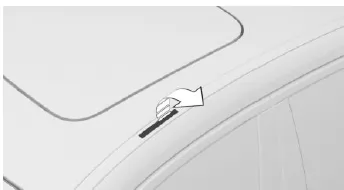
The mounting points are located in the roof rail above the doors.
Fold the cover outward.
Fitting
Observe the roof rack installation instructions.
Make sure there is enough clearance to raise and open the glass roof.
Magnetic roof rack
Magnetic roof racks cannot be used because of the aluminum roof.
Loading
A loaded roof rack changes the driving and steering behavior of the vehicle because the center of gravity shifts.
When loading and driving, therefore observe the following:
- Do not exceed the permissible roof load/axle load and permissible gross weight.
- Make sure there is enough clearance to raise and open the glass roof.
- Distribute the roof load evenly.
- The roof load must not cover too large an area.
- Place heavy luggage at the bottom.
- Secure roof luggage safely, e.g. with ratchet straps.
- Do not let objects protrude into the swing range of the tailgate.
- Drive smoothly and avoid jerky starting and braking or fast cornering.
The chapter “Driving Considerations” in the BMW 5 G30/G31 provides comprehensive guidance for responsible driving. From break-in notes and recommendations for loading the roof rack to safety aspects on downhill gradients or wet roads, the information helps you make optimum use of the vehicle and minimize risks.
The detailed information on component protection and safety is particularly useful, for example on break-in of the brakes or correct use of trailer and roof loads. It allows the driver to make full use of the vehicle's potential without placing unnecessary strain on the technology.
FAQQuestion 1: Is driving with the trunk lid open permitted?
Answer: Only in exceptional cases and with special precautions, such as closed windows and increased blower output, to keep exhaust gases out of the interior.
Question 2: How should you proceed during the first 2000 km of the break-in period?
Answer: Avoid full load and high engine speeds, and observe the specified maximum speeds.
Test yourself
A quick BMW 5 quiz: every answer comes with an explanation and a link to the manual page.