Exhaust
SPECIFICATIONS
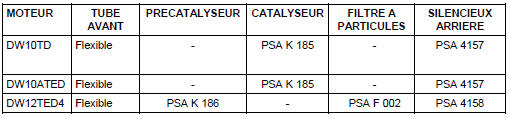
Exhaust lines specific to each market, adapted to the regulations in force in the countries of sale.

PARTICULATE FILTER
Overview
The particulate filter is fitted to DW12TED4 engines.
The purpose of the filtration system is to reduce particulate emissions released into the atmosphere (black smoke emitted at full load or during transient operation).
A particulate filter is fitted in the exhaust line and traps particles as the exhaust gases pass through it.
Particles accumulating during engine operation gradually clog the particulate filter.
To prevent the particulate filter from becoming blocked, it must be "regenerated".
Particulate filter regeneration principle
Regeneration consists of periodically burning off the particles accumulated in the particulate filter.
Mainly composed of carbon and hydrocarbons, these particles trapped in the diesel particulate filter burn in the presence of oxygen at a temperature of 550 °C.
Regeneration of the diesel particulate filter is controlled by the injection system.
The injection system triggers an additional injection to raise the initial exhaust gas temperature from approximately 150 °C to 450 °C at the catalyst inlet.
This temperature increase takes place in 2 stages:
- a post-injection (after TDC) creates post-combustion in the cylinder and raises the temperature by 200 to 250 °C,
- additional post-combustion, generated by an oxidation catalyst placed upstream of the particulate filter, treats the unburned hydrocarbons (HC) from the post-injection. The temperature rises by 100 °C, which reaches the combustion threshold of 550 °C.
The filter must be cleaned and the Eolys additive tank refilled every 80,000 km at a dealer.
Description
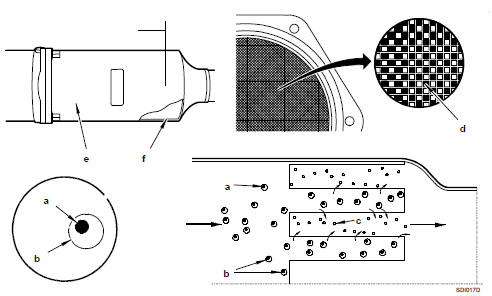
Particulate filter
Key:
- Carbon particles
- Cerium oxide (ceria)
- Filtered exhaust gases
- Porous ceramic walls
- Stainless steel casing
- Heat insulator
Fuel additive system
To lower the regeneration threshold, the fuel is treated with Eolys, a cerium-based compound (ceria), which lowers the combustion temperature of the particles from 550 °C to 450 °C.
The cerium oxide is used as an organic solution stored in an additional tank, located near the fuel tank.
To inject an amount of additive proportional to the volume of fuel added, an additive dosing system has been developed.
The system consists of the following components:
- an additive pump with minimum level detection in the additive tank,
- an additive injection system into the fuel tank,
- a dedicated control unit managing the additive function.
Test yourself
A quick Citroen C5 Aircross quiz: every answer comes with an explanation and a link to the manual page.