Suspension - Steering - Brakes
SUSPENSION
IMPORTANT:It is essential to observe the safety and cleanliness instructions described in the after-sales brochure "precautions and recommendations".
Overview
The suspension is hydraulic.
The suspension is self-adaptive.
There are 2 types of suspension:
- 3rd generation Hydractive, or Hydractive 3.
- 3rd generation Hydractive +, or Hydractive 3+.
Application:

Specifications
The suspension fluid (LDS: Liquide Direction Suspension) is orange and 100% synthetic.
The LDS suspension fluid is supplied in 1 litre containers (Part No. PR: 9979.69).
Important:The LDS suspension fluid is not miscible with LHM hydraulic fluid.
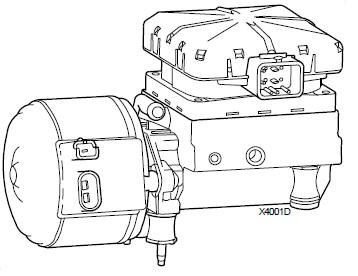
The Hydro Block
The Hydro Block (integrated electronic unit, core of the suspension system) consists of the following components:
- an electric motor to drive the hydraulic pump,
- a 5-piston axial hydraulic pump,
- an anti-pulsation accumulator and flow regulator,
- 4 solenoid valves: 2 per axle, 1 for supply (raising the vehicle), 1 for exhaust (lowering the vehicle)
- an electronic suspension control unit,
- 2 non-return valves,
- 6 hydraulic fluid filters: upstream and downstream of the solenoid valves,
- a pressure relief valve.
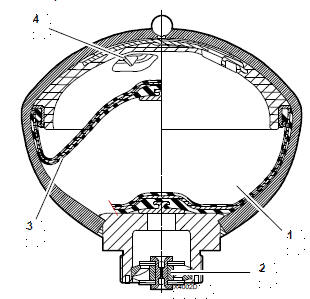
- Suspension sphere (saucer type)
- Hydraulic damper
- Diaphragm
- Safety pre-cut
The suspension spheres are of the "saucer" type.
The suspension spheres use a multi-layer diaphragm, giving them an unlimited service life.
A safety pre-cut is made in the upper part of the sphere.
In the event of bursting from overpressure, the pre-cut prevents metal fragments from being ejected.
IMPERATIVE: It is forbidden to recharge or repair a "saucer" sphere.
Specifications:
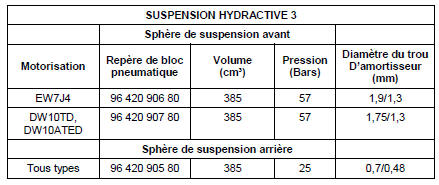
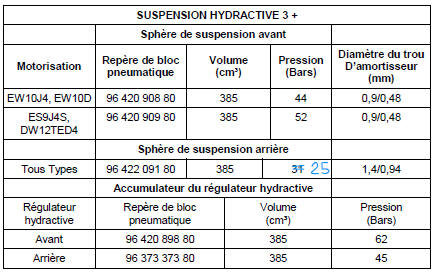
Important: The number stamped on the pneumatic block is the component reference number, not the spare part number.
Operation
The Hydractive 3 suspension has 2 automatic modes:
- motorway position: vehicle height lowered by 15 mm as soon as 110 km/h,
- degraded road position: vehicle height raised by 13 mm up to 90 km/h.
To determine the most suitable vehicle height, the Hydractive 3 Integrated Hydro-electronic Unit uses the following information:
- vehicle speed,
- front and rear vehicle heights.
The Hydractive 3 + suspension has 3 automatic modes:
- motorway position: vehicle height lowered by 15 mm as soon as 110 km/h,
- degraded road position: vehicle height raised by 13 mm up to 90 km/h,
- switching to "comfort" or "dynamic" suspension: variation of suspension firmness.
To determine the most suitable vehicle height and suspension firmness, the Hydractive 3 + Integrated Hydro-electronic Unit uses the following information:
- vehicle speed,
- front and rear vehicle heights,
- steering wheel rotation speed,
- steering wheel angle,
- longitudinal vehicle acceleration,
- lateral vehicle acceleration,
- suspension travel speed,
- accelerator throttle movement.
A vehicle height can be selected by pressing the momentary control buttons inside the vehicle.
There are 4 positions:
- high position: for changing a tyre, cancelled above 10 km/h,
- off-road position: for crossing obstacles, cancelled above 40 km/h,
- normal position: reference height,
- low position: for loading or hitching a trailer.
Important: Driving in low position is prohibited.
The switching thresholds to "dynamic" suspension can be lowered by pressing the control button inside the vehicle.
FRONT AXLE
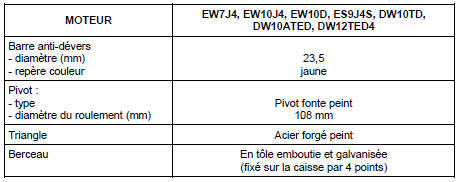
Front axle of MacPherson-type design, with independent wheels, suspension spheres and cylinders.
REAR AXLE
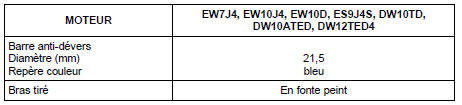
Rear axle with trailing arms, independent wheels, suspension spheres and cylinders.
The rear crossmember consists of:
- A crossmember body made of aluminium extrusion,
- Two aluminium shell-cast brackets integrating the rebound and bump stops.
The brackets are welded to the crossmember body.
The assembly is attached at 4 points to the body.
VEHICLE HEIGHT

Vehicle height
Key:
- H1 - Measurement between the ground and the measuring point on the front subframe
- H2 - Measurement between the ground and the measuring point on the rear crossmember bracket
- R1 - Loaded front wheel radius
- R2 - Loaded rear wheel radius
- L1 - Distance between wheel centre and measuring point on the front subframe (L1 = R1 – H1)
- L2 - Distance between wheel centre and measuring point on the rear crossmember bracket (L2 = H2 – R2)
Front axle (A)

Note: Vehicle at kerb weight: empty vehicle, all fluids full, correct tyre pressure.
Rear axle (B)

Note: Vehicle at kerb weight: empty vehicle, all fluids full, correct tyre pressure.
WHEEL ALIGNMENT
The suspension is hydraulic: checks can be carried out at reference trim or at kerb weight.
Front axle geometry
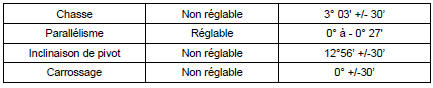
Note: Vehicle at kerb weight: empty vehicle, all fluids full, correct tyre pressure.

Note: Vehicle at kerb weight: empty vehicle, all fluids full, correct tyre pressure.
Test yourself
A quick Citroen C5 Aircross quiz: every answer comes with an explanation and a link to the manual page.