Vehicle electrical states in customer configuration
The table summarises the vehicle's electrical states in customer configuration.
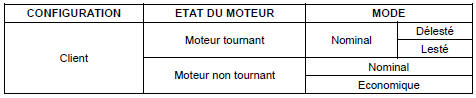
Engine not running
Normal mode
In normal mode, all electrical functions are permitted subject to their operating conditions. After the engine-running information disappears, the consumption mode is normal.
When the switching conditions are met, the system switches to economy mode.
Economy mode
Non-permanent electrical functions are deactivated regardless of the ignition key position. Economy mode prevents battery discharge. Only permanent functions and some permanent on-demand functions are activated.
A permanent function ensures continuity of service even when no user is present.
PERMANENT FUNCTIONS |
| Hazard warning lights (no indication on the instrument cluster, no buzzer) |
| The alarm |
| Central locking |
PERMANENT ON-DEMAND FUNCTIONS |
| The horn |
| Position lights (no indication on the instrument cluster) |
| Headlight flash (no indication on the instrument cluster) |
Switching from normal mode to economy mode
In customer configuration, switching from normal mode to economy mode can only take place with the engine not running.
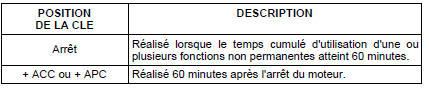
Note: If a phone call is in progress, switching to economy mode will take place once the call ends.
Switching from economy mode to normal mode
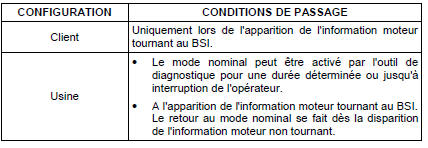
Engine running
Engine running: the electrical system is always nominal.
- The engine running state is divided into ten load-shedding levels, to reduce electrical consumption and thus avoid discharging the battery.
- The engine running state is also divided into four load-up levels. Load-up allows the engine to reach operating temperature faster, to improve the efficiency of the particulate filter. This temperature increase is obtained by increasing the resistive torque of the alternator. The resistive torque of the combustion engine is thereby increased, and so is its temperature.
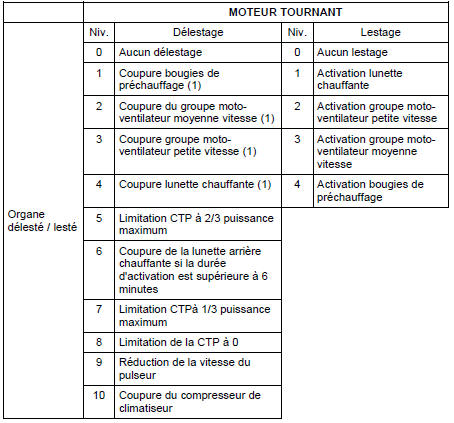
(1) if activated for the particulate filter
Load-shedding strategy
The BSI uses the battery voltage information to adjust the load-shedding level. After reading the battery voltage information, load shedding is performed level by level if the battery voltage drops below the reference voltages.
There is a 10-second delay between two load-shedding level increase operations.
There is a 20-second delay between two load-shedding level decrease operations.
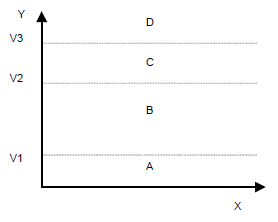
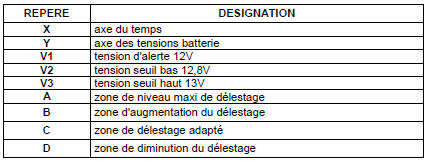
Load shedding starts when the battery voltage is below threshold voltage V2.
Load-up strategy
The BSI receives load-up requests over the CAN network. It forces activation of the consumers in the order of the table. If the current load-shedding level is higher than the load-up level, no load-up is performed until the load-shedding level allows it.
Note: During load-up, no information on the activation of the consumers is given to the customer.
Degraded modes
- If the battery level is unknown, the load-shedding level is 0 in order to preserve customer functions.
- If there is no information on the load-shedding requested by the BSI, it is considered that no load shedding is requested.
- If there is no information on the sheddable levels of a control module, all are considered non-sheddable.
- If the outside temperature is unknown, it is assumed to be below the "outside temperature threshold".
Test yourself
A quick Citroen C5 Aircross quiz: every answer comes with an explanation and a link to the manual page.