Electric parking brake
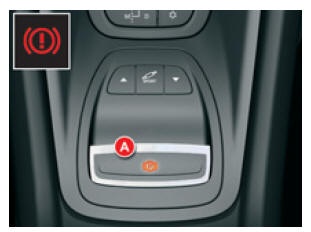
Electric parking brake
The electric parking brake combines two operating modes:
- AUTOMATIC
Automatic application when the engine is switched off and automatic release when the vehicle starts moving (automatic functions activated by default),
- MANUAL
Manual application and release of the parking brake is possible at any time by pulling switch A while pressing the brake pedal.
Automatic operation
Locking with engine off
With the vehicle stationary, the parking brake applies automatically when the engine is switched off.
Parking brake application is indicated:

- by the P indicator light on switch A,

- by the corresponding indicator light in the instrument panel,
- by the message "Parking brake applied" in the instrument panel display.
An operating noise confirms the application or release of the electric parking brake.
! Before leaving the vehicle, make sure that the P indicator light and the instrument panel indicator light are on.
Never leave a child alone inside the vehicle with the ignition on; they could release the parking brake.
Locking with engine running
With the engine running and the vehicle stationary, to immobilise the vehicle you must apply the parking brake manually by pulling switch A.
Parking brake application is indicated:

- by the P indicator light on switch A,

- by the corresponding indicator light in the instrument panel,
- by the message "Parking brake applied" in the instrument panel display.
When the driver's door is opened, an audible signal and a message are triggered if the parking brake is not applied.
! Before leaving the vehicle, make sure that the P indicator light and the instrument panel indicator light are on.
Unlatching
The parking brake releases automatically and progressively when the vehicle moves off:
- With a manual gearbox (first gear or reverse engaged), fully depress the clutch pedal, then press the accelerator pedal and release the clutch.
- With an automatic gearbox, accelerate with the selector in position D, M or R.
Full release of the parking brake is indicated:

- by the P indicator light on switch A going off,

- by the corresponding indicator light in the instrument panel going off,
- by the message "Parking brake released" in the instrument panel display.
When stationary with the engine running, do not accelerate unnecessarily (particularly when starting the engine, including in neutral), as you may release the parking brake.
Do not place any object between the gear lever and the electric parking brake control switch.
Activation / Deactivation of automatic functions
Depending on the vehicle's destination, automatic application when the engine is switched off and automatic release when the vehicle starts moving may be deactivated.
Activation and deactivation are carried out through the configuration menu of the instrument panel display. To do so, select "Vehicle settings / Comfort / Automatic parking brake".
 Deactivation of these functions is indicated by this warning lamp lighting up on the instrument panel.
With automatic functions deactivated, the parking brake is applied and released manually.
! In special conditions, with the engine not running (towing, freezing, etc.), the automatic parking brake can be released manually with the ignition key in the ON position.
If the configuration menu does not offer the option to activate/deactivate the automatic functions, they can be changed at a CITROËN dealer.Manual operation
Manual application and release of the parking brake is always available.
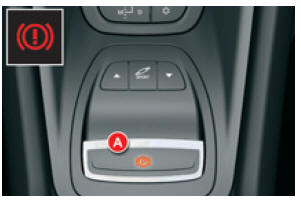
Manual operation
Latching
With the vehicle stationary, to apply the parking brake, with the engine running or switched off, pull switch A.
Parking brake application is indicated:

- by the P indicator light on switch A,

- by the corresponding indicator light in the instrument panel,
- by the message "Parking brake applied" in the instrument panel display.
! When the driver's door is opened with the engine running, an audible signal and a message are triggered if the parking brake is not applied.
Unlatching
With the ignition on or the engine running, to release the parking brake, press the brake pedal, then push and release switch A.
Full release of the parking brake is indicated:

- by the P indicator light on switch A going off,

- by the corresponding indicator light in the instrument panel going off,
- and by the message "Parking brake released" in the instrument panel display.
If you push switch A without depressing the brake pedal, the parking brake does not release and the message "Foot on brake required" appears in the instrument panel.
! When stationary with the engine running, do not accelerate unnecessarily, as you may release the parking brake.
Maximum application
If necessary, you can apply the parking brake to its maximum. This is done by pulling switch A for a long time until the message "Parking brake maximum application" and an audible signal are given.
Maximum application is essential:
- with a vehicle towing a caravan or trailer, when the automatic functions are activated and you apply the parking brake manually,
- when the slope conditions may change while parked (examples: transport by boat, by lorry, or towing).
- When towing, with a heavily loaded vehicle, or when parking on a steep slope, turn the wheels towards the kerb and engage a gear when parking.
- After maximum application, the release time is longer.
Special situations
In certain situations (engine starting, etc.), the parking brake may adjust its applied force by itself. This is normal operation.
To move your vehicle a few centimetres without starting the engine, with the ignition on, press the brake pedal and release the parking brake by pushing then releasing switch A.
Full release of the parking brake is indicated by the P indicator light on the switch going off, by the indicator light in the instrument panel going off, and by the message "Parking brake released" in the instrument panel display.
If the parking brake malfunctions in the applied position or the battery fails, an emergency release is always possible.
To ensure its correct operation and therefore your safety, the number of consecutive applications and releases of the parking brake is limited to eight.
If this limit is exceeded, you are alerted by the message "Parking brake fault" and an indicator light flashes.
Emergency dynamic braking
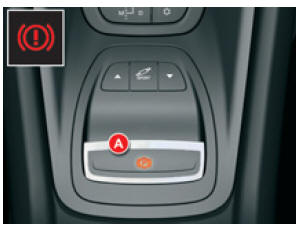
Emergency dynamic braking
In the event of a failure of the main braking system or in an exceptional situation (example: driver taken ill, supervised driving...), pull and hold switch A to stop the vehicle.
The electronic stability control (ESP) ensures stability during dynamic emergency braking.
In the event of a failure of dynamic emergency braking, one of the following messages appears in the instrument panel display:
- "Parking brake fault".
- "Parking brake control fault".
 If the ESP system fails, as indicated by this warning lamp lighting up, braking stability is not guaranteed. In this case, the driver must maintain stability by repeatedly pulling and releasing paddle A.
! Dynamic emergency braking must be used only in exceptional situations.
! If the vehicle cannot be immobilised, do not operate the emergency release control: your vehicle could roll away down the slope.
Consult a CITROËN dealer.
Emergency release
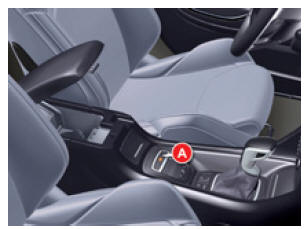
Emergency release
If the electric parking brake does not release, an emergency control allows you to release it manually, provided you can keep the vehicle immobilised for the whole duration of the operation.
- If you can start your vehicle (engine running): immobilise the vehicle by pressing the brake pedal throughout the operation.
- If you cannot start your vehicle (battery failure, for example): do not use this control and contact the CITROËN network. If you are nevertheless obliged to, immobilise the vehicle securely before any operation and follow the instructions below.
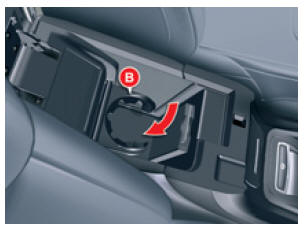
- On a slope: chock the vehicle by placing the wheel chocks (if your vehicle is equipped with them) in front of or behind both front wheels, in the direction opposite to the slope.
On level ground: chock the vehicle by placing the wheel chocks (if your vehicle is equipped with them) in front of and behind one of the front wheels.
- Open the lower compartment of the centre armrest by pulling it.
- Make sure the cup holder B is folded away.
- Remove the rubber mat covering the bottom of the armrest.
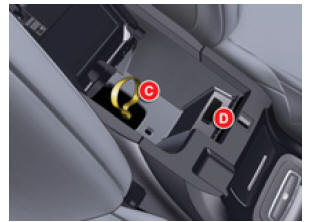
- Release the strap from its housing C.
- Pull the strap to release the brake. A loud click confirms that the brake has been released.
- Make sure you put the strap back in its housing C.
Otherwise, the parking brake can no longer be applied.
Consult a CITROËN dealer.
- Put the rubber mat back in the bottom of the armrest.
! This strap does not allow you to apply your parking brake.
To re-apply the electric parking brake (after fixing the fault or after battery failure), pull the switch A and hold it until the parking brake warning lamp (!) in the instrument panel flashes, then pull it and hold it a second time until the warning lamp stays on steadily.
The next application may take longer than in normal operation.
Until the parking brake has re-applied (warning lamp (!) in the instrument panel flashing, then staying on steadily), you must keep the ignition off to avoid damaging it.
Make sure no dusty or wet objects are introduced near the diagnostic socket D, which is essential for vehicle maintenance.
Operating faults
! If any of these situations occur, consult a Citroën dealer as soon as possible.
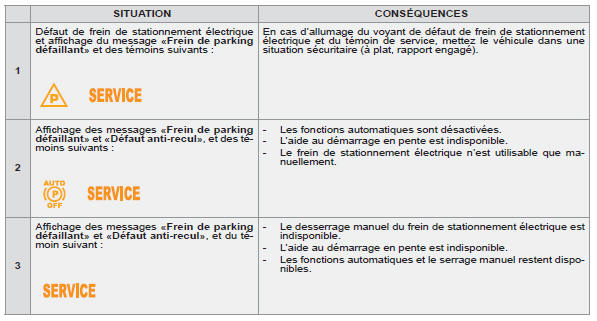
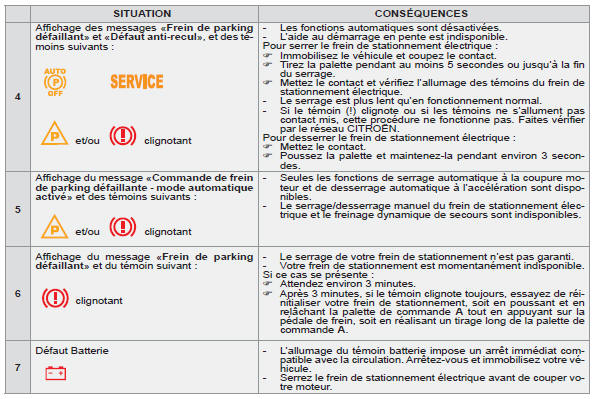
Test yourself
A quick Citroen C5 Aircross quiz: every answer comes with an explanation and a link to the manual page.