Troubleshooting
GENERAL INFORMATION
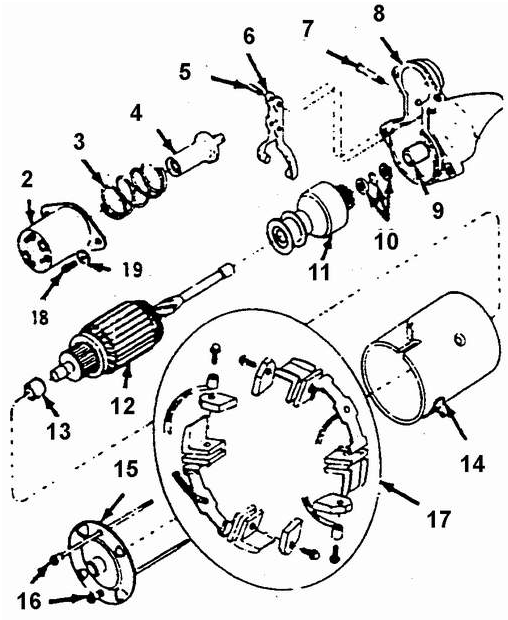
Starter
2. PULL-IN RELAY HOUSING.
3. RETURN SPRING.
4. RELAY PLUNGER.
5. PIN.
6. DRIVE LEVER.
7. AXLE.
8. HOUSING.
9. ELECTRIC MOTOR SHAFT BUSHING.
10. STARTER PINION BUSHINGS.
11. PINION WITH OVERRUNNING CLUTCH.
12. ELECTRIC MOTOR ARMATURE.
13. ELECTRIC MOTOR ARMATURE REAR BUSHING.
14. ELECTRIC MOTOR STATOR.
15. STATOR REAR COVER.
16. TIE BOLT.
17. BRUSH ASSEMBLY.
18. BOLT.
19. WASHER.
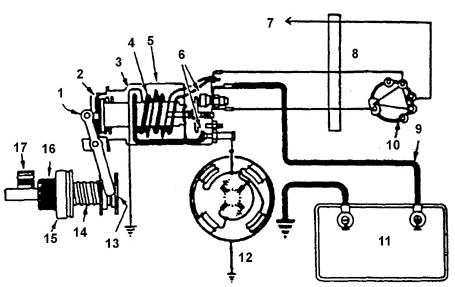
Engine starting system circuit diagram
1. DRIVE LEVER.
2. RELAY PLUNGER.
3. HOLD-IN WINDING.
4. PULL-IN WINDING.
5. PULL-IN RELAY.
6. MOTOR SWITCHING CONTACTS.
7. TO "BAT" TERMINAL OF IGNITION DISTRIBUTOR.
8. CONNECTOR.
9. BATTERY POSITIVE CABLE.
10. IGNITION SWITCH.
11. STARTER BATTERY.
12. STARTER MOTOR.
13. BUSHING.
14. RETURN SPRING.
15. OVERRUNNING CLUTCH.
16. PINION GEAR.
17. FLYWHEEL RING GEAR
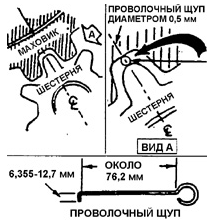
Measuring the Clearance between the Pinion Gear and the Flywheel Ring Gear
Before removing the starter motor from the engine, perform the following checks:
– Check the engine starting system for proper operation.
– Check the battery for proper operation.
– Check the electrical wiring for proper operation: check the wires for continuity and the electrical connections of the battery, ignition switch, and starter, including the ground wire. If necessary, clean the contacts and tighten the connections.
wires.
– Check the ignition switch and starter solenoid for proper operation: inspect and determine the condition of the switch and the solenoid.
– Excessive starter noise: to eliminate starter noise during engine cranking, perform the following.
1) Using the diagnostic table, determine the cause of the excessive noise.
2) Eliminate the detected fault.
2a) Check the flywheel for runout, signs of heavy wear, etc.
2b) Start the engine and mark the teeth of the flywheel ring gear with the greatest radial runout using chalk or charcoal. Stop the engine and turn the
crankshaft so that the marked ring gear teeth are engaged with the
starter pinion.
2c) Disconnect the negative battery cable.
2d) Check the clearance between the pinion gear and the flywheel ring gear using a
wire feeler gauge 0.5 mm in diameter, see Fig. Measuring the Clearance between the Pinion Gear and the
Flywheel Ring Gear. To determine the clearance correctly, center the pinion gear
tooth between the ring gear teeth and insert the gauge between the tip of the pinion tooth and the
ring gear root. If the clearance is less than specified, move the starter away from the flywheel by the required distance.
2e) If the clearance is much greater than 0.5 mm and is about 1.5 mm, move the starter closer to the flywheel. Excessive clearance may cause flywheel ring gear teeth to break.
To reduce the clearance, adjust the thickness of the shims only on the outer
starter mounting. The 0.4 mm shim installed at this location
corresponds to a change in gear clearance of approximately 0.3 mm.
If standard starter shims are not available, flat washers or other similar parts may be used.
Starter check: if the battery, electrical wiring, and ignition switch are serviceable,
remove the starter for further inspection.
Do not operate the starter for more than 30 seconds continuously. Allow a pause of at least 2 minutes between starter operations to cool the starter.
Overheating of the starter due to prolonged and continuous operation may cause it to
fail. Starter components do not require lubrication during operation, except when the starter is completely disassembled.
3) Lower starter bolt.
4) Master cylinder mounting nut.
5) Ignition distributor protective cover.
6) Negative battery cable.
Starter Fault Diagnosis: Excessive Noise
| SYMPTOM | CAUSE |
| High-pitched whine when the starter cranks the engine (before the engine starts). Engine starts normally |
Excessive clearance between the pinion gear and the flywheel ring gear. |
| High-pitched whine after the engine starts and the ignition key is released. The engine starts normally. This defect, which occurs constantly or periodically, is caused by the return spring being unable to disengage the pinion gear from the ring gear. flywheel |
Insufficient clearance between the pinion gear and the flywheel ring gear. Radial runout of the flywheel ring gear makes this defect unstable. |
| Sharp increase in noise or a siren-like sound after the engine starts and before the starter is switched off. |
Most likely cause: malfunction of the overrunning clutch. Replacing the overrunning clutch often eliminates this defect. |
| Rumbling or knocking when the starter is switched off after the engine starts. |
Most likely cause: Deformation or imbalance of the starter armature. The armature must be replaced. |
Test yourself
A quick Daewoo Nexia quiz: every answer comes with an explanation and a link to the manual page.