Refuelling the vehicle
Always switch off the engine before refuelling.
Petrol engines
Use only unleaded petrol with a research octane number (R.O.N.) of at least 95. To avoid damaging the catalytic converter, never add even a small amount of leaded petrol, not even in an emergency.
CAUTION A malfunctioning catalytic converter results in harmful exhaust emissions, causing environmental pollution.
CAUTION Never put leaded petrol into the tank, not even in an emergency, not even a small amount; this would irreparably damage the catalytic converter, making it permanently ineffective.
Diesel engines
Operation at low temperatures
Use only automotive diesel fuel (Specification EN590).
If the vehicle is used or parked for extended periods in mountain or cold areas, it is recommended to refuel with the diesel available locally. In this situation it is also suggested to keep more than 50% of the usable tank capacity filled with fuel.
Refuelling procedure
WARNING When washing the filler neck area with a high-pressure lance, keep a distance of at least 20 cm.
Petrol and Diesel versions
The refuelling procedure described below is illustrated on plate B, fig. 90, located inside the fuel filler flap. The plate also shows the type of fuel (UNLEADED FUEL = petrol, DIESEL = diesel).
To refuel, proceed as follows:
- open flap A, fig. 90, by pulling it outwards;
- insert the nozzle into the filler neck and refuel;
- when refuelling is complete, before removing the nozzle, wait at least 10 seconds to allow the fuel to drain into the tank;
- then remove the nozzle from the filler neck and close flap A.
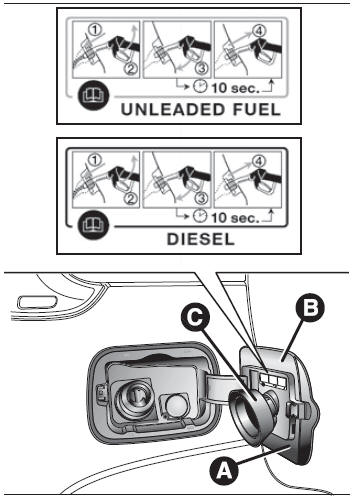
Flap A, fig. 90, is fitted with a dust cap C which, when the flap is closed, prevents dirt and dust from collecting at the end of the filler neck.
Emergency refuelling
Proceed as follows:
- open the boot and take the adapter B, fig. 91, stored in the tool compartment (versions with spare wheel – where applicable) or in the Fix&Go compartment (versions with Fix&Go);
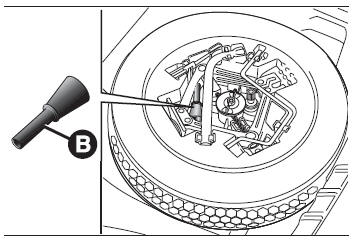
- open flap A by pulling it outwards;
- insert adapter B into the filler neck and refuel;
- when refuelling is complete, remove the adapter, close the flap, return the adapter to its case and store it in the boot.
LPG versions
To access the LPG filler neck, open access flap A, fig. 92, and unscrew cap B.
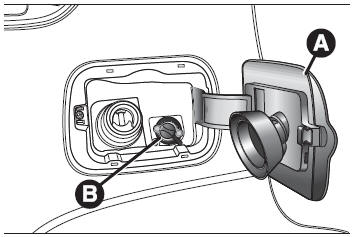
When refuelling, observe the following precautions:
- switch off the engine;
- apply the handbrake;
- turn the ignition key to STOP;
- do not smoke;
- hand the filling adapter A, fig. 93, to the LPG refuelling attendant.
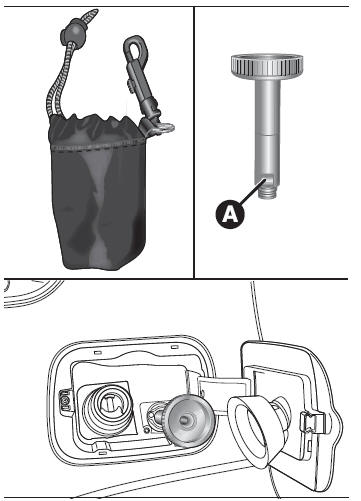
WARNING Depending on the country of sale, different types of adapters are used for LPG pumps. The vehicle is supplied with a filling adapter, stored in a dedicated case, suitable for refuelling in the country where the vehicle was sold. If travelling to another country, check which type of adapter is required.
Natural Power versions
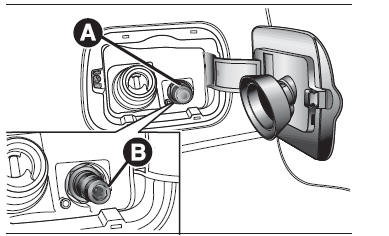
To access the filler neck B, fig. 94, open the small flap and unscrew cap A by turning it anticlockwise.
The profile of the recharging filler neck B is of the universal type, compatible with the "Italia" and "NGV1" standards. In some European countries adapters are considered ILLEGAL (for example Germany).
Fuels – Vehicle compatibility identification.
Graphic symbol for consumer information in accordance with specification EN16942
The symbols below help identify the correct type of fuel to use in your vehicle.
Before refuelling, check the symbols inside the fuel filler flap (where fitted) and compare them with the symbol on the fuel pump (where fitted).
Symbols for petrol-engined vehicles

E5: Unleaded petrol containing up to 2.7% (m/m) oxygen and maximum 5.0% (V/V) ethanol, in accordance with specification EN228.
E10: Unleaded petrol containing up to 3.7% (m/m) oxygen and maximum 10.0% (V/V) ethanol, in accordance with specification EN228.
Symbols for Diesel-engined vehicles
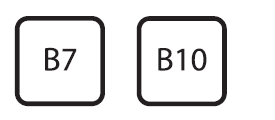
B7: Diesel containing up to 7% (V/V) FAME (Fatty Acid Methyl Esters), in accordance with specification EN590.
B10: Diesel containing up to 10% (V/V) FAME (Fatty Acid Methyl Esters), in accordance with specification EN16734.
Symbols for bi-fuel petrol – LPG vehicles

E5: Unleaded petrol containing up to 2.7% (m/m) oxygen and maximum 5.0% (V/V) ethanol, in accordance with specification EN228.
E10: Unleaded petrol containing up to 3.7% (m/m) oxygen and maximum 10.0% (V/V) ethanol, in accordance with specification EN228.
LPG: Automotive LPG in accordance with specification EN589.
Symbols for bi-fuel petrol – natural gas vehicles
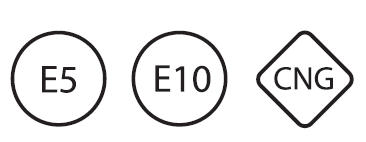
E5: Unleaded petrol containing up to 2.7% (m/m) oxygen and maximum 5.0% (V/V) ethanol, in accordance with specification EN228.
E10: Unleaded petrol containing up to 3.7% (m/m) oxygen and maximum 10.0% (V/V) ethanol, in accordance with specification EN228.
CNG: Compressed natural gas for vehicles in accordance with specification EN16723.
WARNING 128) Do not fit any object or cap to the end of the filler neck other than those provided on the vehicle.Using non-compliant objects or caps may cause pressure to build up inside the tank, creating a hazardous situation.
129) Do not approach the fuel filler neck with naked flames or lit cigarettes: fire hazard. Also avoid bringing your face too close to the filler neck, to avoid inhaling harmful vapours.
130) Do not use a mobile phone near the fuel pump: risk of fire. WARNING 48) For diesel vehicles, use only automotive diesel fuel conforming to European standard EN590. The use of other products or mixtures may cause irreparable engine damage, with resulting loss of warranty coverage for the damage caused. In case of accidental refuelling with other fuel types, do not start the engine and drain the fuel tank. If the engine has run even for a very short time, it is essential to drain the entire fuel system, not only the tank.49) The plates (supplied with the vehicle documents) show the scheduled date for the first cylinder test/inspection. CNG refuelling staff are not authorised to fill cylinders whose test date has expired.
Test yourself
A quick Fiat Panda quiz: every answer comes with an explanation and a link to the manual page.