Fuses
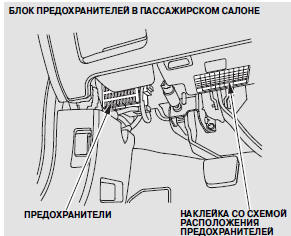
The fuses are located in several fuse boxes, which are located under the instrument panel and in the engine compartment.
The interior fuse box is located under the instrument panel on the driver's side. The fuse layout label is attached under the steering column.
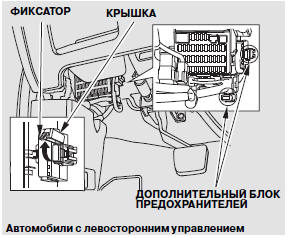
For vehicles with a diesel engine
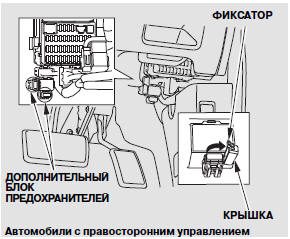
One or two more fuse boxes are located behind the interior fuse box.
To open the fuse box cover, press the release tab in the direction shown in the illustration.
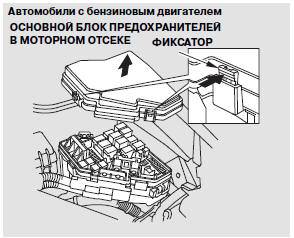
The fuse box is located on the left side at the rear of the engine compartment. To open it, press the release tabs as shown in the illustration.
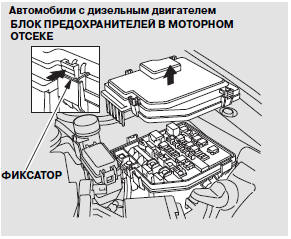
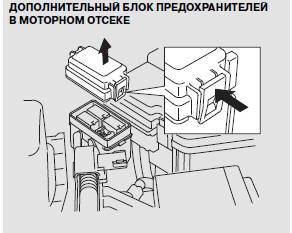
Checking and Replacing Fuses
If any electrical equipment stops working, first check the corresponding fuses. Use the table on pages 557 and 558 for vehicles with a gasoline engine, or the table on pages 559 and 561 for vehicles with a diesel engine, or use the diagram on the fuse box cover to determine which fuse protects the circuit of this equipment. Check the fuses of the malfunctioning equipment first, then all other fuses. Replace any blown fuses and check the operation of the malfunctioning devices.
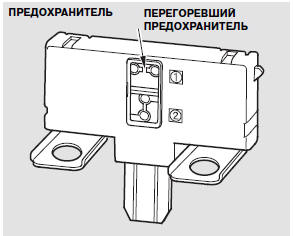
1. Turn the ignition key to the LOCK (0) position. Make sure the headlights and all other electrical loads are turned off.
2. Remove the cover from the fuse box located in the engine compartment.
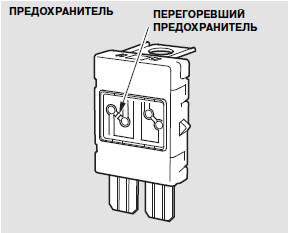
3. Check all large fuses in the fuse box located in the engine compartment. To do this, look through the fuse's side window and check that the fusible link is intact.
To replace a fuse, remove the mounting screws using a Phillips screwdriver.
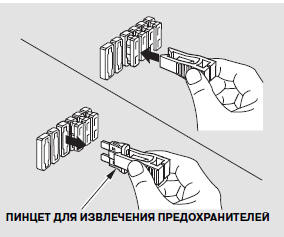
4. Using the tweezers stored under the cover of the engine compartment fuse box, remove each small fuse from the engine compartment fuse box and each fuse from the interior fuse box one at a time, and check them.
On vehicles equipped with a gasoline engine, the fuse puller tweezers are attached to the inside surface of the main fuse box cover in the engine compartment.
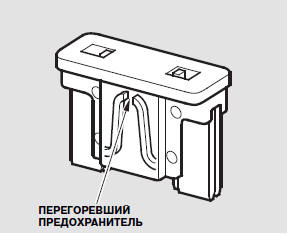
5. A blown fuse is indicated by a melted fusible element inside the fuse body.
Replace the blown fuse with a spare fuse of the same or lower amperage rating.
If you do not have spare fuses and cannot continue driving with a malfunctioning electrical component, we recommend temporarily replacing the blown fuse with a good fuse of the same or lower amperage rating, taken from another slot in the fuse box.
Take the fuse of an electrical circuit that you can do without for a while, for example, the fuse protecting the cigarette lighter circuit.
If you install a fuse with a lower amperage rating instead of the blown fuse, the new fuse may blow immediately.
This is not a sign of a malfunction.
At the first opportunity, install a new fuse with the specified amperage rating.
Replacing a blown fuse with a new fuse of a higher amperage rating greatly increases the probability of damage to the vehicle electrical system due to overload. Therefore, if the correct spare fuse is not available, install a fuse with a lower amperage rating than the one being replaced.
6. If the spare fuse with the specified amperage rating also blows quickly, this indicates a serious malfunction in the vehicle electrical system.
Leave the blown fuse in its slot and have the vehicle checked at an authorized dealer service center.
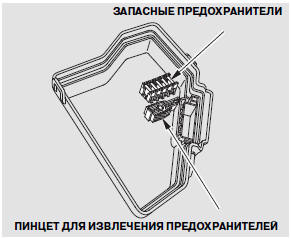
For vehicles with a gasoline engine
Spare fuses are located on the inside of the fuse box cover in the engine compartment.
Test yourself
A quick Honda CR-V quiz: every answer comes with an explanation and a link to the manual page.