Heating and Air Conditioning
1. Start the engine.
2. Set the mode to the desired position. For maximum heating and cooling efficiency, select:
- Heating:
- Cooling:
3. Set the temperature control to the desired position.
4. Set the air intake control to the outside (fresh) air position.
5. Set the fan speed control to the desired speed.
6. If air conditioning is required, turn the air conditioning system on.
Mode Selection
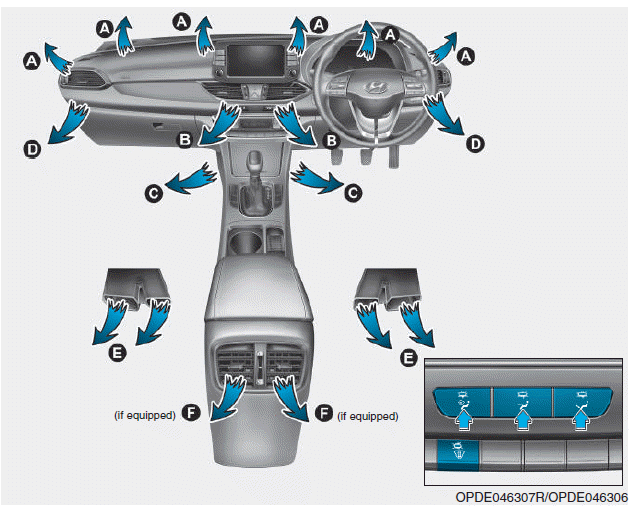
The mode selection button controls the direction of airflow through the ventilation system.
Air may be directed to the floor, instrument panel vents, or windshield.
Defrost Level (A, D)

Most of the airflow is directed to the windshield.
Face level (B, D, F)

Airflow is directed to the upper body and face. In addition, each outlet can be adjusted to direct the air flowing out of the outlet.
Floor level (A, C, D, E, F)

Most of the airflow is directed to the floor.
You can also select 2 or 3 modes at the same time.
- Face ( ) + floor (
 ) mode
- Face ( ) + defrost (
 ) mode
- Floor ( ) + defrost () mode
- Face ( ) + floor () + Defrost (
 ) mode
MAX A/C level (B, D, F)
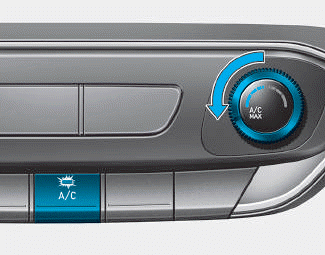
To turn on MAX A/C, turn the temperature control knob fully to the left. Airflow is directed to the upper body and face.
In this mode, the A/C compressor and recirculation air position are selected automatically.
After the cabin has cooled sufficiently, if possible, move the temperature knob away from MAX A/C and press the A/C button.
Instrument Panel Vents
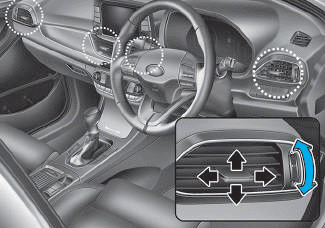
■ Front
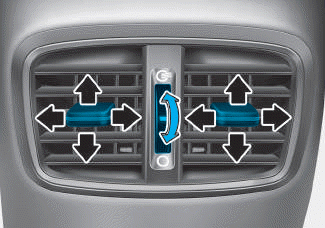
■ Rear
The vents can be opened ( ) or closed (
 ) individually using the wheel.
In addition, you can adjust the direction of airflow from these vents using the vent control lever, as shown in the illustration.
Temperature Control
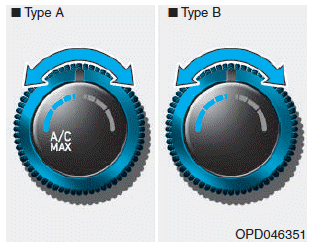
The temperature increases when the knob is turned to the right. The temperature decreases when the knob is turned to the left.
Air Intake Control
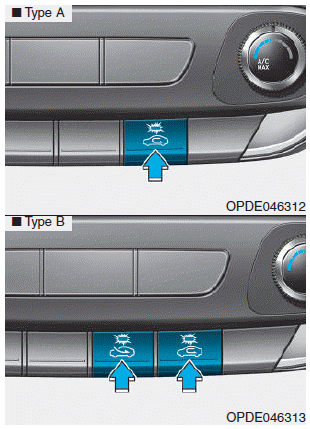
Used to select the outside (fresh) air position or the recirculated air position.
To change the air intake control position, press the control button.
Recirculated Air Position

When the recirculated air position is selected, air from the passenger compartment is drawn through the heating or cooling system according to the selected function.
Outside (Fresh) Air Position


When the outside (fresh) air position is selected, air enters the vehicle from outside and is heated or cooled according to the selected function.
Information
Using the fresh air mode is recommended.
Prolonged operation of the heater in recirculated air position (without A/C) may cause the windshield and side windows to fog up and the air in the cabin to become stale.
Also, prolonged use of air conditioning in recirculation mode will cause excessively dry air inside the vehicle.
WARNING
- Continued climate control operation in the recirculation position may allow humidity inside the vehicle to rise, which may fog the windows and reduce visibility.
- Do not sleep in the vehicle with the air conditioning or heating system on. This may cause serious injury or death due to decreased oxygen levels and/or body temperature.
- Continued operation of the climate control system in recirculation mode may cause drowsiness, and loss of vehicle control. Set the air intake control to the fresh air position as much as possible while driving.
Test yourself
A quick Hyundai i30 quiz: every answer comes with an explanation and a link to the manual page.