Brake System
Description and Operation
In this manual: Brake System
5steps
~30min
2/5difficulty
Done 0 of 5
ESP Description
ESP recognizes critical driving conditions, such as panic reactions in hazardous situations, and stabilizes the vehicle by individual braking of the wheels and engine torque intervention. ESP adds an additional function known as Active Yaw Control (AYC) to the ABS, TCS, EBD and ESP functions. While the ABS/TCS function controls wheel slip during braking and acceleration and thus mainly intervenes in the longitudinal dynamics of the vehicle, Active Yaw Control stabilizes the vehicle about its vertical axis. This is achieved by individual braking of the wheels and adapting the instantaneous engine torque without any action required by the driver. ESP essentially consists of three units: sensors, electronic control unit and actuators. The stability control function operates under all driving and operating conditions. Under certain driving conditions, the ABS/TCS function may be activated simultaneously with the ESP function in response to driver input. In the event of a stability control function failure, the basic safety function of the ABS remains available.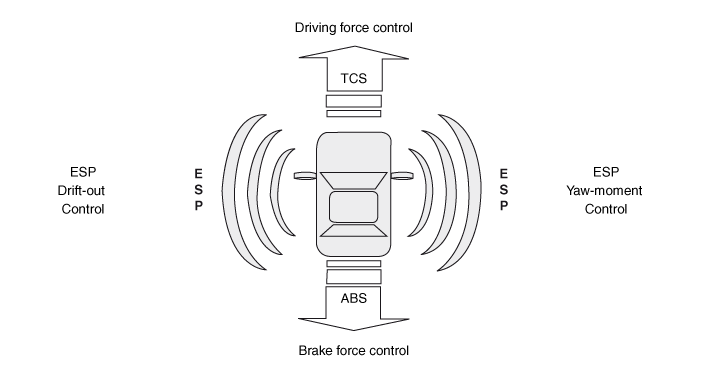
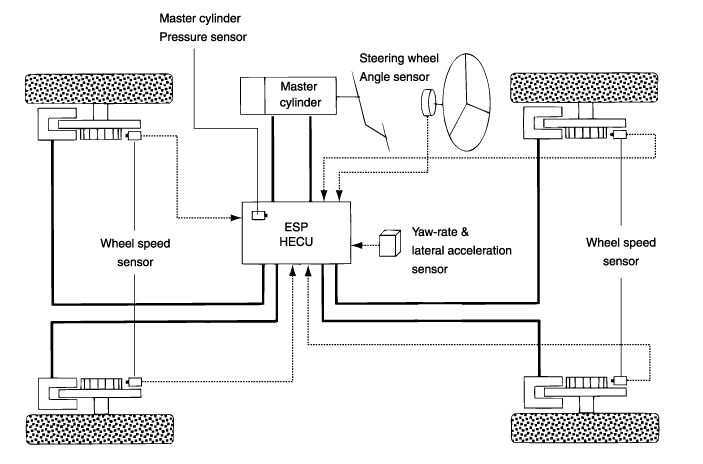
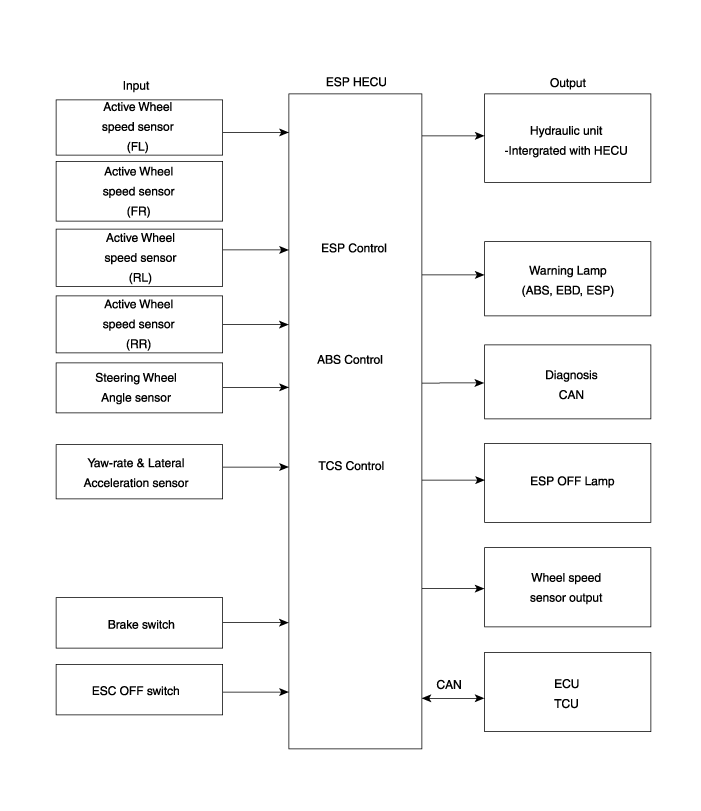
ESP Operation Mode
- STEP 1: ESP analyzes the driver's intention.

- STEP 2: It analyzes the vehicle motion with ESP.

- STEP 3: The HECU calculates the required strategy, then activates the appropriate valves and sends torque control requests via CAN to maintain vehicle stability.
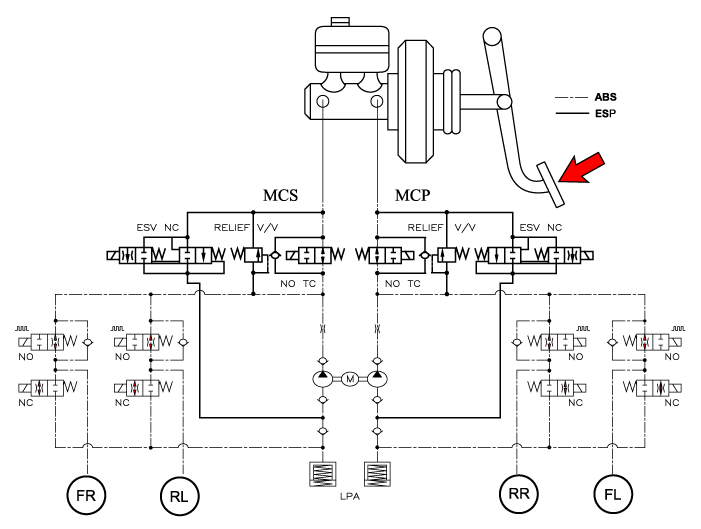
ESP Hydraulic System Diagram
- ESP Not Operating: Normal Braking.
Solenoid valve Continuity Valve Motor Pump TC Valve IN (NO) OFF OPEN OFF OFF OUT (NC) OFF CLOSE - ESP Operation
Solenoid valve Continuity Valve Motor Pump TC Valve Understeer
(Inside Rear Wheel Only)IN (NO) OFF OPEN ON ON OUT (NC) OFF CLOSE Oversteer
(Outside Front Wheel Only)IN (NO) OFF OPEN OUT (NC) OFF CLOSE
Warning Lamp Control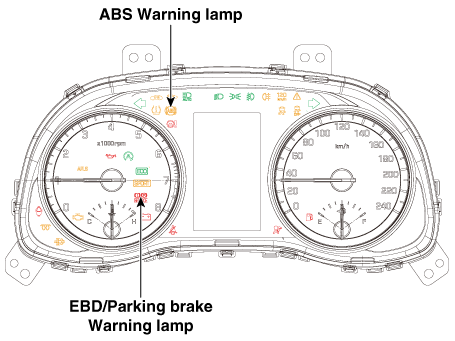
- During the initialization phase after IGN ON (continuously for 3 seconds).
- In case of ABS operation failure during braking.
- In diagnostic mode.
- When the ECU connector is disconnected from the ECU.
- The cluster lamp illuminates when communication with the CAN module is not possible.
- During the initialization phase after IGN ON (continuously for 3 seconds).
- When the parking brake switch is on or the brake fluid level is low.
- When the EBD function has failed.
- In diagnostic mode.
- When the ECU connector is disconnected from the ECU.
- The cluster lamp illuminates when communication with the CAN module is not possible.
- During the initialization phase after IGN ON (continuously for 3 seconds).
- When the ESP function is inhibited due to a system failure.
- When the ESP system is operating (flashing - 2 Hz).
- In diagnostic mode (other than standard mode).
- The cluster lamp illuminates when communication with the CAN module is not possible.
- In initialization mode after IGN ON (continuously for 3 seconds).
- The ESP OFF lamp illuminates when the driver presses the ESP OFF button.
Test yourself
A quick Hyundai Palisade quiz: every answer comes with an explanation and a link to the manual page.
Was this page helpful?