Wireless Smartphone Charging System
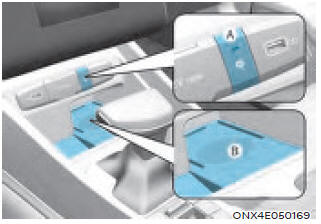
[A]: Indicator light, [B]: Charging pad
On some models, the vehicle is equipped with a wireless smartphone charger.
The system is available when all doors are closed and the ignition switch or Engine Start/Stop button is in the ON (or START) position.
To charge a cellular phone
The wireless smartphone charging system only charges Qi-compatible smartphones ( ). Read the label on the smartphone case or visit your smartphone manufacturer's website to check whether your smartphone supports Qi technology.
Wireless charging starts when you place a Qi-compatible smartphone on the wireless charger.
1. Remove other items, including the smart key, from the wireless charging unit. If not, the wireless charging process may be interrupted. Place the smartphone in the center of the charging pad.
2. The indicator light turns orange while the smartphone is charging. The indicator light turns blue when charging is complete.
3. You can turn the wireless charging function on or off from the settings menu on the instrument cluster. Select:

If your smartphone does not charge:
- Slightly change the position of the smartphone on the charging pad.
- Make sure the indicator light is orange.
The indicator will blink orange for 10 seconds if there is a malfunction in the wireless charging system.
In this case, temporarily stop the charging process and try to charge the smartphone again.
The system will warn you with a message on the LCD display if the smartphone is still on the wireless charger after the vehicle is turned off and the front door is opened.
For some smartphone manufacturers, the system may not warn you even though the smartphone remains on the wireless charging unit. This is due to a special characteristic of the smartphone, not a malfunction of the wireless charging system.
Information
For cellular phones of some manufacturers, the system may not warn you even if the cellular phone is left on the wireless charging unit. This is due to the specific characteristics of the cellular phone and is not a malfunction of the wireless charging system.
NOTICE
- The wireless smartphone charging system may not support certain smartphones that are not verified for the Qi specification ( ).
- When placing the smartphone on the charging pad, position the phone in the center of the pad for optimal charging performance. If the smartphone is off to the side, the charging rate may be lower, and in some cases the smartphone may experience higher heat generation.
- In some cases, wireless charging may temporarily stop when the smart key is used, such as when starting the engine or locking/unlocking the doors, etc.
- When charging certain smartphones, the charging indicator may not change to blue when the smartphone is fully charged.
- The wireless charging process may temporarily stop when the temperature inside the wireless smartphone charging system abnormally increases. Wireless charging resumes when the temperature drops to a certain level.
- The wireless charging process may temporarily stop when there is any metal object, such as a coin, between the wireless smartphone charging system and the smartphone.
- When charging some smartphones with a self-protection function, the wireless charging speed may decrease and wireless charging may stop.
- If the smartphone has a thick case, wireless charging may not be possible.
- If the smartphone is not properly in contact with the charging pad, wireless charging may not work correctly.
- Some magnetic items, such as credit cards, phone cards, or train tickets, may be damaged if left with the smartphone during charging.
- When any smartphone without a wireless charging function or a metal object is placed on the charging pad, a slight noise may occur. This faint sound is caused by the vehicle's intelligent compatibility object placed on the charging pad. It does not affect your vehicle or smartphone in any way.
Information
If the ignition switch is in the OFF position, charging also stops.
Information
This device complies with Part 15 of the FCC Rules. Operation is subject to the following three conditions:
1. This device may not cause harmful interference, and
2. This device must accept any interference received, including interference that may cause undesired operation.
3. Changes or modifications not expressly approved by the party responsible for compliance could void the user's authority to operate the equipment.
Test yourself
A quick Hyundai Tucson quiz: every answer comes with an explanation and a link to the manual page.