Manual transmission
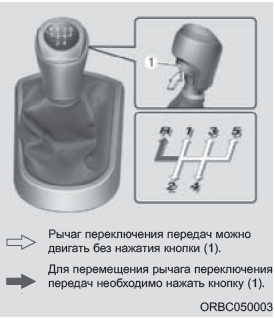
Manual Transmission Operation
The manual transmission has 5 forward speeds.
The shift pattern is shown on the shift lever knob. Thanks to full synchromesh on all forward gears, shifting both to a lower and to a higher gear is easy.
To shift gears, keep the clutch pedal fully depressed during the shift, then release it smoothly.
If the vehicle is equipped with a clutch interlock switch, depress the clutch pedal to start the engine (if equipped).
Before engaging reverse (R), the shift lever must be in the neutral position. Before moving the shift lever to R (Reverse), return it to neutral. Press the button located directly below the shift lever knob, tilt the shift lever fully to the left, then move it to the reverse (R) position.
Shift into reverse only after the vehicle has come to a complete stop.
Never operate the engine with the tachometer needle in the red zone (rpm).
• In cold weather, shifting may be difficult due to thickened transmission oil.
This is normal and does not harm the transmission.
• If the vehicle is stationary and you cannot engage 1st gear or R (Reverse), move the shift lever to N (Neutral) and release the clutch pedal. Depress the clutch pedal again and engage 1st gear or R (Reverse).
This may cause premature wear of the transmission shift forks.
WARNING
• Before leaving the driver's seat, always fully apply the parking brake and stop the engine.
Then, if the vehicle is on level ground or an uphill slope, engage 1st gear; if it is parked on a downhill slope, engage R (Reverse). If these precautions are not taken in the order specified, the vehicle may move suddenly and unexpectedly.
• If your vehicle has a manual transmission and no clutch interlock switch, it may move and cause a serious accident if the engine is started with the clutch pedal released, the parking brake released, and the shift lever not in N (Neutral).
Clutch Operation
Before shifting gears, fully depress the clutch pedal, then release it smoothly. While driving, the clutch pedal must always be fully released. Do not rest your foot on the clutch pedal while driving, as this may cause unnecessary wear. Do not hold the vehicle on a slope by partially engaging the clutch. This also causes unnecessary wear.
To hold the vehicle on a slope, use the service brake or the parking brake. Do not use the clutch excessively or too frequently.
Downshifting
If you need to reduce speed in heavy traffic or when driving up a steep hill, downshift to use engine braking. Downshifting reduces the likelihood of the engine stalling and provides better acceleration when you need to increase speed again. When driving down a long grade, downshifting helps maintain a safe speed and extends the service life of the brake system components.
Proper Driving Techniques
• Never coast downhill in neutral. This is very dangerous. Never turn off the transmission.
• Do not ride the brakes. This causes them to overheat and become damaged.
Instead, when driving down a long grade, reduce speed and select a lower gear. This allows you to use engine braking.
• Reduce speed before downshifting. This prevents engine speed from increasing, which could damage the engine.
• Reduce speed after entering a crosswind. This significantly improves handling.
• Before shifting into R (Reverse), the vehicle must be completely stopped. Otherwise, the transmission may be damaged. To select R (Reverse), depress the clutch pedal, move the shift lever to N (Neutral), then move the lever to R (Reverse).
• Exercise extreme caution when driving on slippery surfaces.
Use particular caution when braking, accelerating, or shifting gears. A sudden change in speed on a slippery road may cause the driving wheels to lose traction with the road and result in loss of vehicle control.
WARNING
• Always wear your seat belt.
The likelihood of serious injury or death in a collision is much higher for an unbelted driver or passenger than for a belted one.
• Do not make turns or U-turns at high speed.
• Do not make sudden steering movements, such as for a quick lane change or a sharp turn.
• If you are driving at high speed, the risk of rollover due to loss of control increases significantly.
• Loss of control often occurs when two or more wheels leave the road and the steering wheel is over-corrected to return to the road.
• If your vehicle leaves the road, do not make sudden steering movements. Instead, reduce speed before returning to the road.
• Never exceed the posted speed limits.
Test yourself
A quick Hyundai Solaris quiz: every answer comes with an explanation and a link to the manual page.