Replacing Wheel Rims. Tire size information. Wheel rim size information. Tire speed rating symbols
When replacing wheel rims or tires on the Kia Opirus (2003–2012), exact dimensions and approved designs are essential. This section explains the codes on the tire sidewall and wheel rim, including size, load index, and maximum permitted speed. Particularly important is the note on tire aging: all tires, including unused spare tires, should be replaced after six years at the latest. This ensures that handling, speedometer accuracy, and safety standards are maintained at all times.
Replacing Wheel Rims
When replacing wheel rims, make sure the replacement rims match the original rims in diameter, width, and offset.
WARNINGAn incorrect wheel size can negatively affect the following: tire and wheel bearing life, braking effectiveness, handling, ground clearance, clearance between the tire and body parts, use of snow chains, speedometer accuracy, headlight aim, and bumper height.
Tire Size Information
The tire sidewall shows the size and construction type of each tire. You need this information when selecting new tires for your vehicle. The letters and numbers on the tire marking are explained below:
Example tire marking: 235/55 R17 98V
235 - Tire width in mm
55 - Aspect ratio = 60% of the tire width
R - R = Radial
17 - Wheel rim diameter in inches
98 - Load index
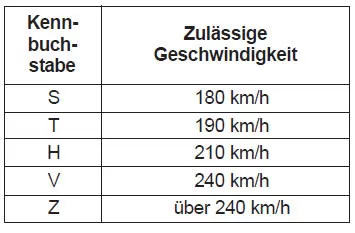
V - Speed rating symbol for the maximum permitted speed. See the corresponding speeds in the table in the section "Tire Speed Rating Symbols".
Wheel Rim Size Information
The wheel rims are also marked with size information. Observe this information when replacing wheel rims. The wheel rim marking is explained below:
Example wheel rim marking: 6.5 J x 17
6.5 - Wheel rim width in inches
J - Rim flange design
x - One-piece rim (drop-center rim)
17 - Wheel rim diameter in inches
Tire Speed Rating Symbols
The following table shows the currently common speed rating symbols and maximum speeds for passenger cars.
The speed rating symbol is part of the marking on the tire sidewall. It indicates the maximum permitted speed of the tire.
Determining the Age of a Tire
Tires that are older than 6 years (based on
the production date) are aged and should no longer be used.
This also applies to spare tires that have not been used. Therefore, replace all tires that are older than 6 years. The production date of a tire is shown as part of the DOT code on the tire sidewall.
On some tires, the DOT code is located only on the inner tire sidewall.
DOT : XXXX XXXX OOOO
The last 4 digits of the DOT code indicate the production date in weeks and year. The first two DOT code groups provide information about the manufacturing plant, tire size, and tread pattern.
For example: DOT XXXX XXXX 1606 This code indicates that the tire was manufactured in the 16th week of 2006.
WARNINGThe condition of tires deteriorates over time, even if they are not used. Regardless of the remaining tread depth, it is recommended that tires generally be replaced after six (6) years (under normal use). Heat from hot climate conditions or high loads from heavy cargo can accelerate the aging process. Failure to observe this warning may result in unexpected tire failure. This may cause loss of control of the vehicle, which can lead to an accident resulting in serious or fatal injuries.
When replacing wheels and tires on the Kia Opirus 2003–2011, it is important to observe the original sizes and specifications. Only this ensures stable handling and maintains safety.
Tire age is also an important factor. Tires older than six years should be replaced to reduce the risk of damage or accidents.
FAQWhy are correct wheel and tire sizes important?
Because they directly affect braking performance, handling and safety.
How can the age of a tire be determined?
Using the DOT code on the sidewall, which shows the week and year of production.
Test yourself
A quick Kia Opirus quiz: every answer comes with an explanation and a link to the manual page.