Tire Inflation Pressure. Replacing Tires. Replacing Tires. Adjusting and Balancing Wheels
This chapter on tyre inspection and care in the Kia Opirus provides comprehensive information on optimal tyre pressure, tyre rotation and recognising tread wear indicators. In addition to safety warnings about pressure loss in warm tyres, it explains how often the wheels should be rotated and balanced. The chapter also contains detailed explanations of tread depth, wheel alignment and correct action in the event of tyre damage. If you want even tyre wear and good traction, you will find practical recommendations for everyday use here.
Tyre pressure
Check the tyre pressure of all tyres, including the spare tyre, at regular intervals when the tyres are cold.
"Cold" means that the vehicle has not been driven during the last 3 hours, or has not been driven more than approx. 1.6 km.
With the correct tyre pressure, handling is optimal and tyre wear is at its lowest.
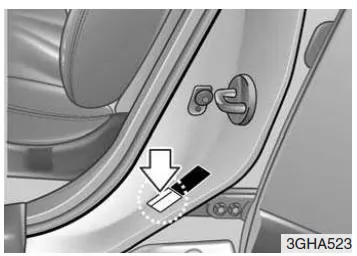
The specifications (tyre size and tyre pressure) can be found on a label at the bottom of the driver's door frame.
WARNINGInsufficient tyre pressure can cause the tyres to overheat, particularly at high outside temperatures and at higher speeds. This could result in, for example, the tread separating from the tyre. This could cause you to lose control of the vehicle, which could result in serious or fatal injury.
NOTE
- The pressure of warm tyres is generally approx. 0.28 - 0.41 bar (approx. 28 - 41 kPa) higher than the pressure of cold tyres. Do not reduce the pressure of warm tyres, as this would result in under-inflation.
- Insufficient tyre pressure results in excessive tyre wear, poorer handling and higher fuel consumption. There is also a risk that the tyre will be damaged by overheating, causing air to escape, and that the seal between the tyre and rim will be impaired. In cases of severe under-inflation, the rim may be deformed and/or the tyre may come off the rim. Therefore, check and correct the tyre pressure regularly as necessary. If a tyre regularly loses air, have it checked by an authorised KIA dealer.
- Excessively high tyre pressure leads to harsher and less safe handling, excessive tyre wear in the centre of the tread, and a greater risk of damage from stones, potholes, etc.
- Make sure the valve caps are fitted after checking the tyre pressure. Without valve caps, dust and moisture could enter the valve and cause air loss. If a valve cap is lost, obtain a replacement as soon as possible.
Both excessively high and excessively low tyre pressure lead to excessive tyre wear, adversely affect handling and can cause sudden tyre failure. This could cause you to lose control of the vehicle.
Rotating tyres
To equalise tyre wear, it is recommended that the wheels are swapped between the front and rear axles every 15,000 km. If wear is uneven, have the wheels rotated at shorter intervals.
When rotating the wheels, check that they are properly balanced.
When rotating the tyres, check them for uneven wear and damage. Uneven wear is usually caused by incorrect tyre pressure, incorrect wheel alignment, unbalanced wheels, hard braking or aggressive cornering.
Also check the tread and sidewalls for bulges and irregularities. Replace damaged and worn tyres.
After rotating the tyres, correct the tyre pressure (front/rear) and make sure the wheel nuts are tightened securely. Refer to Chapter 8, Technical Data, for the tyre pressure and wheel nut tightening torque.

The brake pads of the disc brakes should be checked every time the wheels are changed.
NOTE
Directional tyres may only be swapped between the front and rear axle on the same side of the vehicle, but not between the right and left sides of the vehicle.

Replacing tyres
When the tread is worn evenly, a tread wear indicator becomes visible as a band across the tread. If the wear indicator is level with the tread at any point, the remaining tread depth is less than 1.6 mm. In this case, replace the tyres.
Do not wait until the tread wear indicator reaches the tread level across the full width of the tyre. Replace tyres as soon as the wear indicator reaches tread level at any point.
Wheel alignment and wheel balancing
The wheels on your vehicle have been carefully aligned and balanced at the factory to ensure maximum durability and reliability.
In most cases, wheel alignment never needs to be changed. However, if you notice that the tyres are wearing unevenly or that the vehicle regularly pulls to one side, a correction of the wheel alignment may be necessary.
If you notice that the steering wheel vibrates while driving on level ground, the wheels may need to be balanced.
NOTE
Special balancing weights must be used when balancing alloy wheels, otherwise the alloy wheels may be damaged.
WARNING- Never fit tires of different construction types (radial tires, belted tires, etc.) to your vehicle at the same time. All four tires must be of the same construction type and have the same tread pattern, size, and load capacity. Use only tires approved for your vehicle. Refer to the information label on the driver's door frame and to the registration documents for the correct specifications. Also use only tire and wheel rim combinations that are listed on the information label or recommended by an authorized KIA dealer. Failure to observe these instructions can seriously affect the safety and handling of your vehicle.
- Using a tire size or type that is not approved can negatively affect handling, ground clearance, the clearance between the wheel and body parts, and the accuracy of the speedometer.
- Driving on worn tires is dangerous. It reduces braking performance, steering accuracy, and traction.
- It is recommended to replace all four tires at the same time. If this is not possible or necessary, replace the tires in pairs on the same axle, front or rear. Replacing only one tire can seriously degrade the handling of your vehicle.
Correct tire pressure and regular tire rotation are essential for safety and ride comfort on the Kia Opirus 2003–2012. They prevent uneven wear and improve road holding.
Proper wheel alignment and balancing extend tire life and ensure smooth driving. This keeps the Kia Opirus reliable even at high mileage.
Using approved tire and wheel rim combinations is essential for the handling and safety of the vehicle.
Test yourself
A quick Kia Opirus quiz: every answer comes with an explanation and a link to the manual page.