Parking Assist
The Parking Assist in the Kia Opirus (2003–2011) reliably supports the driver when parking and pulling out by means of audible warning signals. Depending on the distance to obstacles, the system adjusts the tone length and frequency, up to a continuous tone when very close. Despite its high technical precision, this chapter emphasizes the driver's responsibility. Environmental conditions such as snow, ice or loud noises can impair sensor function. Visual checks are therefore always essential.
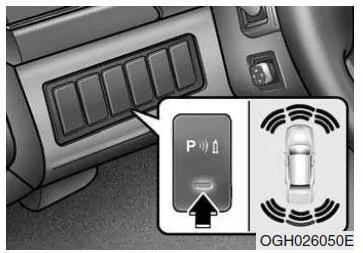
Parking Assist supports the driver when parking while the vehicle is moving. The system gives a warning tone if it detects an obstacle in front of or behind the vehicle within a distance of 100 cm.
Parking Assist is only a supplementary system. It is not intended to, and therefore in no way releases the driver from the responsibility to exercise special care and attention.
The area covered by the sensors and the objects detectable by the sensors are limited. Therefore, when driving, always pay as much attention to what is in front of and behind you as you would when driving a vehicle without Parking Assist.
WARNINGThe Parking Assist system must be regarded only as a supplementary function. The driver must look forward and backward and check that the areas are clear.
The operation of Parking Assist can be impaired by many factors and environmental conditions, so responsibility always rests with the driver.
Using Parking Assist
Operating conditions
- The system is activated when the front and rear warning function button is pressed with the engine running.
- The detection range when reversing is approx. 100 cm if you drive slower than 15 km/h.
- The detection range when driving forward is approx. 60 cm if you drive slower than 10 km/h.
- If more than two obstacles are detected at the same time, the warning signal refers to the nearest obstacle.
NOTE
If the distance to an obstacle is already less than 25 cm when the system is switched on, the system may no longer respond.
Types of warning chimes
- When an obstacle is approx. 61 to 100 cm behind the rear bumper: the warning tone sounds at intervals
- When an obstacle is approx. 31 to 60 cm in front of the front bumper: 2 warning tones are given at intervals
- When an obstacle is within a range of up to 30 cm in front of the front bumper or behind the rear bumper: a continuous warning tone sounds. The warning tone is reduced if the distance to the obstacle remains unchanged for longer than 3 seconds.
Conditions under which Parking Assist does not operate
The function of Parking Assist may be restricted if:
1. There is hoarfrost on the sensors (Parking Assist will operate normally again once the hoarfrost has melted).
2. The sensors are obstructed or blocked, e.g. by dirt (Parking Assist will operate normally again once the obstruction or blockage has been removed from the sensors).
3. The sensors are covered, e.g. by ice, snow or foreign objects (Parking Assist will operate normally again once the sensors are clear).
A Parking Assist malfunction may be present if:
1. Driving on uneven and unpaved road surfaces such as gravel or crushed-stone tracks, over loose rocks, and on steep vehicle inclines.
2. Objects cause excessive noise, such as vehicle horns, loud engine noise or truck compressed-air brakes.
3. Heavy rain and spray water.
4. Transmitters or mobile phones operated near the sensors.
5. The sensors are covered with snow.
The detection range may be reduced under the following circumstances
1. The outside temperatures are extremely hot or cold.
2. Objects are smaller than 1 m or narrower than 14 cm.
The following obstacles may not be detected by the sensors
1. Pointed or thin objects, such as ropes, chains or narrow posts.
2. Objects that can absorb the transmitted sensor frequency, such as clothing, spongy material or snow.
NOTE
1. Depending on the speed and the shapes of the detected objects, the warning tone intervals may not be output as described above.
2. The parking assist system may not work properly if the height of the bumper or the mounting of the sensors has been changed. Any non-standard attachments or accessories may impair sensor performance.
3. The sensors may fail to detect objects or may show an incorrect distance if objects are less than 30 cm (12 in.) from the sensors.
Drive carefully.
4. If the sensors are iced over or covered with snow or water, they may not function until they are cleaned with a soft cloth.
5. Do not press, scratch, or strike the sensor surfaces with hard objects, as this may damage the sensors.
The sensors could be damaged.
NOTE
This system can only detect objects within the detection area and detection range of the sensors. It cannot detect objects in other areas where no sensors are installed. The system also cannot detect pointed or thin obstacles, or objects located between the sensors. When reversing, always check for yourself that the area behind and in front of your vehicle is clear.
Make sure that other drivers of your vehicle, who are not familiar with its operation, are informed about the capabilities and limitations of the parking assist system.
Your new vehicle warranty does not cover accidents or damage to your vehicle, or personal injury caused by the performance limitations of the parking assist system described here.
Always drive carefully.
WARNINGUse extreme caution when driving the vehicle close to objects on the road, pedestrians, and especially children.
Keep in mind that the sensors may not detect some objects due to their distance, size, or material.
The detection capability of the sensors is limited in the cases described above. Always check visually that there are no obstacles behind the vehicle before reversing.
The parking assist system of the Kia Opirus 2003–2011 makes parking and pulling out easier by warning the driver audibly of obstacles. The sensors monitor the area in front of and behind the vehicle, contributing to safety.
However, the driver remains responsible for a careful visual check, as the parking assist system serves only as a supporting function. In this way, the Kia Opirus is also a reliable companion when parking.
The clear structure of the warning signals and the precise operation of the sensors significantly increase comfort and safety in everyday driving.
Test yourself
A quick Kia Opirus quiz: every answer comes with an explanation and a link to the manual page.