Brake system. Brake system with brake booster. In the event of brake failure. Brake pad wear indicator. Electrically adjustable pedals*
The brake system in the Kia Opirus (2003–2012) combines efficient hydraulics with a brake booster that allows braking even when the engine is off. In an emergency, the parking brake can be used to decelerate safely. The brake pad wear indicator, which alerts you early to the need for maintenance, is particularly noteworthy. Together with electrically adjustable pedals, it offers not only comfort but also a high level of safety.
Brake system with brake booster
Your vehicle's brake system has a brake booster and is adjusted automatically during normal use.
In cases where brake booster assistance is not available, such as when the engine is off or in other situations, you can still use the brakes, but you must press the brake pedal harder. The braking distance may, however, be longer.
When the engine is off, the stored brake booster assistance is reduced with each press of the brake pedal. For this reason, do not press the brake pedal repeatedly without need. Only pump the brake pedal several times in succession if it is necessary for driving safety.
In the event of brake failure
If the foot brake fails while driving, you can make an emergency stop using the parking brake. However, the braking distance will be considerably longer than with normal braking using the foot brake.
CAUTION - Parking brakeApplying the parking brake at normal driving speed can cause sudden loss of control of the vehicle. If you must use the parking brake while driving to bring the vehicle to a stop, be especially careful.
CAUTION - Brakes- Do not rest your foot on the brake pedal while driving. This causes the brakes to overheat and wear excessively, and lengthens the braking distance.
- When driving downhill for a longer period, shift to a lower gear and avoid continuous braking. If the brakes are applied continuously over a longer period, they will overheat, which may result in a temporary loss of braking performance.
- Wet brakes can lengthen the braking distance and cause the vehicle to pull to one side when braking. A light test brake application will show you whether the brake system has become wet. Always test your brakes in this way after driving through deep water. To dry the brake system, under safe driving conditions, lightly press the brake pedal until normal braking performance is restored.
Brake pad wear indicator
Your vehicle is equipped with disc brakes.
When brake pad wear has progressed to the point where the brake pads should be replaced, you will hear a high-pitched squealing noise from the front or rear wheels. This noise may be audible intermittently, or only when the brake pedal is pressed.
Under certain driving or climatic conditions, a squealing brake noise may be heard after the vehicle has been standing, when braking lightly, or when braking for the first time. This is a normal occurrence and does not indicate a problem with the brake system.
NOTE
Do not drive with worn brake pads, as this can cause costly repairs. With worn brake pads you endanger yourself and other road users.
CAUTION - Brake wearThe noise from the wear indicator means that your vehicle needs maintenance. If you ignore the noise, braking performance may deteriorate, which could result in an accident.
CAUTIONAlways have the brake pads on the front or rear axle replaced as a set.
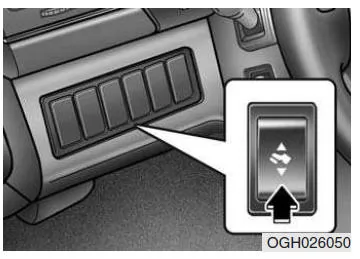
Electrically adjustable pedals*
To adjust the accelerator and brake pedals, with the selector lever in "P", switch the ignition on (ignition position "ON") and operate the switch.
Press the "▲" side of the switch to move the pedals toward the driver.
Press the "▼" side of the switch to move the pedals away from the driver.
Adjusting to the driver
1. Make sure the parking brake is applied.
2. Move the pedals fully forward by pressing the "▼" side of the switch.
3. Adjust the seat and steering wheel height correctly.
4. Move the pedals toward you by pressing the "▲" side of the switch until you can fully depress the brake pedal.
5. Press the pedals several times so you get a feel for the new setting.
WARNING- Adjust the pedals only when the vehicle is stationary and on level ground. Never adjust the pedals while driving.
- Never adjust the pedals while your foot is on the accelerator pedal. This could depress the accelerator, raise the engine speed and accelerate the vehicle accordingly.
- Before driving off, make sure you can fully depress the brake pedal. Otherwise you may not be able to press the brake pedal hard enough for an emergency stop.

The brake system of the Kia Opirus 2003–2011 offers modern technology and high safety standards. The brake booster makes braking easier, while the brake pad wear indicator alerts you in time when the brake pads need replacing.
Thanks to its well-designed systems and warnings, the Kia Opirus remains easy to control and safe, even in difficult situations. The vehicle meets the highest requirements for reliability and safety.
The electrically adjustable pedals add to the comfort and allow individual adjustment for an optimal driving position.
Test yourself
A quick Kia Opirus quiz: every answer comes with an explanation and a link to the manual page.