Automatic transmission
The automatic transmission in the Kia Opirus offers not only convenient shifting but also a dynamic driving experience in Sport mode. From the Park position to manual gear changes, the transmission provides a range of options for individual driving needs. This section explains in detail how to shift safely between driving positions, what to observe when starting on inclines, and how to override the shift lock in an emergency. Ideal for anyone who wants to combine technology and safety.
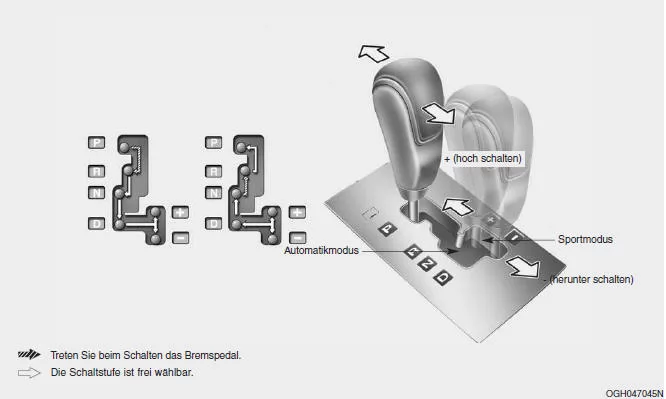
Operating the Automatic Transmission
For normal forward driving, move the selector lever to the D (Drive) position.
To move the selector lever out of the P (Park) position, depress the brake pedal and press the selector lever lock release button.
To move the selector lever easily from the N (Neutral) position into a forward or reverse gear, depress the brake pedal while shifting.
CAUTION - Automatic Transmission- Before leaving the vehicle, make sure the selector lever is in the P (Park) position. Then apply the parking brake and turn off the engine. If these precautions are not followed, the vehicle may suddenly and unexpectedly move.
NOTE
- To avoid damage to the transmission, do not accelerate the engine with the brake applied in R (Reverse) or in any forward gear.
- Do not hold the vehicle in place on an incline by applying the accelerator. Instead, apply the brake pedal or the parking brake.
- Do not shift the selector lever from N (Neutral) or P (Park) to D (Drive) while the engine is running above idle speed.
Shift Positions
P (Park position)
Only shift into P (Park) once the vehicle has come to a complete stop. In this position, the transmission is locked and the front wheels are blocked.
NOTE
Shifting the selector lever to P (Park) while driving can damage the automatic transmission.
Always shift into P (Park) only after the vehicle has come to a stop.
WARNING- Shifting the selector lever to P (Park) while driving locks the drive wheels. This will cause you to lose control of the vehicle.
- Do not use the P (Park) position in place of the parking brake. Always make sure the selector lever is engaged in P (Park) so that it can only be moved after pressing the lock button, AND apply the parking brake.
- Before leaving the driver's seat, always make sure the selector lever is in the P (Park) position. Firmly apply the parking brake, turn off the engine and take the ignition key with you. If these precautions are not followed, the vehicle may suddenly and unexpectedly move.
- Never leave children unattended in the vehicle.
R (Reverse)
Select this position to drive in reverse.
WARNINGAlways depress the brake pedal when stopping the vehicle on a downhill slope with the selector lever in D (Drive). Do NOT rely on the engine and transmission to prevent the vehicle from rolling downhill.
Before attempting to reverse on an incline, always depress the brake pedal before shifting the selector lever to R (Reverse).
CAUTIONAlways shift into or out of R (Reverse) only after the vehicle has come to a complete stop. Shifting into R while the vehicle is moving can damage the transmission, except as described in "Freeing a Stuck Vehicle" in this manual.
N (Neutral)
The drive wheels and transmission are not locked. The vehicle will keep rolling until the parking brake or brake pedal is applied.
D (Drive)
This is the normal driving position for forward travel. The automatic transmission automatically selects the appropriate one of five gears for the best fuel economy and the required performance.
When more power is required for passing or driving uphill, depress the accelerator pedal fully. The transmission then automatically downshifts to the next lower gear.
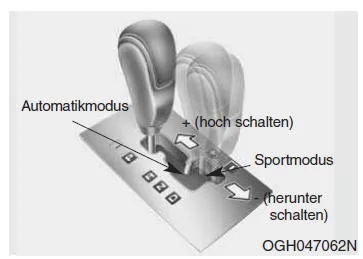
Sport Mode
You can select Sport Mode both when the vehicle is stationary and while driving. To do so, move the selector lever from D into the manual shift gate on the right. To return to D, move the selector lever back into the automatic shift gate on the left.
In Sport Mode, you can upshift or downshift quickly by pushing the selector lever forward or pulling it back. Unlike a manual transmission, gear changes can be made here with the accelerator pedal depressed.
Upshift (+): Push the selector lever forward once to shift to the next higher gear.
Downshift (-): Pull the selector lever back once to shift to the next lower gear.
NOTE
- In Sport Mode, upshifting does not occur automatically. The driver must upshift manually, taking traffic conditions into account. Make sure the engine speed stays below the range marked in red on the tachometer.
- In Sport Mode, only the five forward gears can be selected. To shift into R (Reverse) or P (Park), first move the selector lever into the left shift gate, then into the desired position.
- In Sport Mode, downshifting occurs automatically as vehicle speed decreases. When the vehicle comes to a stop, the transmission automatically shifts into first gear.
- In Sport Mode, when the engine speed approaches a set maximum speed, the transmission automatically shifts to the next higher gear.
- To protect the vehicle and for safety reasons, the control system may not carry out certain manual shifts.
- When starting off on slippery or icy surfaces, push the selector lever forward once (+ upshift). The transmission shifts into second gear, which is better suited for starting off on slippery surfaces. If necessary, pull the selector lever back once (- downshift) to return to first gear.
Starting on Steep Inclines
Before starting on a steep incline, apply the parking brake, depress the brake pedal, and move the selector lever to D. Then select a gear suitable for the vehicle weight and the gradient, and release the parking brake.
Depress the accelerator pedal moderately and release the brake pedal.
When starting on a steep incline, the vehicle may tend to roll backward.
If the selector lever is moved to 2 (second gear) in Sport Mode, the vehicle is prevented from rolling backward.
Ignition Key Lock Interlock*
The ignition key cannot be removed unless the selector lever is in P (Park). The ignition key can only be removed in the LOCK ignition position.
Shift Lock
For safety reasons, the automatic transmission is equipped with a shift lock. This safety device prevents the selector lever from being moved out of P (Park) unless the brake pedal is depressed at the same time.
To shift out of P (Park):
- Version A
1. Depress the brake pedal and keep it depressed.
2. Move the selector lever.
- Version B (if equipped with ignition key lock interlock)
1. Depress the brake pedal and keep it depressed.
2. Start the engine or turn the ignition key to the ON position.
3. Move the selector lever.
If the brake pedal is depressed repeatedly while the selector lever is in P (Park), a rattling noise may be heard near the selector lever. This is normal.
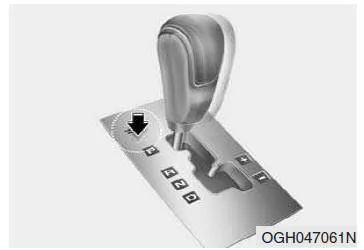
Overriding the Shift Lock
If the selector lever cannot be moved out of P (Park), proceed as follows:
1. Press the release button and move the selector lever.
2. Have your vehicle inspected immediately by an authorized KIA dealer.
The automatic transmission of the Kia Opirus 2003–2011 offers the driver maximum comfort and easy operation in everyday driving. The Sport mode lets you adapt the driving characteristics to individual needs, making the driving experience especially flexible.
Safety features such as the shift lever lock and the ignition key interlock switch play a key role in protecting the vehicle from unintended movement. This makes the Kia Opirus a reliable companion on the road.
FAQWhy must the selector lever not be shifted to P (Park) while driving?
Because this locks the drive wheels, and you may lose control of the vehicle.
What is the advantage of Sport mode in the Kia Opirus 2003–2011?
It allows the driver to select gears manually for sportier driving and better adaptation to driving conditions.
Test yourself
A quick Kia Opirus quiz: every answer comes with an explanation and a link to the manual page.