Brake System. Parking Brake. Parking on Roads with Curbs. ABS Braking System
In the Kia Opirus, the mechanical parking brake keeps the vehicle stable when parked, whether on a slope or on level ground. Applying and releasing the brake correctly prevents unnecessary wear and ensures a secure hold. This section also provides important information on parking next to curbs and on the ABS system. The ABS system supports braking performance in emergency maneuvers, but it must not be regarded as a substitute for anticipatory driving.
Parking brake
To apply the parking brake, keep the foot brake pedal depressed and at the same time press the parking brake pedal firmly down.
CAUTIONIf the parking brake is not released while driving, the brake pads and brake discs will wear excessively.
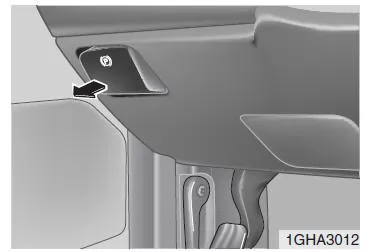
Releasing the Parking Brake
To release the parking brake, keep the foot brake pedal depressed and at the same time pull the parking brake release button. The parking brake pedal then returns automatically to its fully released position. If the parking brake cannot be released or the pedal does not return fully to its original position, have the parking brake checked by an authorized KIA dealer.
CAUTION - Parking brake- To ensure that a stopped or parked vehicle does not move unintentionally, do not place the gear selector lever in a drive position as a substitute for the parking brake. Apply the parking brake AND make sure the gear selector lever is firmly engaged in P (Park).
- Do not allow anyone unfamiliar with operating your vehicle, or children, to touch the parking brake release button. If a person pulls the release button, the parking brake will be released. Depending on the parking position, this could cause an accident.
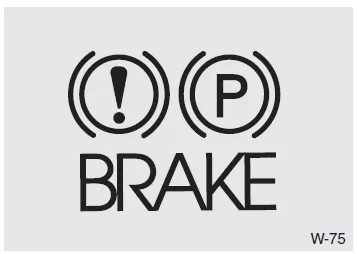
Check the brake warning light by switching the ignition ON (do not start the engine).
The light illuminates when the ignition key is turned to the ON position (or to START when starting the engine) with the parking brake applied.
Before driving off, make sure the parking brake is fully released and the brake warning light is off.
If the brake warning light does not go out after releasing the parking brake, there may be a fault in the brake system. In this case, have your vehicle inspected immediately.
If possible, do not drive the vehicle further in this case. If this is not possible, drive with extreme caution and only as far as necessary to reach a safe parking place or a workshop.
Parking on Roads with Curbs
- When parking on an uphill slope, park as close as possible to the curb and turn the wheels toward the road center, so that the front wheel rolls against the curb if the vehicle moves backward.
- When parking on a downhill slope, park as close as possible to the curb and turn the wheels toward the curb, so that the front wheel rolls against the curb if the vehicle moves forward.
ABS Braking System
CAUTION - Braking with ABSThe ABS system is not a substitute for responsible driving. Accidents can still occur despite ABS. For example, under the following driving conditions an ABS system cannot prevent accidents:
- Irresponsible driving, disregarding safety warnings, driving too fast or driving without a sufficient safety distance.
- Driving at excessive speeds in situations where insufficient traction is available, e.g. on wet roads with a risk of aquaplaning.
- Driving too fast on unsuitable road surfaces.
The ABS system is designed to achieve the most effective braking performance on typical road or motorway surfaces in good condition. On unsuitable surfaces and roads that are not in good condition, the ABS system may reduce effective braking performance.
The ABS system continuously monitors the wheel speeds. Just before the wheels lock during braking, the ABS system regulates the brake pressure of the affected wheels by alternately reducing and increasing the hydraulic brake pressure.
If you apply the brake pedal under conditions that could cause the wheels to lock, you may hear a ticking working noise from the brakes or feel a pulsing of the brake pedal.
This is normal operation and confirms that the ABS system is active.
To get the maximum benefit from the ABS system in an emergency, do not try to regulate the brake pressure yourself by pumping the brake pedal. Press the brake pedal as firmly as possible (or as the situation requires) and let the ABS system automatically regulate the hydraulic brake pressure at each wheel.
- Even if your vehicle is equipped with an ABS system, the vehicle still needs an adequate braking distance to come to a stop. Therefore, always maintain a sufficient safety distance from vehicles ahead of you.
- Reduce your speed when traffic conditions require it. The ABS system cannot prevent accidents resulting from excessive speed.
- On unpaved and uneven surfaces, using the ABS system may lengthen the braking distance compared with a vehicle without ABS.
NOTE
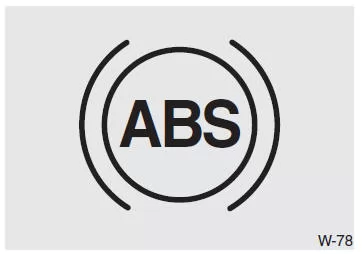
- If the ABS warning light comes on and stays on, there may be a malfunction in the ABS system. In the event of an ABS malfunction, however, the conventional brake system without ABS control is still available.
- After switching on the ignition (ignition switch position ON), the ABS warning light comes on for approx. 3 seconds. During this time, the ABS system performs a self-diagnosis, and if there is no malfunction, the warning light goes out afterwards. If the warning light does not go out after approx. 3 seconds, there may be a malfunction in the ABS system. In this case, have your vehicle checked by an authorized KIA dealer as soon as possible.
NOTE
- If you keep the brake pedal pressed for a long time when driving on a surface that offers no traction, e.g. black ice, the ABS system may stay permanently activated and the warning light may stay on permanently. In this case, bring your vehicle to a stop in a safe place and switch off the engine.
- Then restart the engine. If the ABS warning light goes out, the ABS system is functioning properly. If the light does not go out, there may be a malfunction in the ABS system. In this case, have your vehicle checked by an authorized KIA dealer as soon as possible.
NOTE
If your vehicle has to be started with jumper cables because of a discharged battery, the engine may run less smoothly than usual and the ABS warning light may come on at the same time. This is a result of the low battery voltage and does not indicate a malfunction in the ABS system.
- Do not pump the brake pedal!
- Have the battery charged before driving.
The parking brake of the Kia Opirus 2003–2011 is designed to reliably secure the vehicle, including on slopes. Together with the clear parking recommendations, parking the vehicle becomes safer and more convenient.
The ABS system assists the driver when braking by preventing the wheels from locking, which makes it easier to keep control of the vehicle, even in critical situations.
FAQHow can the function of the brake warning light on the Kia Opirus 2003–2011 be checked?
By switching on the ignition with the parking brake applied – the light should come on.
Why should the parking brake be fully released before driving off?
To avoid excessive wear of brake pads and brake discs.
Test yourself
A quick Kia Opirus quiz: every answer comes with an explanation and a link to the manual page.