Air Conditioning
General Safety Information and Precautions
Precautions (R-134a)
When Handling Refrigerant
Liquid refrigerant R-134a evaporates very easily. A drop on your skin may cause local frostbite. Always wear gloves when working with refrigerant.
It is standard practice to wear safety glasses or goggles to protect the eyes and gloves to protect the hands. If refrigerant gets into the eyes, flush them immediately with clean water.
The R-134a container is under high pressure. Never leave it in a hot place, and make sure the storage temperature is below 52 °C.
Use an electronic leak detector to check the system for refrigerant leaks. Note that R-134a produces phosgene, a very toxic gas, when it contacts an open flame.
Use only the lubricant recommended for R-134a systems. If lubricants other than the recommended type are used, system failure may occur.
PAG lubricant absorbs moisture from the atmosphere very quickly, so the following precautions must be observed:
When removing refrigerant components from the vehicle, cap the components immediately to prevent moisture from entering.
When installing refrigerant components on the vehicle, do not remove the cap until immediately before connecting the components.
Complete the connection of all refrigerant lines and hoses without delay to prevent moisture from entering the air conditioning system.
Use only recommended lubricant taken from a sealed container.
In the event of an accidental discharge into the system, ventilate the work area before resuming service.
When replacing parts in the air conditioning system
Never open or loosen a connection until the system has been discharged.
Immediately cap or plug open component fittings to prevent moisture or dirt from entering.
Do not remove the sealing caps from a replacement component until it is ready for installation.
Always install a new O-ring before connecting an open fitting. Lubricate and seal the fitting with refrigerant oil before connecting.
When installing, connect parts
Flange with Guide Pin
Check the new O-ring for damage (use only the specified part) and lubricate it with compressor oil. Tighten the nut to the specified torque.

Handling of Tubes and Fittings
The internal parts of the refrigeration system will remain chemically stable as long as clean refrigerant free of moisture and refrigerant oil are used. Abnormal amounts of dirt, moisture or air can disturb chemical stability and cause malfunctions or serious damage.
The following precautions must be observed
When the refrigerant system must be opened, prepare all the parts needed to service the system in advance so that the system is not left open longer than necessary.
Close or plug all lines and fittings as soon as they are opened to prevent dirt and moisture from entering.
All lines and components in parts storage must remain capped or sealed until they are ready for use.
Never attempt to bend formed lines to make them fit. Use the correct line for the system you are servicing.
All tools, including the refrigerant dispensing manifold, manifold gauge set and charging hoses, must be kept clean and dry.
Precautions (R-1234yf)
When Handling Refrigerant
Liquid R-1234yf refrigerant evaporates very quickly. A drop on your skin may cause localized frostbite. Always wear gloves when handling refrigerant.
It is standard practice to wear safety glasses or goggles to protect the eyes and gloves to protect the hands. If refrigerant gets into the eyes, flush them immediately with clean water.
The R-1234yf container is under high pressure. Never leave it in a hot place, and make sure the storage temperature is below 52 °C.
Use an electronic leak detector to check the system for refrigerant leaks. Be aware that R-1234yf produces phosgene, a highly toxic gas, when exposed to flame.
Use only the lubricant recommended for R-1234yf systems. If lubricants other than the recommended type are used, system failure may occur.
PAG lubricant absorbs moisture from the atmosphere very quickly, so the following precautions must be observed:
When removing refrigerant components from the vehicle, cap the components immediately to prevent moisture from entering.
When installing refrigerant components on the vehicle, do not remove the cap until immediately before connecting the components.
Complete the connection of all refrigerant lines and hoses without delay to prevent moisture from entering the air conditioning system.
Use only recommended lubricant taken from a sealed container.
In the event of an accidental discharge into the system, ventilate the work area before resuming service.
Remove all dirt, grease, and debris from and around refrigerant connections before servicing and disconnecting refrigerant connections.
When replacing parts in the air conditioning system
Never open or loosen a connection until the system has been discharged.
Immediately cap or plug open component fittings to prevent moisture or dirt from entering.
Do not remove the sealing caps from a replacement component until it is ready for installation.
Always install a new O-ring before connecting an open fitting. Lubricate and seal the fitting with refrigerant oil before connecting.
The evaporator core (cooling coil) is never repairable. Either replace it with a new one or with one removed from a used or salvaged vehicle; any new or replacement A/C evaporator must be certified (and marked) as conforming to SAE Standard J2842.
If all vehicles are serviced and identified as having a leaking evaporator, the leak must not be repaired. Service the system only by replacing the leaking evaporator with a new evaporator conforming to SAE J2842. An evaporator from a salvaged vehicle air conditioning system must not be repaired or removed from any vehicle air conditioning system with the intention of reusing it in the same or another vehicle. However, if the evaporator assembly includes a refrigerant control device (TXV / shut-off valve) and is in working condition, reuse of the refrigerant control device is permitted.
When installing, connect parts
Flange with Guide Pin
Check the new O-ring for damage (use only the specified part) and lubricate it with compressor oil. Tighten the nut to the specified torque.
Handling of Tubes and Fittings
The internal parts of the refrigeration system will remain chemically stable as long as clean refrigerant free of moisture and refrigerant oil are used. Abnormal amounts of dirt, moisture or air can disturb chemical stability and cause malfunctions or serious damage.
The following precautions must be observed
When the refrigerant system must be opened, prepare all the parts needed to service the system in advance so that the system is not left open longer than necessary.
Close or plug all lines and fittings as soon as they are opened to prevent dirt and moisture from entering.
All lines and components in parts storage must remain capped or sealed until they are ready for use.
Never attempt to bend formed lines to make them fit. Use the correct line for the system you are servicing.
All tools, including the refrigerant dispensing manifold, manifold gauge set and charging hoses, must be kept clean and dry.
Carefully inspect refrigerant connections, connection seals, and sealing surfaces for signs of wear, deformation, contamination, or damage after disassembly. Before disassembly, check the mating surfaces for refrigerant oil. This may indicate a leak.
Never reuse O-rings or seals. Always replace them with new parts.
Ensure that pipes and hoses are properly aligned, and tighten them so that there is no misalignment or stress in the fitting connection.
Description and Operation
Refrigeration Cycle

Repair Procedures
Refrigerant System Service Basics (R-134a)
Refrigerant Recovery
Use only service equipment that is UL listed and certified to meet the requirements of SAE J2210 to remove HFC-134a (R-134a) from the air conditioning system.
In case of accidental discharge of the system, ventilate the work area before resuming work.
Additional health and safety information may be obtained from refrigerant and lubricant manufacturers.
Connect R-134a Refrigerant Recovery/Recycling/Charging Station
Recovery/recycling/recharging system to the high-pressure service port (B) and low-pressure service port (A) as shown, in accordance with the equipment manufacturer's instructions.
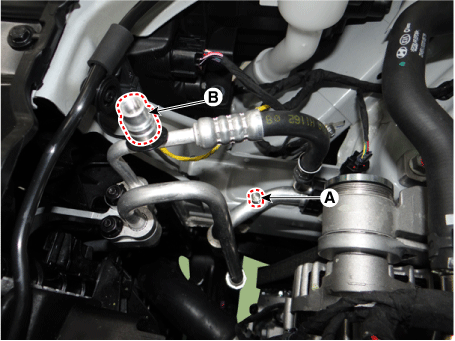
Measure the amount of refrigerant oil removed from the air conditioning system after the recovery process is complete. Be sure to add the same amount of new refrigerant oil back into the air conditioning system before charging.
System Evacuation
Use only service equipment that is UL listed and certified to meet the requirements of SAE J2210 to remove HFC-134a (R-134a) from the air conditioning system.
In case of accidental discharge of the system, ventilate the work area before resuming work.
Additional health and safety information may be obtained from refrigerant and lubricant manufacturers.
When the air conditioning system has been opened to the atmosphere, for example during installation or repair, it must be evacuated using the R-134a recovery/recycling/charging station. (If the system has been open for several days, the receiver/drier must be replaced and the system evacuated for several hours.)
Connect R-134a Refrigerant Recovery/Recycling/Charging Station
Connect the recovery/recycling/charging station to the high-pressure service port and the low-pressure service port as shown, following the equipment manufacturer's instructions.
If the low pressure does not reach 93.3 kPa (700 mmHg, 27.6 inHg) after 10 minutes, there is probably a leak in the system. Partially charge the system and check it for leaks (refer to Refrigerant Leak Test).
Remove the low-pressure valve from the low-pressure service port.
System Charging
Use only service equipment that is UL listed and certified to meet the requirements of SAE J2210 to remove HFC-134a (R-134a) from the air conditioning system.
In case of accidental discharge of the system, ventilate the work area before resuming work.
Additional health and safety information may be obtained from refrigerant and lubricant manufacturers.
Connect R-134a Refrigerant Recovery/Recycling/Charging Station
Connect the recovery/recycling/charging station to the high-pressure service port as shown, following the equipment manufacturer's instructions.
Add the same amount of new refrigerant oil to the system as was removed during recovery. Use only the specified refrigerant oil. Charge the system with 600 ± 25 g (21.2 ± 0.88 oz) of R-134a refrigerant. Do not overcharge the system, or the compressor will be damaged.
Refrigerant Leak Test
Always perform a leak test using an electronic leak detector whenever a refrigerant leak is suspected, and after service operations that involve disassembling or loosening or connecting fittings.
If a refrigerant leak is detected, perform the following steps:
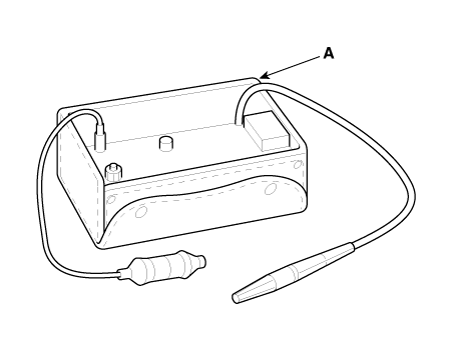
Check the torque at the connection fittings and, if it is too loose, tighten to the specified torque. Check for refrigerant leakage using a leak detector (A).
If the leak continues even after tightening the fitting, drain the refrigerant from the system, disconnect the fittings, and inspect their seating surfaces for damage. Always replace them, even if the damage is minor.
Check the compressor oil and add oil if necessary.
Charge the system and recheck for leaks. If no leaks are found, evacuate and recharge the system again.
Refrigerant System Service Basics (R-1234yf)
Refrigerant Identification
Do not mix HFO-1234yf (R-1234yf) in the vehicle with other refrigerants, such as R-12, R-134a, etc.
Use only service equipment that is UL listed and certified to meet SAE standards for recovery and recycling of R-1234yf from the air conditioning system. Do not use service equipment for other refrigerants, such as R-12, R-134a, etc.
Check which refrigerant is in the system if there is concern that the system has been tampered with in any way, and check the type and quantity of refrigerant that should be in the air conditioning system, and possible problems resulting from accidental or intentional mixing of refrigerants.
It is recommended to use a SAE certified refrigerant identifier to prevent incorrect recovery and, as a result, further spread of contaminated refrigerant, which can potentially damage other air conditioning systems and service equipment. Contaminated refrigerant (a mixture of more than one refrigerant or non-system refrigerant) in recovery/recycling equipment may lead to potential contamination of more refrigerant.
Some types of electronic leak detectors (heated diode or corona discharge), as well as motors, switches and controls on recovery and recycling machines, can produce sparks that may serve as ignition sources in the presence of refrigerants classified by ASHRAE as flammable (A2 or A3), Standard 34-2006.
Mixing refrigerants in the air conditioning system may result in higher than expected system pressure, damage to the system and components, diagnostic trouble codes, and/or other potential hazards to people and the environment.
In the event of mixing with another refrigerant, recover the contaminated refrigerant from the air conditioning system and dispose of it in accordance with all applicable national, regional or local regulations. Flush the interior of the air conditioning system with special flushing agent and charge with new refrigerant.
Refrigerant Recovery
Use only service equipment that is UL listed and certified to meet SAE standards for removal of HFO-1234yf (R-1234yf) from the air conditioning system.
In case of accidental discharge of the system, ventilate the work area before resuming work.
Additional health and safety information may be obtained from refrigerant and lubricant manufacturers.
Connect R-1234yf refrigerant
Recovery/recycling/recharging system to the high-pressure service port (B) and low-pressure service port (A) as shown, in accordance with the equipment manufacturer's instructions.
Measure the amount of refrigerant oil removed from the air conditioning system after the recovery process is complete. Be sure to add the same amount of new refrigerant oil back into the air conditioning system before charging.
System Evacuation
Use only service equipment that is UL listed and certified to meet SAE standards for removal of HFO-1234yf (R-1234yf) from the air conditioning system.
In case of accidental discharge of the system, ventilate the work area before resuming work.
Additional health and safety information may be obtained from refrigerant and lubricant manufacturers.
When the air conditioning system has been opened to the atmosphere, for example during installation or repair, it must be evacuated using R-1234yf refrigerant recovery/recycling/charging equipment. (If the system has been open for several days, the receiver/drier should be replaced and the system evacuated for several hours.)
Connect R-1234yf refrigerant
Connect the recovery/recycling/charging station to the high-pressure service port and the low-pressure service port as shown, following the equipment manufacturer's instructions.
If the low pressure does not exceed 87.7 kPa (658 mmHg, 25.9 inHg) after 5 minutes, there is probably a leak in the system. Partially charge the system and check for leaks (refer to "Refrigerant Leak Check").
Remove the low-pressure valve from the low-pressure service port.
System Charging
Use only service equipment that is UL listed and certified to meet SAE standards for removal of HFO-1234yf (R-1234yf) from the air conditioning system.
In case of accidental discharge of the system, ventilate the work area before resuming work.
Additional health and safety information may be obtained from refrigerant and lubricant manufacturers.
Connect R-1234yf refrigerant
Connect the recovery/recycling/charging station to the high-pressure service port as shown, following the equipment manufacturer's instructions.
Add the same amount of new refrigerant oil to the system as was removed during recovery. Use only the specified refrigerant oil. Charge the system with 520 ± 25 g (18.3 ± 0.88 oz) of R-1234yf refrigerant. Do not overcharge the system, or the compressor will be damaged.
Refrigerant Leak Test
Always perform a leak test using an electronic leak detector whenever a refrigerant leak is suspected, and after service operations that involve disassembling or loosening or connecting fittings.
If a refrigerant leak is detected, perform the following steps:
Check the torque at the connection fittings and, if it is too loose, tighten to the specified torque. Check for refrigerant leakage using a leak detector (A).
If the leak continues even after tightening the fitting, drain the refrigerant from the system, disconnect the fittings, and inspect their seating surfaces for damage. Always replace them, even if the damage is minor.
Check the compressor oil and add oil if necessary.
Charge the system and recheck for leaks. If no leaks are found, evacuate and recharge the system again.
Components and Component Location
Component Location Index
Engine Compartment
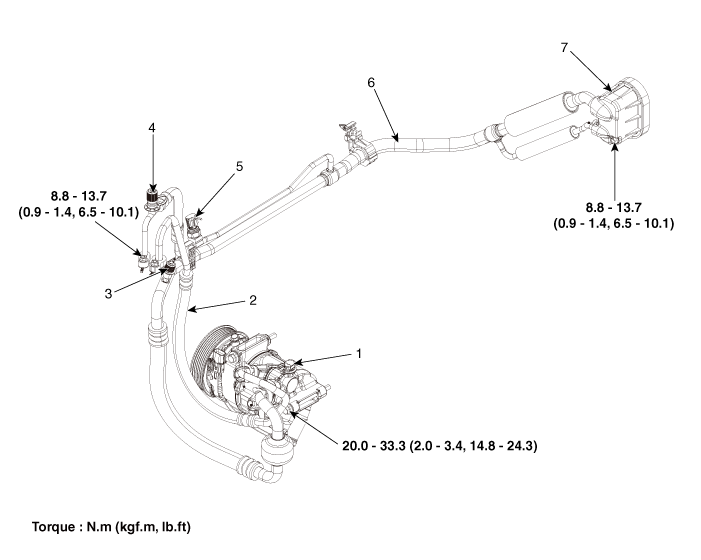
| 1. Compressor 2. Drain hose 3. Service port (low pressure) 4. Service port (high pressure) |
5. A/C pressure transducer (APT) 6. Suction and liquid line assembly 7. Expansion valve |
[Interior]
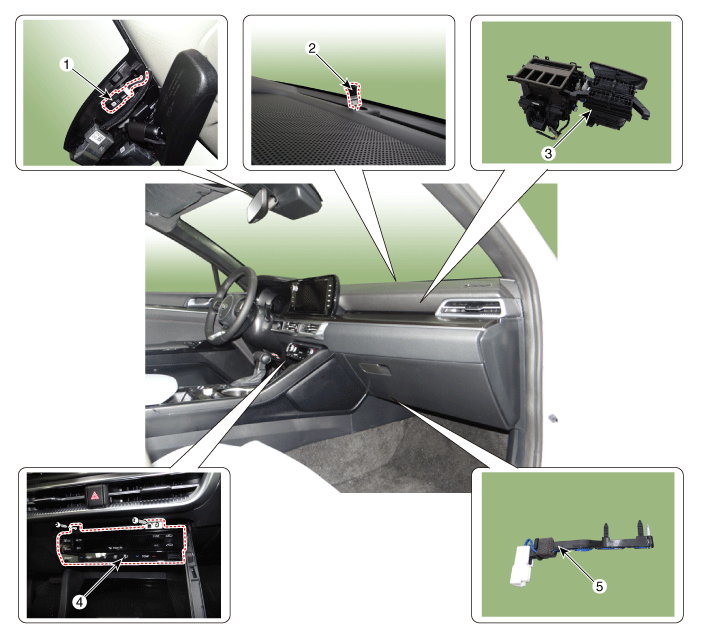
| 1. Automatic defog sensor 2. Photo sensor 3. Heater and blower |
4. Heater and A/C control unit 5. Evaporator temperature sensor |
Test yourself
A quick Kia Optima DL3 quiz: every answer comes with an explanation and a link to the manual page.