Vehicle Load Limit
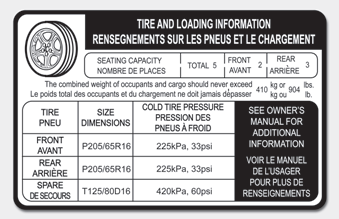
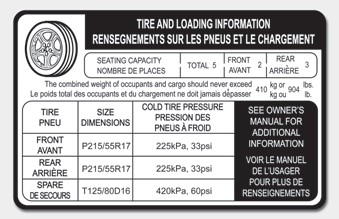
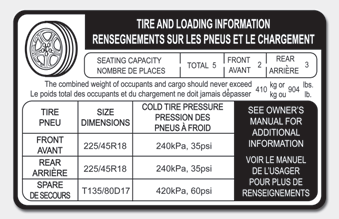
Tire and Loading Information Label
The label affixed to the driver's door pillar provides the original tire size, the recommended cold tire pressure for your vehicle, the seating capacity, and the maximum vehicle weight.
Vehicle Load Capacity: 410 kg (904 lb)
The vehicle load capacity is the maximum combined weight of passengers and cargo.
Seating Capacity: Total: 5 persons (Front seat: 2 persons, Rear seats: 3 persons)
The maximum seating capacity includes the driver.
However, the seating capacity may be reduced depending on the weight of the occupants and the cargo carried.
Do not overload the vehicle, as there is a maximum total weight or load limit, including passengers and cargo, that the vehicle can carry.
Towing Capacity: It is not recommended to use this vehicle to tow a trailer.
Load Capacity: The load capacity increases or decreases depending on the weight and number of occupants and the load on the hitch if the vehicle is equipped with a trailer.
How to Determine the Exact Load Limit
- Note the information "The combined weight of occupants and cargo should never exceed XXX kg or XXX lb." on the vehicle label.
- Calculate the combined weight of the driver and passengers who will be in the vehicle.
- Subtract the combined weight of the driver and passengers from XXX kg or XXX lb.
- The resulting figure is the allowable cargo weight. For example, if XXX is 635 kg (1400 lb) and there are five passengers weighing 68 kg (150 lb) each in the vehicle, the allowable cargo weight would be 295 kg (650 lb).
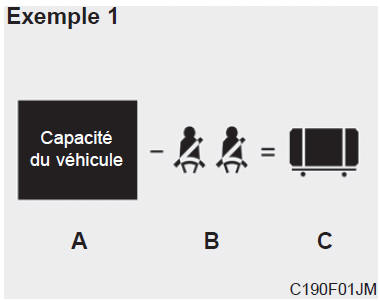
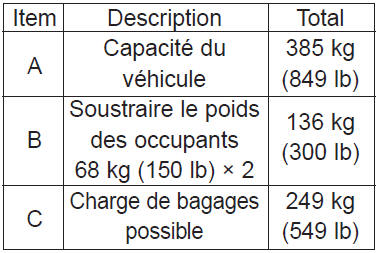
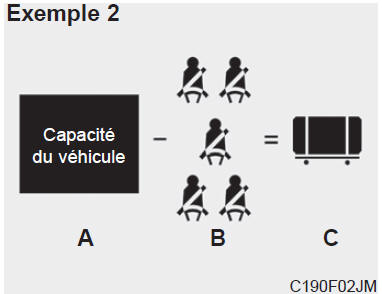
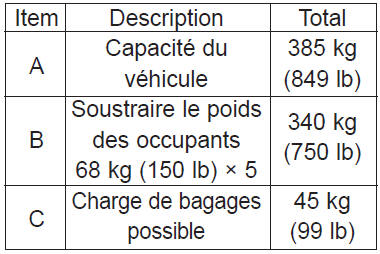
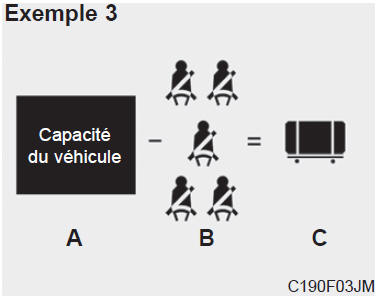
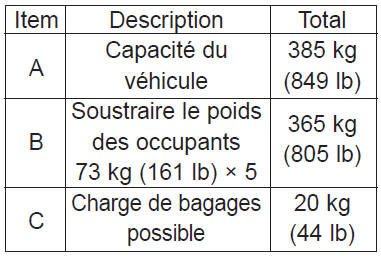
Refer to the tire and loading information label for specific information on the vehicle's capacity and seating positions. The combined weight of the driver, passengers and cargo must never exceed the capacity shown for your vehicle.
Certification Label
The certification label is located on the driver's door pillar, at the center pillar.
This label shows the maximum permissible weight of the fully loaded vehicle. This is called the Gross Vehicle Weight Rating (GVWR). The GVWR includes the weight of the vehicle, occupants, fuel and cargo.
This label also shows the maximum weight that can be supported by the front and rear axles, called the Gross Axle Weight Rating (GAWR).
To determine the actual loads on the front and rear axles, drive the vehicle to a public weigh station and have it weighed.
Your dealer can help you with this. Be sure to distribute the load evenly on both sides of the centerline.
WARNING - Overloading- Never exceed the GVWR listed for your vehicle, the GAWR for the front or rear axle, or the maximum vehicle capacity.
Exceeding these values may cause an accident or damage to the vehicle.
You can calculate the weight of cargo by weighing items (or people) before placing them in the vehicle. Make sure not to overload the vehicle.The label will help you calculate the load and installed equipment that your vehicle can carry.
If you carry items inside the vehicle (suitcases, tools, packages, etc.), they will move as fast as the vehicle does. If you have to stop or turn suddenly, or if you are in an accident, the items will keep moving and may injure someone in the vehicle.
WARNING- Overloading the vehicle may cause the tires to overheat and possibly result in a blowout, which could lead to an accident.
- Overloading the vehicle may increase the distance required to stop the vehicle, which may lead to an accident.
- An accident caused by poor handling, vehicle damage, a tire blowout or increased stopping distance can result in serious or even fatal injuries.
- Overloading the vehicle can cause damage. Such repairs are not covered by the warranty. Do not overload the vehicle.
- Using a firmer suspension for greater durability will not change the maximum permissible weights. Ask an authorized Kia dealer how to load the vehicle correctly.
Items you carry inside the vehicle can strike and injure occupants during sudden stops or sharp turns, or in an accident.
- Place items in the cargo area. Try to distribute the weight evenly.
- Never stack items such as suitcases inside the vehicle higher than the top of the seatbacks.
- Never leave a child restraint in the vehicle unsecured.
- If you carry items inside the vehicle, secure them.
- Do not drive with the seats folded down unless necessary.
Test yourself
A quick Kia Optima DL3 quiz: every answer comes with an explanation and a link to the manual page.