Manual transaxle
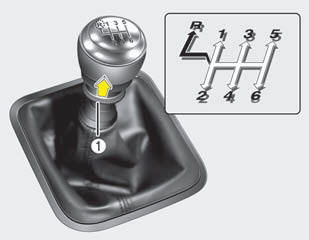
 The shift lever
can be moved without having to pull the ring (1).
 The ring (1) must be lifted
to move the shift lever.
Using the manual transaxle
The transaxle has 6 forward gears.
The shift pattern is printed on the shift knob. The transaxle is fully synchronized in all forward gears, providing very easy gear shifting.
If your vehicle is equipped with an ignition switch lock, the engine will not start unless you press the clutch pedal.
Depress the clutch pedal to shift gears, then release it quickly.
The shift lever must be returned to neutral before you can shift into reverse (R).
The ring (1) located directly below the shift knob must be lifted while moving the shift lever to the R position.
Make sure the vehicle is completely stopped before engaging reverse (R).
Never run the engine into the red zone of the tachometer (rpm).
CAUTION- When downshifting from fifth to fourth, be careful not to push the lever too far and engage second gear. Such an excessive downshift could run the engine into the red zone on the tachometer. Such engine overspeed could cause damage.
- Never downshift more than 2 gears, or downshift when the engine is running at high speed (5,000 rpm or more).
- In cold weather, shifting gears may be difficult until the transaxle oil has warmed up. This is normal and does not damage the transaxle.
- If the vehicle is completely stopped and it is difficult to engage first or reverse, place the lever in neutral (N) and release the clutch pedal. Depress the clutch pedal again, then engage first or reverse.
- To avoid premature wear or damage to the clutch, do not drive with your foot resting on the clutch pedal. Also, do not use the clutch to hold the vehicle stopped on a slope while waiting for a traffic light to change, etc.
- Do not use the shift lever as an armrest while driving, as this may cause premature wear of the transaxle's shift forks.
- Before leaving the vehicle, always apply the parking brake and turn off the engine. Then make sure to engage the transaxle in 1st gear if the vehicle is parked on level ground or facing uphill, or in reverse if it is facing downhill. If you do not perform these steps in the order indicated, the vehicle could move unexpectedly or suddenly.
Using the clutch pedal
The clutch pedal must be fully depressed before shifting gears, then released slowly. The pedal must be fully released when driving. Do not rest your foot on the clutch pedal while driving. This causes unnecessary wear. Do not partially engage the clutch to hold the vehicle on a slope. Do not operate the clutch pedal quickly and repeatedly.
Downshifting
When you need to slow down in traffic or when climbing a steep hill, downshift before the engine begins to labor.
Downshifting reduces the risk of stalling and provides better acceleration when you need to gain speed. When descending a steep hill, downshifting helps maintain a safe speed and extends brake life.
Good driving practices
- Never coast down a hill with the clutch disengaged. This is extremely dangerous.
Always keep the vehicle in gear with the clutch engaged.
To shift into reverse, depress the clutch pedal, move the shift lever to neutral, then move the lever to the reverse position.
Use special caution when braking, accelerating and shifting gears. On a slippery surface, any sudden change in vehicle speed may cause loss of traction and control. WARNING
- Always fasten your seat belt! In a collision, a passenger who is not wearing a seat belt is far more likely to be seriously injured or killed than a passenger who is wearing one.
- Avoid taking corners at high speed.
- Do not perform abrupt maneuvers such as quick lane changes or sharp, fast turns.
- The risk of a multi-vehicle collision increases greatly if you lose control of your vehicle at high speed on the highway.
- Loss of control often occurs when two or more wheels leave the paved surface and the driver reacts abruptly to return to the pavement.
- If your vehicle leaves the road, do not make a sudden steering correction. Instead, slow down before attempting to return to the normal driving lane.
- Never exceed the posted speed limit.
Test yourself
A quick Kia Optima DL3 quiz: every answer comes with an explanation and a link to the manual page.