Special driving conditions
Hazardous conditions
If you encounter hazardous road conditions such as water, snow, ice, mud, sand, or others, follow these suggestions:
- Drive carefully and allow a greater braking distance.
- Avoid sudden braking and sharp maneuvers.
- If your vehicle does not have ABS brakes, pump the brake pedal with short, light strokes until the vehicle stops.
Do not pump the brake pedal if the vehicle is equipped with ABS.
- If you become stuck in snow, mud, or sand, shift into second gear.
Downshifting an automatic transmission on a slippery road can cause an accident. A sudden change in wheel speed can cause a skid. Be careful when downshifting on slippery roads.
Rocking the vehicle
If you need to rock the vehicle to free it from snow, sand, or mud, turn the steering wheel left and right to clear the area around the front wheels. Then alternate between 1st and reverse in the case of a manual transmission, or between reverse and a forward gear in the case of an automatic transmission. Do not over-rev the engine or spin the wheels if possible. If you are still stuck after a few attempts, call a towing service to avoid overheating the engine and damaging the transmission.
CAUTIONProlonged rocking can overheat the engine, damage the transmission, and damage the tires.
WARNING - Tire spinDo not spin the tires, especially at speeds above 56 km/h.
Spinning the wheels at high speed while the vehicle is stationary can overheat a tire, which could then fail and injure people nearby.
NOTICE
The ESC system (if equipped) should be turned off if you are rocking the vehicle.
WARNINGIf the vehicle gets stuck in snow, mud, sand or other material, you may try rocking the vehicle forward and backward. Do not attempt this if people or objects are near the vehicle. While rocking, the vehicle may suddenly jump forward or backward as it frees itself, which could injure people or damage nearby objects.
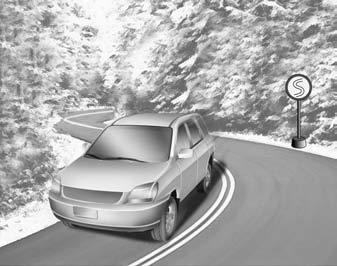
Take Corners Smoothly
Avoid braking or shifting gears in corners, especially on wet roads. Preferably, always take corners under smooth acceleration. If you follow these suggestions, tire wear will be kept to a minimum.
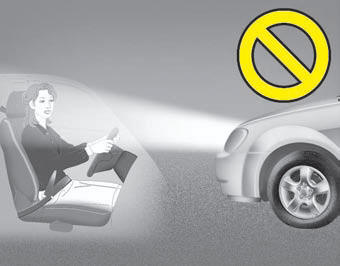
Night Driving
Driving at night presents more risks than driving during the day. Keep the following important points in mind:
- Slow down and keep a greater distance between you and other vehicles, because it is difficult to see well in the dark, especially where there is little lighting.
- Adjust the rear-view mirror to reduce glare from headlights.
- Keep the headlights clean and properly aimed on vehicles that are not equipped with an automatic headlight leveling device. Dirty or misaligned headlights reduce visibility at night.
- Avoid looking directly at the headlights of oncoming vehicles.
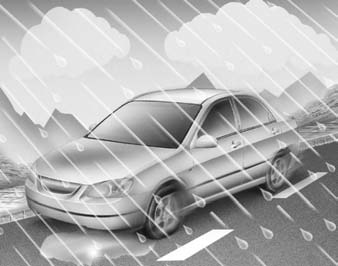
Driving in Rain
Rain and wet roads make driving dangerous, especially if you are not prepared for slippery pavement.
Consider the following points:
- A heavy downpour greatly reduces visibility and increases stopping distance: slow down.
- Keep the wiper blades in good condition.
Replace wiper blades that streak or do not wipe the entire windshield surface.
Make sure your tires are in good condition.
Driving Through Flooded Areas
Avoid driving through flooded areas unless you are certain the water level will not reach the bottom of the wheel hubs. Drive through water slowly. Maintain a sufficient stopping distance, as braking performance may be affected.
After driving through water, dry the brakes by lightly pressing the brake pedal several times while driving slowly.
Driving on the Highway
Tires
Adjust tire pressure to specification. Underinflated tires may overheat and cause problems.
Worn or damaged tires may offer reduced traction and cause problems.
NOTICE
Never inflate a tire above the maximum pressure marked on the tire.
WARNING- Underinflated or overinflated tires can affect handling, cause loss of control and fail, which could lead to an accident, injury or even death. Make sure your tires are properly inflated before driving. For the correct pressure, see "Tires and Wheels" in section 8.
- Driving on tires with worn tread can be dangerous. Worn tires can lead to loss of control, collisions, injury or even death. Worn tires should be replaced as soon as possible and should never be driven on. Always check the tread condition of your tires before driving. For more details and the tread wear limit, see "Tires and Wheels" in section 7.
Fuel, Engine Coolant, Engine Oil
Driving at cruising speed uses more fuel than driving in the city.
Remember to check the engine coolant and engine oil levels.
Drive Belt
A loose or damaged belt can cause the engine to overheat.
Test yourself
A quick Kia Optima DL3 quiz: every answer comes with an explanation and a link to the manual page.