Braking system
Brake Booster
Your vehicle is equipped with a brake booster that adjusts automatically during normal use.
If the brakes lose booster assistance because the engine has stalled or for any other reason, you can still stop the vehicle by pressing the brake pedal harder than normal. The stopping distance will also be longer.
When the engine is not running, the reserve braking power is reduced each time you press the brake pedal. Do not pump the brake pedal when the brake booster is not working.
Pump the brake pedal only to maintain steering control on a slippery surface.
WARNING - Brakes- Do not drive with your foot resting on the brake pedal. This will overheat the brakes, cause premature wear of the brake pads and increase the braking distance.
- When driving down a long or steep hill, downshift and avoid applying the brakes continuously. Continuous braking causes overheating, which could result in a temporary loss of braking force.
- If the brakes are wet, they may not stop the vehicle as well as usual or may pull to one side.
In the Event of Brake Failure
If the vehicle's brakes fail while the vehicle is moving, you can make an emergency stop by using the parking brake. However, the braking distance will be much longer than normal.
WARNING - Parking BrakeApplying the parking brake while the vehicle is moving at normal speed may cause a sudden loss of vehicle control. If you must use the parking brake to stop the vehicle, use extreme caution.
Disc Brake Wear Indicator
Your vehicle is equipped with disc brakes.
When the brake pads are worn and new pads are required, you will hear a high-pitched warning squeal from the front or rear brakes. This sound may be intermittent or may occur each time you press the brake pedal.
Note that certain climates or driving conditions may cause the brakes to squeal. This is normal and does not indicate a problem with the brakes.
CAUTION- To avoid costly brake repairs, do not continue driving with worn brake pads.
- Always replace brake pads as a complete set for the front or rear wheels.
The brake wear warning sound means your vehicle needs repair. If you ignore this warning sound, your brakes will eventually lose their effectiveness, which could lead to a serious accident.
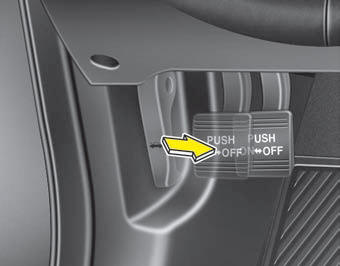
Parking brake
Applying the Parking Brake
Pedal
To apply the parking brake, first press the brake pedal, then press the parking brake pedal down as far as it will go.
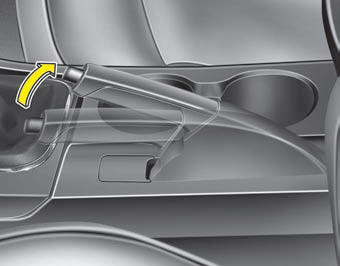
Hand Lever
To apply the parking brake, first press the brake pedal, then pull the parking brake lever up as far as it will go.
It is also recommended that, when parking the vehicle on a slope, you engage a low gear on a manual transmission, or P (Park) on an automatic transmission.
CAUTION- Driving with the parking brake applied will cause excessive wear of the brake pads and brake rotors.
- Do not apply the parking brake while the vehicle is moving, except in an emergency. You could damage the system and make driving dangerous.
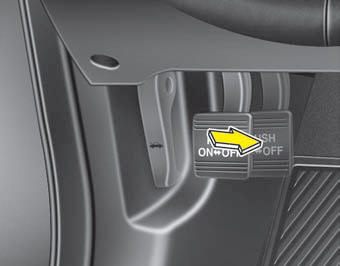
Releasing the Parking Brake
Pedal
To release the parking brake, press the parking brake pedal a second time while holding the foot brake.
The pedal will automatically return to the released position.
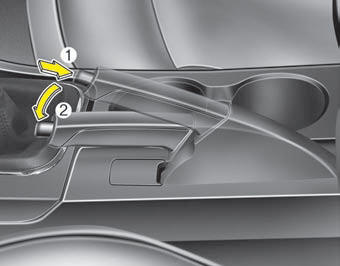
Hand Lever
To release the parking brake, first press the brake pedal, then lift the parking brake lever slightly.
Then press the release button (1) and lower the parking brake lever (2) while holding the release button down.
If the parking brake pedal does not return or does not fully return, have the system checked by an authorized Kia dealer.
WARNING- To prevent the vehicle from moving unintentionally when parked, do not use the gear selector in place of the parking brake. Apply the parking brake AND make sure the transmission is in 1st or reverse on a manual transmission, or in P (Park) on an automatic transmission.
- Never allow a person who is unfamiliar with the vehicle, or a child, to touch the parking brake. If the brake is released unintentionally, serious injury could result.
- Any parked vehicle should have its parking brake applied to prevent accidental movement, which could injure passengers or pedestrians.
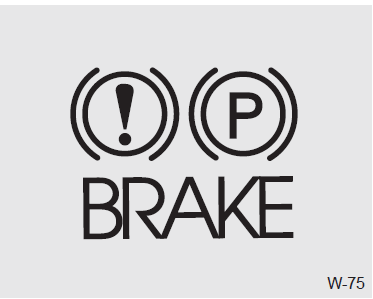
Check the brake warning light by turning the ignition key to ON (without starting the engine). The light will come on if the parking brake is applied when the ignition key is in ON or START.
Before driving, make sure the parking brake is fully released and the brake warning light is off.
If the brake warning light stays on after the parking brake is released while the engine is running, this may indicate a problem with the braking system. Have it addressed immediately.
If possible, stop driving the vehicle immediately. Otherwise, drive with extreme caution and only until you reach a safe place to stop the vehicle or a service station.
Anti-lock Braking System (ABS)
WARNINGABS (ESC) does not prevent an accident if you make a mistake or drive dangerously. Although vehicle control is improved during emergency braking, always keep a safe distance between you and the objects in front of you. Always reduce vehicle speed in extreme driving conditions.
The braking distance of vehicles equipped with anti-lock braking system (Electronic Stability Control) may be longer than that of vehicles without such a system, under the following road conditions.
Under these conditions, you should drive at reduced speed:
- Road in poor condition or snow-covered.
- Roads with uneven or damaged pavement.
The safety features of a vehicle equipped with ABS (ESC) should not be tested by driving or cornering at high speed. You could endanger yourself or others.
The ABS system continuously monitors wheel speed. If the wheels are about to lock, the ABS continuously modulates the hydraulic pressure applied to the brakes.
If, during braking, the wheels are about to lock, you will hear a clicking sound from the brakes or feel a vibration through the brake pedal.
This is normal and indicates that the ABS system is working.
To get the most from ABS during emergency braking, do not try to modulate brake pressure by "pumping" the brake pedal. Press the brake pedal as hard as possible or as necessary for the situation, and let the ABS system control the pressure applied to each wheel.
NOTICE
You may hear a clicking noise from the engine compartment when the vehicle starts to move after the engine is started. This is normal and indicates that the anti-lock braking system is operating properly.
- Even with the anti-lock braking system, your vehicle requires an adequate stopping distance.
Always maintain a safe distance from the vehicles in front of you.
CAUTION
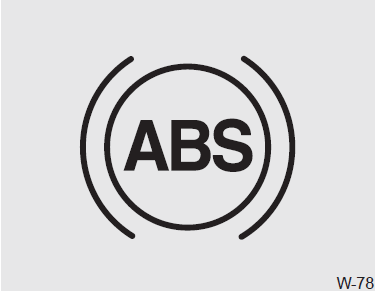
- If the ABS warning light comes on and stays on, there may be a problem with the system.
- If you are driving on a road with low traction, such as an icy road, and keep applying the brakes, the ABS will be continuously activated and the ABS warning light may come on. Stop in a safe place and turn off the engine.
- Restart the engine. If the ABS warning light is off, the ABS system is operating normally.
NOTICE
If you use jumper cables to start the vehicle after the battery has been discharged, the engine may not run smoothly and the ABS warning light may stay on. This is caused by low battery voltage and does not mean that the ABS is faulty.
- Do not "pump" the brake pedal.
- Let the battery recharge before driving.
Electronic Stability Control (ESC)
The Electronic Stability Control (ESC) system helps stabilize the vehicle when you corner. ESC compares the direction in which you intend to go with the direction the vehicle is actually taking. ESC applies the brakes at each wheel and takes over control of the engine management system to stabilize the vehicle.
WARNINGNever drive too fast for road conditions or through curves. Electronic Stability Control (ESC) does not prevent accidents. Excessive speed in curves, sudden maneuvers and hydroplaning on wet surfaces can cause serious accidents. Only a careful and attentive driver can prevent an accident by avoiding maneuvers that result in a loss of traction.
Even with ESC, always take normal precautions, such as driving at a speed that is safe for road conditions.
Electronic Stability Control (ESC) helps the driver maintain control of the vehicle in difficult conditions. It is not a substitute for good driving practices. Factors such as speed, road conditions and driver reaction all affect how effectively ESC can prevent a loss of control. As the driver, it is always your responsibility to drive and corner at a reasonable speed and to allow an adequate safety margin.
If you press the brake pedal in conditions where the wheels could lock, you may hear a clicking sound from the brakes or feel a similar reaction through the brake pedal. This is normal and indicates that ESC is operating.
NOTICE
You may hear a clicking noise from the engine compartment when the vehicle starts to move after the engine is started. This is normal and indicates that the Electronic Stability Control is operating properly.
ESC Operation
ESC On

- When the ignition switch is ON, the ESC and ESC OFF warning lights come on for about 3 seconds, then the ESC light goes off.
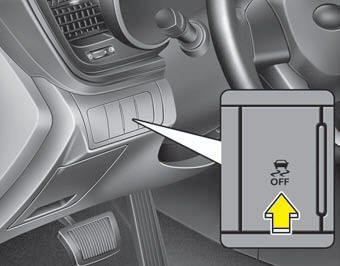
- Press the ESC OFF button for at least half a second after turning the ignition key to ON to turn ESC off (the ESC OFF indicator light comes on). To turn ESC back on, press ESC OFF again (the ESC OFF indicator light goes off).
- When you start the engine, you may hear a slight clicking sound. This is ESC performing a self-check and does not indicate a problem.
ESC Active
 When
ESC is active, the ESC indicator light flashes.
- When the Electronic Stability Control is working correctly, you may feel slight pulses in the vehicle. This is only the effect of the control on the brakes and does not indicate anything unusual.
- When you drive out of mud or leave a slippery road, pressing the accelerator pedal may not increase engine speed.
ESC Off
ESC OFF

- To turn ESC off, press the ESC OFF button (the ESC OFF indicator light comes on).
- If the ignition key is turned to LOCK while ESC is off, the system remains off. When you start the engine, ESC turns back on automatically.
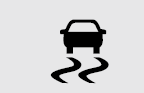
ESC indicator light (flashing)
ESC OFF indicator light (on)
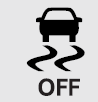
Warning Light
When you turn the ignition key to ON, the warning light comes on, then goes off if the ESC system is working correctly.
The ESC indicator light flashes when ESC is operating, and stays on if ESC has a malfunction.
The ESC OFF indicator light comes on if ESC is turned off with the button, or if ESC does not engage when you try to turn it on.
CAUTIONDriving with tires or wheels of different sizes may cause ESC to malfunction. When replacing tires, make sure all of them are the same size as the original equipment tires.
WARNINGElectronic Stability Control is only a driving aid.
Always drive carefully, slowing down when cornering or on snowy or icy roads.
Drive slowly and do not try to accelerate when the ESC indicator light flashes or when roads are slippery.
Using ESC OFF
On the Road
- For everyday driving, it is best to keep ESC on as much as possible.
- To turn ESC off while driving, press the ESC OFF button while driving on a flat road.
Never press the ESC OFF button when ESC is active (ESC indicator light flashing).
If you turn ESC off while it is active, you could lose control of the vehicle.
NOTICE
- When the vehicle is on a dynamometer, make sure ESC is off (ESC OFF indicator light on). If ESC is left on, it may prevent the vehicle from accelerating, which will affect diagnostic results.
- Turning ESC off does not affect the ABS or the braking system.
Never press the ESC OFF button when ESC is active (ESC indicator light flashing).
If you turn ESC off while it is active, you could lose control of the vehicle.
To turn ESC off while driving, press the ESC OFF button while driving on a flat road.
Hill-start Assist Control (HAC) (if equipped)
Hill-start assist is a convenience function. It mainly prevents the vehicle from rolling backward when you start on an uphill slope. HAC holds the brake pressure applied by the driver when stopped for 2 seconds, giving the driver enough time to press the accelerator and move off. Brake pressure is released as soon as the system detects the driver's intention to accelerate.
WARNINGNormally, HAC only operates for 2 seconds. The driver must take care to avoid reversing, as this could cause an accident or injure someone. If the driver feels the vehicle is trying to roll back on the slope, the driver must press the brake pedal firmly enough to stop the vehicle.
NOTICE
- HAC does not engage if the gear selector is in P (Park) or N (Neutral).
- HAC engages even if ESC is off, but does not engage if ESC has a malfunction.
Vehicle Stability Management (VSM) (if equipped)
This system further improves vehicle stability and steering response when driving on a slippery road, or if the vehicle detects changes in the traction coefficient between the right and left wheels during braking.
VSM Operation
When VSM is operating, the ESC indicator light ( ) flashes.
When the Vehicle Stability Management system is working correctly, you may feel slight pulses and/or abnormal steering wheel feedback (EPS). This is only the response of the brakes and EPS and does not indicate anything abnormal.
VSM will not operate when:
- you are driving on an incline (uphill or downhill);
- you are reversing;
- the ESC OFF indicator light (
 )
stays on in the instrument cluster; - the EPS warning light stays on in the instrument cluster.
Turning VSM Off
If you press the ESC OFF button to turn ESC off, VSM will also be turned off and the ESC OFF indicator light ( ) will come on.
Press the button again to turn VSM back on. The ESC OFF indicator light will go off.
Malfunction Indicator
VSM may turn off even if you have not turned it off by pressing ESC OFF. This indicates that a fault has been detected in the Electronic Power Steering (EPS) system or the VSM system. If the ESC indicator light ( ) or the
EPS malfunction indicator light stays on, contact an authorized Kia dealer and have the system checked.
NOTICE
- VSM is designed to operate at speeds above approximately 15 km/h when cornering.
- VSM is designed to operate at speeds above approximately 30 km/h when braking on a surface with variable friction coefficient.
- The Vehicle Stability Management system does not replace good driving practices; it is only a supplementary feature. It is always the driver's responsibility to check the speed and the distance between the vehicle and other vehicles.
Good Braking Practices
WARNING- Each time you leave the vehicle or park, always fully apply the parking brake and place the shift lever in P (Park). If the parking brake is not fully applied, the vehicle could move unintentionally and cause injury.
- The parking brake of any vehicle must always be fully applied when parking to prevent unintended vehicle movement, which could result in personal injury to occupants or pedestrians.
- Before driving, make sure the parking brake is released and the parking brake indicator is off.
- Driving through water can wet the brakes. The same applies when driving through a car wash. Wet brakes are dangerous. Your vehicle may not stop as quickly if the brakes are wet, and wet brakes may pull the vehicle to one side or the other.
To dry the brakes, lightly press the brake pedal until braking returns to normal, taking care to maintain control of the vehicle at all times. If braking does not return to normal, stop the vehicle as soon as it is safe to do so and contact an authorized Kia dealer.
It also accelerates wear of the brake components.
Keep your foot firmly on the brake pedal when the vehicle is stopped.
Then release the parking brake.
Test yourself
A quick Kia Optima DL3 quiz: every answer comes with an explanation and a link to the manual page.