Automatic Transaxle
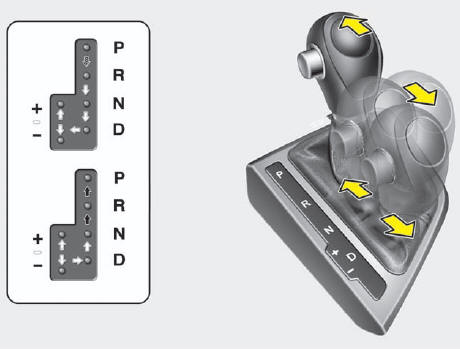
 Shifting - depress the brake pedal
and press the button.
 Press the button to
shift gears.
 The shift lever can be
moved freely.
Using the Automatic Transaxle
The high-efficiency automatic transaxle provides 6 forward gears and one reverse gear. Each gear is selected automatically, depending on the position of the shift lever.
NOTICE
The first gear shifts may be abrupt on a new vehicle or if the battery has been disconnected.
This is normal, and the shift sequence is adjusted by the TCM (Transmission Control Module) or the PCM (Powertrain Control Module) after a few shifts.
For smooth operation, depress the brake pedal when shifting from neutral (N) to forward or reverse.
WARNING - Automatic Transaxle- Before shifting into Drive (D) or Reverse (R), always look around the vehicle to check for people nearby, especially children.
- Before leaving the vehicle, always make sure to place the lever in P (Park), set the parking brake and turn off the engine. If you do not perform these steps in the order indicated, the vehicle could move unexpectedly or suddenly.
- To avoid damaging the automatic transaxle, do not accelerate in reverse or forward when the brakes are applied.
- When stopping on a slope, do not hold the vehicle in place using engine power.
Automatic Transaxle Gear Positions
The indicator light on the instrument panel shows the position of the shift lever when the ignition switch is in the ON position.
P (Park)
Always bring the vehicle to a complete stop before moving the lever to P (Park).
This position locks the automatic transaxle and prevents the front wheels from turning.
WARNING- Shifting into P (Park) while the vehicle is moving will lock the drive wheels, causing loss of vehicle control.
- Do not use P (Park) as a substitute for the parking brake. Always make sure the shift lever is in P (Park) and the parking brake is set.
- Never leave a child alone in the vehicle.
The automatic transaxle may be damaged if you shift into P (Park) while the vehicle is moving.
R (Reverse)
Use this position to drive the vehicle in reverse.
CAUTIONAlways bring the vehicle to a complete stop before shifting into reverse; you could damage the automatic transaxle by shifting into reverse while the vehicle is moving, except as explained in "Rocking the Vehicle" later in this manual.
N (Neutral)
The wheels and the automatic transaxle are disengaged. The vehicle rolls freely, even on a slight slope, unless the parking brake or the brakes are applied.
D (Drive)
This is the normal forward driving position. The automatic transaxle shifts automatically through the 6-speed sequence to ensure maximum fuel economy and power.
For more power when passing or climbing a hill, press the accelerator pedal fully. The automatic transaxle will then downshift automatically.
NOTICE
Always come to a complete stop before shifting the lever to "D" (Drive).
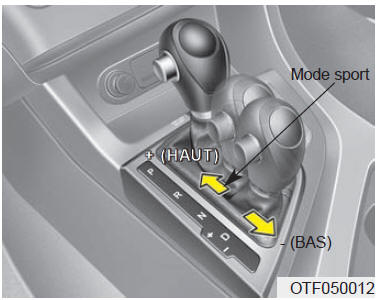
Sport Mode
Whether the vehicle is stationary or moving, you can switch to Sport Mode by pushing the shift lever from D (Drive) into the manual shift gate. To return to automatic driving (D), move the lever back into the main shift gate.
In Sport Mode, moving the lever backward or forward allows you to shift gears quickly. Unlike a manual transmission, Sport Mode allows gear changes without releasing the accelerator pedal.
UP (+): Push the lever forward once to shift to the next higher gear.
DOWN (-): Pull the lever back once to downshift one gear.
NOTICE
- In Sport mode, the driver must shift gears according to road conditions, taking care not to run the engine into the red zone.
- In Sport mode, only the 6 forward gears can be used.
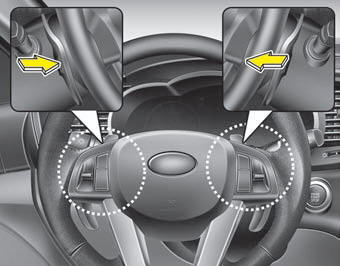
Automated manual transmission (if equipped)
The automated manual transmission is available when the gear selector is in D or in Sport mode.
Gear selector in D
The automated manual transmission operates when the vehicle is traveling above 10 km/h.
Pull the [+] or [-] paddle to shift to a higher or lower gear; the transmission automatically changes from automatic mode to manual mode.
If the vehicle is traveling below 10 km/h, if you press the accelerator pedal for more than 7 seconds, or if you move the gear selector from D to Sport mode and back to D, the system will change from manual mode to automatic mode.
Gear selector in Sport mode
Pull the [+] or [-] paddle once to shift to a higher or lower gear.
NOTICE
If you pull the [+] and [-] paddles simultaneously, you will not be able to change gears.
Gear selector lock release (if equipped)
For your safety, the automatic transaxle is equipped with a locking device that prevents the transaxle from shifting from P (Park) to R (Reverse) unless the brake pedal is depressed.
To shift from P (Park) to R (Reverse):
- Hold the brake pedal depressed.
- Start the engine or turn the ignition key to ON.
- Move the gear selector.
If you repeatedly press and release the brake pedal while the gear selector is in P (Park), you may hear a click from the selector. This is normal.
WARNINGAlways depress the brake pedal when shifting from P (Park) to another gear to prevent accidental vehicle movement, which could injure people in or around the vehicle.
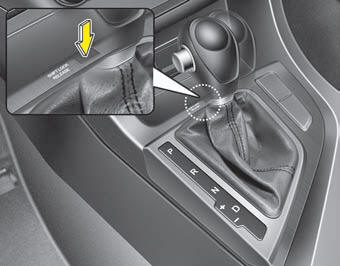
Shift lock override
If the gear selector cannot be moved out of P (Park) or N (Neutral) to R (Reverse) while you press the brake pedal, keep the brake pedal depressed and proceed as follows:
- Carefully remove the cap from the shift lock override access hole.
- Insert a key (or a screwdriver) into the access hole and push.
- Move the gear selector.
- Then have the vehicle inspected at an authorized Kia dealer as soon as possible.
Ignition key lock
The ignition key cannot be removed from the ignition switch unless the gear selector is in P (Park).
Good driving practices
- Never move the selector from P or N to another position while depressing the accelerator pedal.
- Never move the gear selector to P while the vehicle is moving.
- Make sure the vehicle is completely stopped before engaging R (Reverse) or D (Drive).
- Never shift to neutral to coast down a hill.
This is extremely dangerous.
Always keep the vehicle in gear with the clutch engaged.
Otherwise, the lower gear may not engage.
- Always fasten your seat belt! In a collision, a passenger who is not wearing a seat belt is far more likely to be seriously injured or killed than a passenger who is wearing one.
- Avoid taking corners at high speed.
- Do not perform abrupt maneuvers such as quick lane changes or sharp, fast turns.
- The risk of a multi-vehicle collision increases greatly if you lose control of your vehicle at high speed on the highway.
- Loss of control often occurs when two or more wheels leave the paved surface and the driver reacts abruptly to return to the pavement.
- If your vehicle leaves the road, do not make a sudden steering correction. Instead, slow down before attempting to return to the normal driving lane.
- Never exceed the posted speed limit.
If the vehicle becomes stuck in snow, mud, sand, etc., you may try rocking the vehicle forward and backward to free it. Do not attempt this procedure if people or objects are near the vehicle. While rocking, the vehicle may suddenly move forward or backward when it frees itself, causing injury to people or damage to property.
Climbing a hill from a stopped position
To climb a steep hill from a stopped position, depress the brake pedal and move the gear selector to D (Drive). Select the appropriate gear depending on the load and the angle of the slope, then release the parking brake.
Gradually press the accelerator pedal while releasing the brakes.
Test yourself
A quick Kia Optima DL3 quiz: every answer comes with an explanation and a link to the manual page.