AHS (Adaptive High-beam System)
The Adaptive High-beam System (AHS) of the Lexus GS (4th generation, L10, 2016–2020) represents state-of-the-art lighting technology and the highest driving safety. It dynamically adjusts the light distribution to the traffic situation and reduces glare for vehicles ahead, while optimally illuminating the road. This chapter explains operation, how the system works and the conditions of use. It also provides important safety information so that drivers can use the AHS correctly under different visibility and weather conditions and make full use of the system's potential.
The Adaptive High-beam System uses the brightness of the lights of vehicles ahead of you, as well as street lighting, etc., to evaluate conditions.
a camera sensor located behind the upper area of the windshield, and automatically adjusts the light distribution of the headlights to the conditions.
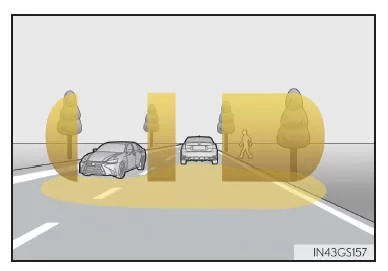
- Adjusts the brightness and illuminated area of the high beams according to vehicle speed.
- Adjusts the brightness of the high beams while cornering so that the area in the direction the vehicle is moving is illuminated more brightly than the other areas.
- Operates the variable high beam so that the area around vehicles ahead of your vehicle is partially not illuminated by the high beams, while all other areas remain illuminated.
The variable high beam helps improve forward visibility while reducing the glare for drivers of vehicles ahead of you.
- Adjusts the range of the low beams according to the distance to a vehicle ahead.
WARNING
Limitations of the Adaptive High-beam System
Do not rely on the Adaptive High-beam System. Always drive with care, watch your surroundings and turn the high beams on or off manually when necessary.
How to prevent a malfunction of the Adaptive High-beam System
Do not overload the vehicle.
Activating the Adaptive High-beam System
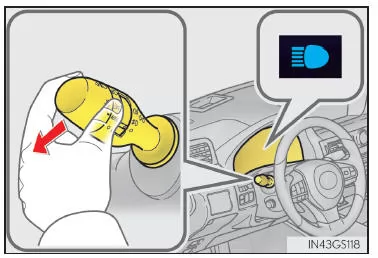
- Push the lever away from you while the headlight switch is in the
 or
 position.
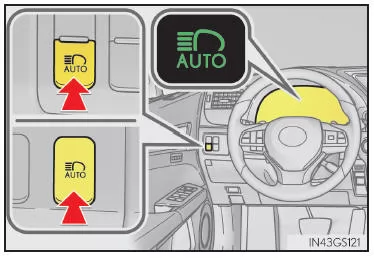
- Press the Adaptive High-beam System switch.
The Adaptive High-beam System indicator light comes on when the headlights are switched on automatically, to indicate that the system is active.
Manually turning the high beams on/off
Switching to low beams
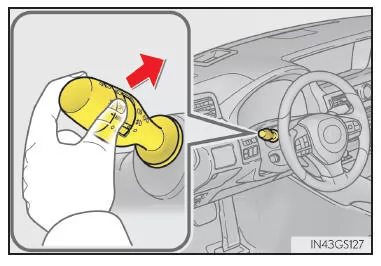
Pull the lever back to its original position.
The Adaptive High-beam System indicator light turns off.
Push the lever away from you to reactivate the Adaptive High-beam System.
Switching to high beams

Press the Adaptive High-beam System switch.
The Adaptive High-beam System indicator light turns off and the high beam indicator light comes on.
Press the switch to reactivate the Adaptive High-beam System.
Conditions under which the headlight beam pattern control changes automatically
- When all of the following conditions are met, the high beams turn on automatically and the system becomes active:
*: While cornering, the area in the direction the vehicle is traveling is illuminated brighter than the other areas.
- When all of the following conditions are met, the variable high beam turns on and the low beam range is adjusted automatically according to the position of vehicles ahead of you:
- When any of the following conditions is met, the high beam or variable high beam automatically switches to low beam:
Information on detection by the camera sensor
- In the following situations, the high beam may not automatically switch to the variable high beam:
- The high beam may switch to the variable high beam when a vehicle ahead of your vehicle is detected whose fog lights are on while its headlights are off.
- Illuminated buildings, street lights, traffic lights, and illuminated billboards or signs may cause the high beam to switch to the variable high beam, cause the high beam not to switch to the variable high beam, or cause the unlit area to change.
- The following factors may affect the time it takes for the high beam to turn on or off, or for the unlit areas to change:
- The headlight beam pattern control may change unexpectedly.
- Bicycles and similar objects may not be detected.
- In the situations listed below, the system may not be able to correctly detect the ambient brightness. This may cause the low beam to stay on, or the high beam to dazzle pedestrians, drivers of vehicles ahead of your vehicle or other road users. In these cases, switch manually between high beam and low beam.
Warning message
Warning messages indicate a system malfunction or alert the driver that special caution is required.
Customization
You can customize some functions.
The Adaptive High-beam System in the Lexus GS GRL1 provides optimal road illumination without dazzling other road users. Using advanced camera sensor technology, the system adjusts automatically to conditions, enhancing safety when driving at night.
The precise control of the light distribution, which adapts to speed, the course of the road and traffic conditions, is a particular highlight. This underscores the high technological standard of the Lexus GS 4th generation.
Thanks to these intelligent functions, the Lexus GS 2016–2020 remains a model of driving comfort and safety, even in difficult lighting conditions.
Test yourself
A quick Lexus GS quiz: every answer comes with an explanation and a link to the manual page.