Engine Switch (Ignition Switch)
The Lexus GS (fourth generation, L10, 2016–2020) offers a finely tuned suspension that combines sporty dynamics with high long-distance comfort. This chapter describes the details of the suspension tuning and provides guidance on the correct use of the drive modes, from ECO to SPORT S+. Additional tips on tire pressure monitoring, the effect of load on handling, and the function of electronic stability systems make this chapter an important guide for anyone who wants to make full use of the potential of the Lexus GS.
When you have the electronic key with you, you can start the engine or change the engine switch modes as follows.
Starting the engine
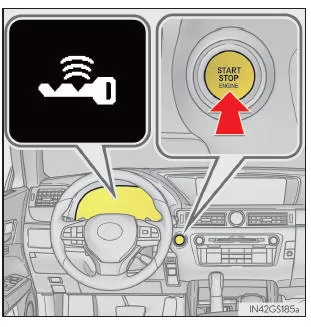
- Press the parking brake switch to make sure the parking brake is applied. The parking brake indicator light will then illuminate.
- Make sure the shift lever is in the "P" position.
- Depress the brake pedal firmly.
 and a message (GS F only) will be shown on the multi-information display.
If the symbol is not displayed, the engine cannot be started.
- Press the engine switch.
The engine cranks until it starts, but for no longer than 30 seconds.
Keep depressing the brake pedal until the engine has fully started.
The engine can be started in any engine switch mode.
Turning off the engine
- Stop the vehicle.
- Shift the shift lever to "P".
- Apply the parking brake.
- Press the engine switch.
- Release the brake pedal and make sure that "POWER ON" is turned off on the multi-information display.
Changing the Engine Switch Modes
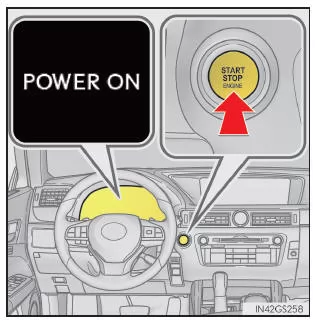
The mode can be changed by pressing the engine switch with the brake pedal released. (The mode changes each time the switch is pressed.)
OFF*
The hazard warning flashers can be turned on.
"POWER ON" is not displayed on the multi-information display.
ACCESSORY Mode
Some electrical components, such as the
audio system, can be used.
"POWER ON" is displayed on the multi-information display.
IGNITION ON Mode
All electrical components can be used.
"POWER ON" is displayed on the multi-information display.
*: If the engine is turned off while the shift lever is in a position other than "P", the engine switch will not turn off but will switch to ACCESSORY mode.
When the engine is turned off with the shift lever in a position other than "P"
If the engine is turned off while the shift lever is in a position other than "P", the engine switch will not turn off but will switch to ACCESSORY mode. To turn off the switch, proceed as follows:
- Make sure the parking brake is applied.
- Shift the shift lever to "P".
- Make sure that "Turn power off." is displayed on the multi-information display, then press the engine switch once.
- Make sure that "Turn power off." is no longer displayed on the multi-information display.
Auto Power Off Function
If the vehicle remains in ACCESSORY mode for more than 20 minutes, or in IGNITION ON mode for more than one hour with the shift lever in "P" and the engine off, the engine switch will turn off automatically. However, this function cannot completely prevent battery discharge. Do not leave the vehicle with the engine switch in ACCESSORY or IGNITION ON mode for extended periods when the engine is not running.
Electronic key battery discharge
Conditions affecting the function
Notes on the Push-Button Start System
If the engine does not start
- The immobilizer system may not have been deactivated. Contact a Lexus dealer or authorized repair shop, or another qualified and properly equipped workshop.
- Make sure the shift lever is fully in the "P" position. The engine may not start if the shift lever is not fully in the "P" position. The multi-information display shows "Shift to P position to start".
Steering Wheel Lock
After the engine switch is turned off and the doors are opened and closed, the steering wheel is locked by the steering lock. When the engine switch is pressed again, the steering lock is automatically released.
If the steering lock cannot be released
The multi-information display shows "Steering lock engaged".
Make sure the shift lever is in the "P" position. Press the engine switch while turning the steering wheel left and right.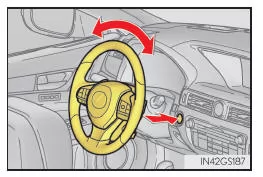
Preventing Overheating of the Steering Lock Motor
To prevent the steering lock motor from overheating, its operation may be interrupted if the engine is repeatedly switched on and off within a short period. In this case, do not attempt to start the engine. After approximately 10 seconds, the steering lock motor resumes operation.
If "Malfunction in Access System with Elec. Key. See manual." is displayed on the multi-information display
There may be a malfunction in the system. Have the vehicle inspected immediately by a Lexus dealer or authorized repair shop, or another qualified and properly equipped workshop.
When the electronic key battery is discharged
Operating the Engine Switch
- A short, firm press is sufficient to operate the engine switch. If the switch is not pressed properly, the engine may not start or the engine switch mode may not change. It is not necessary to hold the switch down.
- The engine may not restart immediately after the engine switch has been turned off. After turning off the engine switch, wait a few seconds before restarting the engine.
If the smart entry & start system has been deactivated by a customized setting
WARNING
When Starting the Engine
Start the engine only when you are seated in the driver's seat. Never depress the accelerator pedal while starting the engine.
This may result in an accident causing death or serious injury.
Precautions While Driving
If an engine malfunction occurs while driving, do not lock or open the doors until the vehicle has come to a safe and complete stop. Activating the steering lock under these circumstances may cause an accident resulting in death or serious injury.
Stopping the Engine in an Emergency
To stop the engine in an emergency while driving, press and hold the engine switch for more than 2 seconds, or press the switch briefly 3 or more times in succession. Except in an emergency, never touch the engine switch while driving. Stopping the engine while driving does not cause a loss of steering or braking control; however, the power steering and brake booster will no longer operate. This makes the vehicle harder to steer and brake, so pull over and stop the vehicle as soon as it is safe to do so.
NOTEHow to Prevent Battery Discharge
- Do not leave the engine switch in ACCESSORY or IGNITION ON mode for extended periods when the engine is not running.
- If "POWER ON" is shown on the multi-information display, the engine switch is not off. Do not leave the vehicle until you have turned off the engine switch.
- Do not turn off the engine when the shift lever is in any position other than "P". If the engine is turned off with the shift lever in another position, the engine switch will not turn off but will switch to ACCESSORY mode. If the vehicle remains in ACCESSORY mode, the battery may discharge.
When Starting the Engine
- Do not rev a cold engine.
- If you experience starting difficulties or the engine stalls frequently, have your vehicle inspected immediately by a Lexus dealer or authorized repairer, or another qualified and properly equipped workshop.
Symptoms Indicating a Malfunction of the Engine Switch
If the engine switch seems to operate differently than usual, for example if it sticks slightly, a malfunction may exist. In this case, contact a Lexus dealer or authorized repairer, or another qualified and properly equipped workshop, immediately.
The engine switch of the Lexus GS GRL1 (4th generation) combines ease of use with modern safety technology. Starting and stopping the engine is intuitive and supports comfortable operation. Thanks to the intelligent system, accidental battery discharge is also prevented.
The clear structure of the modes, from ACCESSORY to IGNITION ON, underlines the premium character of the sedan. In this way, the Lexus GS 2016–2020 remains an example of well-thought-out vehicle design.
The reliable steering lock and the instructions for emergency engine shutdown also provide the highest level of safety in every driving situation.
Test yourself
A quick Lexus GS quiz: every answer comes with an explanation and a link to the manual page.