Blind Spot Monitoring (BSM) system
The Blind Spot Monitoring (BSM) system is designed to help the driver monitor the blind spots on both sides of the rear of the vehicle under certain conditions, such as changing lanes on roads or highways or reversing the vehicle to exit a parking garage.
A malfunction in the system or operating conditions is indicated by a warning.
Refer to Indicator and Warning Lights on page 4-24.
Refer to Blind Spot Monitoring (BSM) Buzzer on page 7-42.
The Blind Spot Monitoring (BSM) system consists of Blind Spot Monitoring (BSM) and Rear Cross Traffic Alert (RCTA).
WARNING
Do not rely entirely on the Blind Spot Monitoring (BSM) system, and always be sure to look over your shoulder before changing lanes or reversing the vehicle to exit a parking garage:
The Blind Spot Monitoring (BSM) system assists the driver by confirming that the surrounding area is free of hazards, but it is not a complete substitute. The driver is responsible for lane changes and other maneuvers. Always pay attention to the direction the vehicle is moving and the area around the vehicle.
NOTE
The detection capabilities of the radar sensors are limited. The Blind Spot Monitoring (BSM) system may not operate properly under the following conditions:
- Ice, snow or dirt adheres to the surface of the rear bumper around the radar sensors.
- Under severe weather conditions, such as rain or snow, or in conditions where water is splashed.
- The area of the rear bumper around the radar sensors is obstructed by a foreign object (such as a sticker or bicycle carrier).
The radar sensors do not detect humans, animals, shopping carts, bicycles or stationary objects such as fences.
The radar sensors may not detect all types of vehicles around the vehicle, including the following types:
- Mopeds
- Vehicles with a body shape the radar cannot detect, such as a flatbed semi-trailer with no load.
- Vehicles with a reduced body height, such as sports cars.
The system detecting objects at the edge of the road, such as parked vehicles or guardrails, and activating the warning chime/light does not indicate a malfunction.
If the vehicle is driven on a road with light traffic and few vehicles that can be detected by the radar sensors, the system may be temporarily suspended (the BSM OFF indicator light on the instrument panel flashes). This does not indicate a malfunction.
Under the following conditions, the visibility of the blind spot monitoring (BSM) indicator lights on the outside rearview mirrors may be affected, making it more difficult to determine whether the lights are on or off:
- Ice or snow is adhering to the outside rearview mirrors.
- The door window glass is tinted.
The rear bumper is equipped with radar sensors. (page 4-133)
If the rear bumper is struck, even in a minor accident, have the radar sensors inspected by an authorized Mazda dealer. If the vehicle is driven with a damaged radar sensor, the system may not operate properly and an accident may result.
Consult an authorized Mazda dealer for repair or painting work around the radar sensors, or for bumper replacement.
The radar sensors of the blind spot monitoring (BSM) system may be subject to the radio wave regulations of the country in which the vehicle is used.
Use of the system's sensors is approved in the United States (including its territories), Canada and Mexico. If a vehicle equipped with the blind spot monitoring (BSM) system is used in a country other than the United States, Canada or Mexico, the system must be turned off using the BSM OFF switch.
Blind Spot Monitoring (BSM)
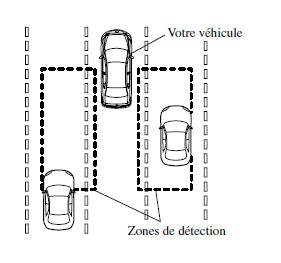
The blind spot monitoring (BSM) system monitors the detection zones on both sides of the vehicle and at the rear. When vehicles are present in a detection zone, it alerts the driver by illuminating the BSM indicator light when the vehicle speed moving forward is approximately 10 km/h or more.
If the turn signal lever is operated toward the side where the illuminated BSM indicator light is flashing, the system warns the driver that there is a vehicle in the detection zone by sounding the BSM warning chime.
NOTE
- The blind spot monitoring (BSM) system does not operate when the vehicle speed is below approximately 10 km/h.
- The BSM detection zone is set based on the lane width of standard highways. Therefore, on roads with narrower lanes, the system may detect vehicles in an adjacent lane and activate the warning chime/light. On roads with wider lanes, the system may not detect vehicles in an adjacent lane and may not activate the warning chime/light.
- Under the following conditions, the system may be unable to detect vehicles, or detection may be delayed.
- The vehicle starts from a stop with a vehicle beside it.
- A vehicle changes two lanes to reach the adjacent lane.
- The speed difference between the vehicle and another vehicle is large when passing, and the vehicle is in the detection zone for a short period of time.
- On a steep slope or when there is a difference in height between lanes.
- When the system is turned off and then immediately turned back on by pressing the BSM OFF switch again (the BSM OFF indicator light on the instrument panel is on).
- (Vehicles with automatic transmission) The shift lever is moved to R, or immediately after being moved from R.
- The system may not operate properly when towing a trailer. Turn off the system by pressing the BSM OFF switch when towing a trailer.
- The Rear Cross Traffic Alert (RCTA) system is activated when the shift lever (manual transmission) or selector lever (automatic transmission) is placed in the R position.
Rear Cross Traffic Alert (RCTA)
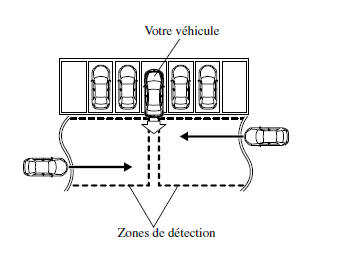
When reversing the vehicle out of a parking space, vehicles approaching from either side of the vehicle are detected to warn the driver of a possible collision. The BSM indicator light flashes and the BSM warning chime sounds.
Rear Cross Traffic Alert (RCTA) System Operation
- The Rear Cross Traffic Alert (RCTA) system activates when the shift lever (manual transmission) or selector lever (automatic transmission) is placed in the R position.
(With rearview monitor) The rearview monitor display is shown.
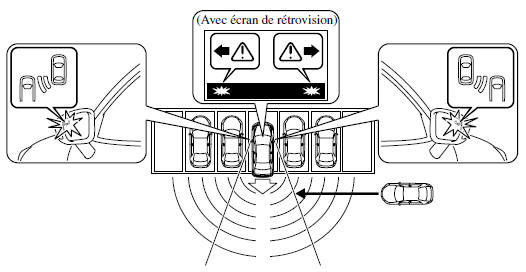
- If a vehicle that may collide with you approaches, the blind spot monitoring (BSM) indicator flashes and the blind spot monitoring (BSM) warning beep sounds at the same time.
(With rearview monitor) The warning display of the rear cross traffic alert (RCTA) system on the rearview monitor is also synchronized with the blind spot monitoring (BSM) indicator on the door mirrors.
NOTE
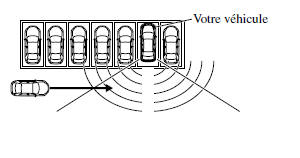
Under the following conditions, the system may not be able to detect vehicles, or detection may be delayed.
- The vehicle has been reversed at a speed of 12 km/h or more
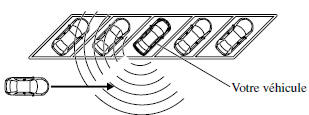
- The radar is obstructed by objects such as a large vehicle parked alongside or a wall. (Move the vehicle backward to a position where the radar is not obstructed.)
- A vehicle approaches directly from behind
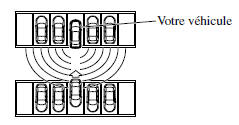
- The vehicle is parked at a very sharp angle
- When the system is turned off and then immediately turned back on by pressing the blind spot monitoring (BSM) OFF switch again (the blind spot monitoring (BSM) OFF indicator on the instrument panel is illuminated).
BSM indicator
The blind spot monitoring (BSM) system alerts the driver to the presence of another vehicle in an adjacent lane using the BSM indicators and the warning beep while the system is operating.
The indicator is installed on the left and right door mirrors.
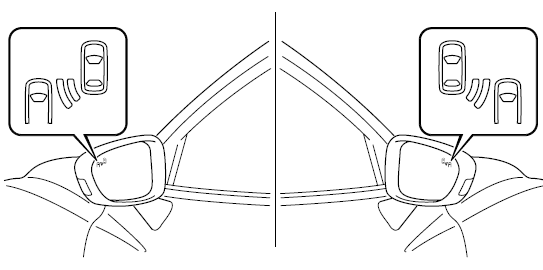
This light comes on for a few seconds when the ignition switch is turned to ON.
Driving forward
If the blind spot monitoring (BSM) system detects a vehicle in the detection zone while the vehicle speed is approximately 10 km/h or more, the BSM indicator illuminates on the side of the vehicle where the vehicle approaching from behind is detected. An indicator flashes when the turn signal lever is operated toward the side where the BSM indicator is illuminated to alert the driver.
Reversing
If vehicles approach from behind on both the left and right sides, the BSM indicators flash on both sides.
NOTE
- If ice or snow is stuck to the surface of the outside mirror, the BSM indicator may not be visible.
- If the door glass is tinted, the visibility of the BSM indicator may be affected and it may be more difficult to determine whether the indicator is on or off.
BSM OFF switch
When the BSM OFF switch is pressed, the BSM system is turned off and the BSM OFF indicator illuminates.
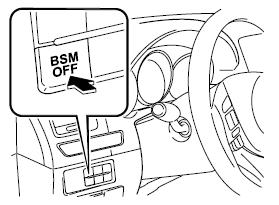
Press the BSM OFF switch again to turn on the BSM system.
The BSM OFF indicator turns off.
NOTE
- The system may not operate correctly when towing a trailer. Turn the system off using the BSM OFF switch when towing a trailer.
- If the ignition switch is placed in the off position while the BSM system is off, the system operates automatically when the ignition switch is placed in the ON position.
Radar Sensor Maintenance
The rear bumper is equipped with radar sensors.
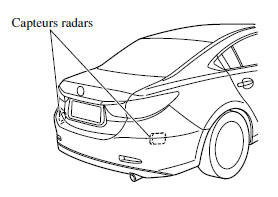
Always keep the bumper surface near the radar sensor area clean so that the BSM system operates normally.
Refer to Exterior Care on page 6-61.
NOTE
- The BSM OFF indicator flashes if the radar sensors are not operating normally. If the indicator continues to flash after the bumper surface near the radar sensor area has been cleaned, contact an authorized Mazda dealer.
- Consult an authorized Mazda dealer for repair or painting work around the radar sensors, or for bumper replacement.
Test yourself
A quick Mazda 6 quiz: every answer comes with an explanation and a link to the manual page.