Tire Pressure Monitoring System
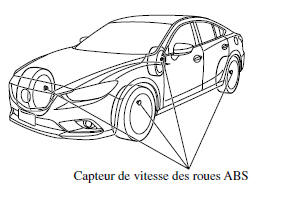
- The Tire Pressure Monitoring System (TPMS) monitors the air pressure of all four tires. If the air pressure of one or more tires is too low, the system warns the driver by illuminating the Tire Pressure Monitoring warning light on the instrument cluster (the warning is also shown on the Type A instrument cluster display) and sounding a beep. The system monitors tire pressure indirectly using data sent by the ABS wheel speed sensors.
For the system to operate correctly, it must be initialized with the specified tire pressure (value on the tire pressure label). Follow the procedure to perform the initialization.
- For vehicles equipped with a Type A instrument panel, check the vehicle condition or have the vehicle inspected by an authorized Mazda dealer as indicated.
- A malfunction in the system or operating conditions is indicated by a warning.
Refer to Indicator and Warning Lights on page 4-24.
Refer to Tire Pressure Monitoring Buzzer on page 7-42.
WARNING
All tires, including the spare tire (if provided), must be checked monthly when cold and inflated to the tire pressure recommended by the vehicle manufacturer on the vehicle placard or tire inflation pressure label. (If the vehicle has tires of a different size than the size indicated on the vehicle placard or tire inflation pressure label, you should determine the proper tire inflation pressure for those tires.) As an added safety feature, your vehicle has been equipped with a Tire Pressure Monitoring System (TPMS) that illuminates a low tire pressure warning light when one or more of your tires is significantly under-inflated.
Therefore, when the low tire pressure warning light illuminates, stop and check your tires as soon as possible, and inflate them to the correct pressure. Driving on a significantly under-inflated tire causes the tire to overheat and can lead to tire failure. Under-inflation also reduces fuel economy and tire tread life, and may affect the vehicle's handling and braking ability.
Please note that the TPMS is not a substitute for proper tire maintenance, and it is the driver's responsibility to maintain correct tire pressure, even if under-inflation has not reached the level to trigger illumination of the TPMS low tire pressure warning light.
Your vehicle is also equipped with a TPMS malfunction indicator to alert you when the system is not functioning properly.
The TPMS malfunction indicator is combined with the low tire pressure warning light. When the system detects a malfunction, the light will flash for approximately one minute and then remain illuminated. This sequence will repeat every time the vehicle is started as long as the malfunction exists. When the malfunction indicator is illuminated, the system may not be able to detect or signal low tire pressure. TPMS malfunctions may occur for a variety of reasons, including the installation of replacement or alternate tires or wheels on the vehicle that prevent the TPMS from functioning properly. Always check the TPMS malfunction indicator after replacing one or more tires or wheels on your vehicle to ensure that the replacement or alternate tires and wheels allow the TPMS to continue to function properly.
To avoid false indications, the system samples over a certain period before indicating a problem. Because of this, it will not immediately indicate a sudden deflation or blowout of a tire.
NOTE
Because this system detects slight changes in tire condition, the warning time may be faster or slower in the following cases:
- The tire size, manufacturer or type differs from the specification.
- The tire size, manufacturer or type differs from the others, or the tread wear level differs too much between tires.
- The system uses a flat tire, studded tire, snow tire or tire chains.
- A spare wheel is used (the tire pressure monitoring system indicator may flash, then stay on continuously).
- To repair a tire, use the emergency tire puncture repair kit.
- The tire pressure is much higher than the specified pressure, or the tire pressure has suddenly dropped for any reason, such as a tire blowout while driving.
- The vehicle speed is below approximately 15 km/h (including when the vehicle is stopped), or the driving time is less than 5 minutes.
- The vehicle is driven on an extremely rough or slippery road, or on ice.
- Hard steering and repeated rapid deceleration/acceleration during aggressive driving on winding roads.
- A load is applied to one tire, such as by loading heavy luggage on one side of the vehicle.
- The system initialization was not performed with the specified tire pressure.
Tire Pressure Monitoring System Initialization
In the following cases, system initialization must be performed so that the system operates normally.
- The tire pressure has been adjusted.
- The tires have been rotated.
- A tire or wheel has been replaced.
- The battery has been replaced or completely discharged.
- The tire pressure monitoring system indicator is on.
Initialization Procedure
- Park the vehicle in a safe place and firmly apply the parking brake.
- Allow all four (4) tires to cool down and adjust their pressure to the specified pressure shown on the tire pressure label located on the driver's door pillar (with the driver's door open). Refer to Tires on page 9-7.
- Turn the ignition switch to ON.
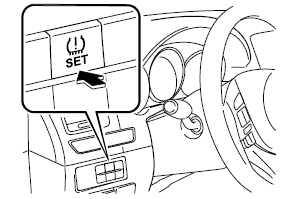
- While the vehicle is parked, press and hold the tire pressure monitoring system setting switch and check that the tire pressure monitoring system indicator on the instrument panel flashes twice and a beep sounds once.
With a Type A instrument panel, a message on the instrument panel display indicates that initialization has been completed.
WARNING
If system initialization is performed without adjusting the tire pressure, the system cannot detect the normal tire pressure, and it may not turn on the tire pressure monitoring system indicator even if a tire's pressure is low, or it may turn on the indicator even if the pressures are normal.
System initialization will not be performed if the switch is pressed while the vehicle is being driven.
Test yourself
A quick Mazda 6 quiz: every answer comes with an explanation and a link to the manual page.