Help
MEASURING THE CONTROL VOLTAGE OF THE CABIN BLOWER MOTOR POWER MODULE
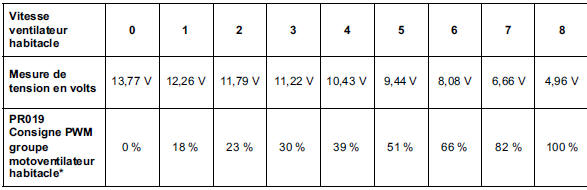
There are two ways to measure the control voltage of the cabin blower motor power module: 1 / MEASUREMENT USING A MULTIMETER (voltmeter position, DC voltage measurement): With the power module connector connected, measure between pin 6 of the module and ground.
At speed 0, the measured voltage is equal to battery voltage (± 1 V), and at speed 8, the voltage is 5 V (± 0.5 V).
For the seven intermediate speeds, the voltage varies between 0 and 14 V.
Examples of measurements taken with a voltmeter with the engine at idle (for reference only):
2 / MEASUREMENT USING AN OSCILLOSCOPE (Optima 5800, CLIP technical): The cabin blower motor power module is controlled by a modulated control voltage (PWM).
This control voltage always stays at 12 V; it is the control signal (square wave) that varies: the amplitude and frequency do not change, but the high state (12 V) varies relative to the low state (5 V).
To take the measurement, connect the oscilloscope ground lead to the battery ground and the oscilloscope measuring lead to pin 6 (6-pin connector) of the power module (with the module connector connected).
Set the oscilloscope timebase to 500 µs per division with a range of 5 V per division.
The signals obtained must be: a straight line at 14 V (± 1 V) for speed 0, and a straight line at 5 V (± 0.5 V) for speed 8.
Examples of measurements taken with an oscilloscope with the engine at idle (for reference only)
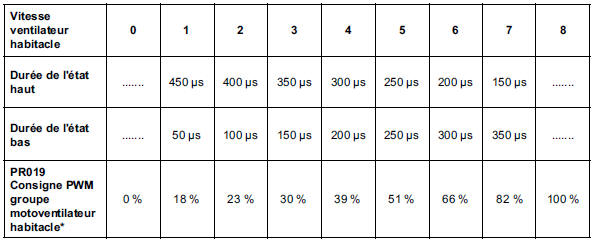
* PWM cabin blower motor: modulated control voltage of the cabin blower motor
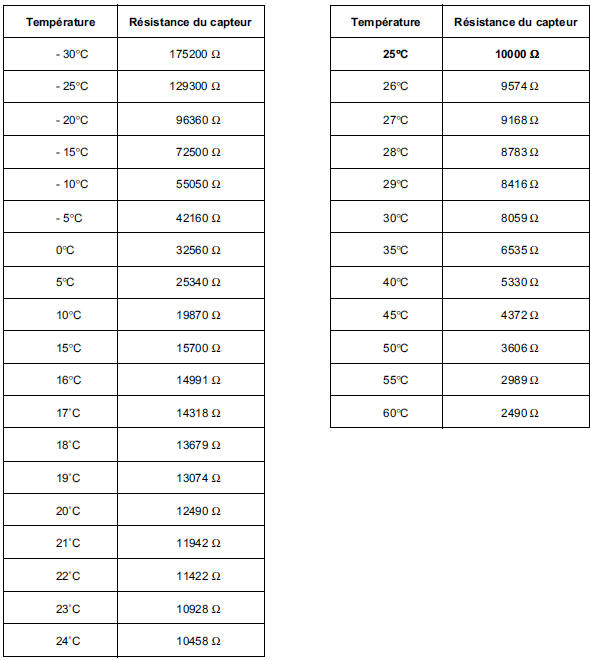
Electrical characteristics of the interior temperature sensor as a function of temperature (tolerance: ± 5 %).
Interior temperature sensor
Operation of the engine cooling fan assembly as a function of refrigerant pressure and vehicle speed.
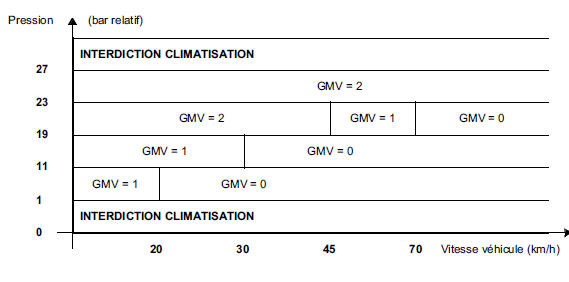
FAN = 1 Engine cooling fan low speed
FAN = 2 Engine cooling fan high speed
FAN = 0 Engine cooling fan off
The engine cooling fan assembly is not used at vehicle speeds above 70 km/h, except in rare cases where, despite such speed, the refrigerant pressure is above 23 bar (e.g. driving behind a truck).
At standstill, the engine cooling fan assembly is always used at low speed if refrigerant pressure is below 19 bar (gauge), and at high speed otherwise.
While driving, the engine cooling fan assembly may either stay off or run at low or high speed, depending on the refrigerant pressure at the condenser outlet and the vehicle speed.
Test yourself
A quick Renault Megane quiz: every answer comes with an explanation and a link to the manual page.