Leak detection
AIR CONDITIONING or AUTOMATIC AIR CONDITIONING
Leak detection table
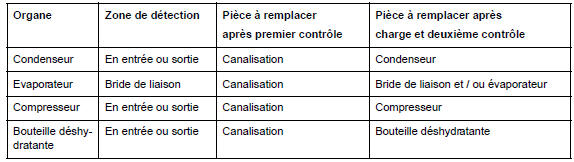
There are several types of leak detection equipment:
- electronic leak detectors,
- tracer-dye leak detectors.
I - ELECTRONIC LEAK DETECTORS
WARNINGRead the equipment operating instructions before any work.
This equipment measures a variation in the amount of refrigerant in the air and emits an audible signal depending on this variation.
- The equipment must be zeroed before the check.
To do so:
- hold the equipment still,
- calibrate the equipment at one point in the engine compartment.
This reading then serves as the reference for detecting the contamination level.
- This equipment is very sensitive. During detection, follow the circuit path as closely as possible to limit variations caused by other gases.
This equipment only detects relatively large leaks.
WARNINGMake sure the probe at the end of the wand is extremely clean and in good condition.
II - TRACER DYE LEAK DETECTORS
- Tracer dye leak detection involves adding a dye to the refrigerant and locating the leak points with an ultraviolet lamp.
Strictly observe the safety instructions when working on the refrigerant circuit (Air Conditioning chapter, Safety Precautions, page 62A-7).
WARNING: Strictly follow the procedure described.
Note: This leak detection method should be used as a last resort for “leaks not found” cases.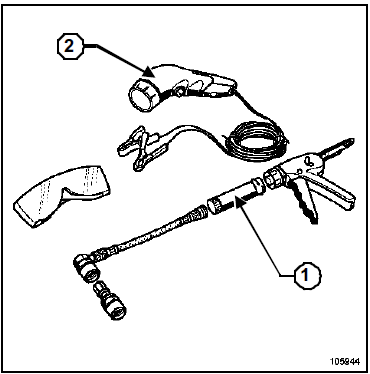
- The refrigerant leak detection procedure uses single-use dye capsules (1). Leak traces are revealed with an ultraviolet lamp (2).
The dye remains in the air conditioning system.
Without adding more dye, the condition of the refrigerant circuit can be checked at any time with the ultraviolet lamp.
If there is no indication that dye has been used previously (label, etc.):
- place a cloth,
- release a small burst of refrigerant at both valves,
- illuminate the inside of the valves,
- check for fluorescent traces.
Do not add dye to the refrigerant circuit if fluorescent traces appear.
- If there are no fluorescent traces and no warning label, add one dose of leak detection dye.
- Stick on a label.
- Record the date the dye was added.
1 - Adding dye to the circuit
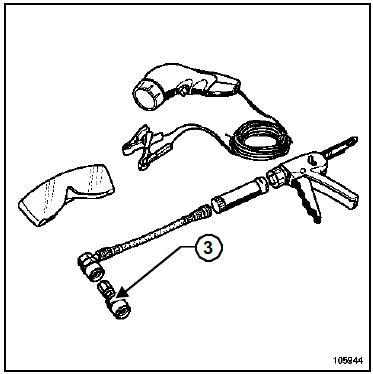
- Connect the dye injection system to the low-pressure valve, using adapter (3) for vehicles with only one valve.
- Add the dye to the circuit.
- Run the air conditioning for approximately 15 minutes.
2 - Leak detection procedure
- Carry out a first check with the engine off by scanning the circuit with the ultraviolet lamp.
Note: Use an adjustable mirror for hard-to-reach areas.
- If no leak appears:
- thoroughly clean the outside of the refrigerant circuit,
- Run the air conditioning until the leak is detected (otherwise, check the condition of the evaporator).
After adding dye to the refrigerant, always attach a label (supplied with the dye capsule) stating that dye has been used and the date of the operation. The label must be placed clearly near the refrigerant circuit filling valves (strut tower).
Test yourself
A quick Renault Megane quiz: every answer comes with an explanation and a link to the manual page.