Engine Control System/Fuel System
Repair Procedures
In this manual: Engine Control System/Fuel System
16steps
~96min
4/5difficulty
Done 0 of 16
Fuel Pressure Inspection (Low-Pressure System)
- Relieve the residual fuel pressure in the fuel line. (Refer to Fuel System - Repair Procedures - "Relieve Residual Fuel Pressure in Fuel Line").
When the fuel pump fuse is removed, a diagnostic trouble code (DTC) is stored. Clear the DTC with GDS after completing the "Relieve Residual Fuel Pressure in Fuel Line" procedure.
- Install the Special Service Tool (SST).
- Disconnect the low-pressure fuel feed hose from the low-pressure inlet of the high-pressure fuel pump.
Some residual pressure may remain even after releasing the residual fuel pressure in the fuel line. Therefore, cover the hose connection with a shop towel to prevent fuel from spilling before disconnecting any fuel connection. - Install the special service tool to measure the fuel pressure between the low-pressure fuel feed hose and the low-pressure inlet of the high-pressure fuel pump (see figure below).
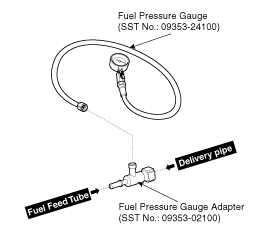
- Disconnect the low-pressure fuel feed hose from the low-pressure inlet of the high-pressure fuel pump.
- Inspect for fuel leaks at the low-pressure fuel feed hose connections, the low-pressure inlet of the high-pressure fuel pump, and the SST components with the ignition ON.
- Measure the fuel pressure.
- Start the engine and measure the fuel pressure at idle. Fuel pressure: 480 ~ 500 kPa (4.9 ~ 5.1 kgf/cm², 69.7 ~ 72.5 psi)
If the fuel pressure is out of specification, repair or replace the related part (see the table below).
Fuel
PressureCause Related Part Too low Clogged fuel filter Fuel filter Fuel leakage Fuel Pressure Regulator Too high Fuel pressure regulator stuck Fuel Pressure Regulator - Stop the engine, then check the fuel pressure gauge reading for changes. Specification: The gauge reading should be held for approximately 5 minutes after the engine is stopped.
If the gauge reading is not held, repair or replace the related part (see the table below).Fuel Pressure
(After Engine Stop)Cause Related
PartFuel pressure drops slowly Injector leakage Injector Fuel pressure drops immediately Fuel pump check valve stuck open Fuel pump - Turn the ignition off.
- Start the engine and measure the fuel pressure at idle. Fuel pressure: 480 ~ 500 kPa (4.9 ~ 5.1 kgf/cm², 69.7 ~ 72.5 psi)
- Relieve the residual fuel pressure in the fuel line. (Refer to Fuel System - Repair Procedures - "Relieve Residual Fuel Pressure in Fuel Line").
When the fuel pump fuse is removed, a diagnostic trouble code (DTC) is stored. Clear the DTC with GDS after completing the "Relieve Residual Fuel Pressure in Fuel Line" procedure. - End of test
- Remove the special service tool (SST) from the low-pressure fuel feed hose and the low-pressure inlet of the high-pressure fuel pump.
- Connect the low-pressure fuel feed hose to the low-pressure inlet of the high-pressure fuel pump.
Release Fuel Line Residual Pressure
|
|
- Turn the ignition OFF and disconnect the negative battery cable.
- Remove the fuel pump fuse (A).
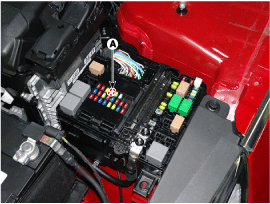
- Connect the negative battery cable.
- Run the engine for approximately 1 minute to reduce the pressure in the low pressure line.
- Turn the engine off.
- Disconnect the quick-connector of the low pressure fuel line at the high pressure pump. Use rags to cover the opening and collect spillage while removing the fuel line.
- Start the engine and let it idle until the engine stops. At this point, the pressure should be below 30 psi.
- Continue with the service or repair. Use a shop towel to cover the opening and collect any spilled fuel when opening the high-pressure system.
- Reinstall/reconnect all components in the reverse order of removal. Start the engine, confirm proper operation, and make sure there are no fuel leaks.
- After completion, clear the DTCs using the GDS diagnostic scan tool (the procedure described above will set DTCs).
Test yourself
A quick Hyundai Sonata LF quiz: every answer comes with an explanation and a link to the manual page.
Was this page helpful?