SRS airbag
SRS airbags inflate when the vehicle is subjected to certain types of severe impact that could cause serious injury to occupants. They work in conjunction with the seat belts to help reduce the risk of serious or fatal injury.
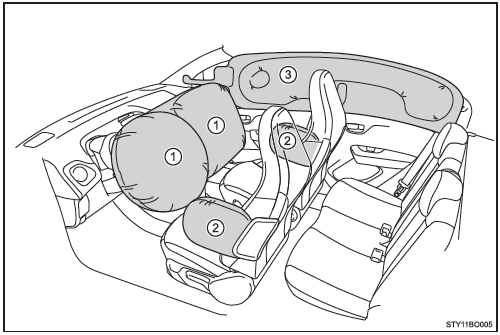
◆ Front SRS airbags
- Driver's SRS airbag/front passenger SRS airbag
Can help protect the head and chest of the driver and front passenger from impact with interior components
◆ Side and curtain SRS airbags
- Side SRS airbags
Can help protect the chest and hips of front seat occupants - Curtain SRS airbags (if equipped)
Can help protect mainly the heads of outboard seat occupants
SRS airbag system components
3-door models
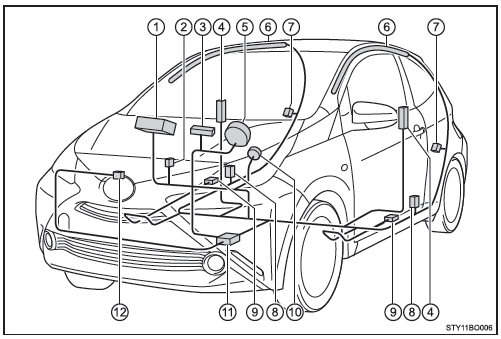
- Front passenger airbag
- Manual airbag on/off switch
- "PASSENGER AIR BAG" light
- Side airbags
- SRS airbag warning light
- Curtain airbags (if equipped)
- Side impact sensors (rear) (if equipped)
- Seat belt pretensioners and force limiters
- Side impact sensors (front doors)
- Driver's airbag
- Airbag sensor assembly
- Front impact sensor
5-door models
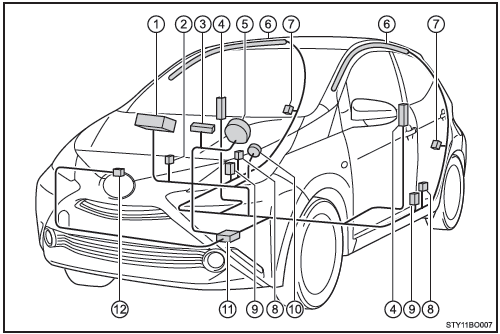
- Front passenger airbag
- Manual airbag on/off switch
- "PASSENGER AIR BAG" light
- Side airbags
- SRS airbag warning light
- Curtain airbags (if equipped)
- Side impact sensors (rear) (if equipped)
- Side impact sensors (front)
- Seat belt pretensioners and force limiters
- Driver's airbag
- Airbag sensor assembly
- Front impact sensor
The main components of the SRS airbag system are shown above. The SRS airbag system is controlled by the airbag sensor assembly.
When the airbags deploy, a chemical reaction inside the inflators quickly fills the airbags with non-toxic gas to restrain the movement of the occupants.
WARNING
■ SRS airbag precautions Observe the following precautions for the SRS airbags.
Failure to observe this may result in serious or fatal injury.
- The driver and all passengers in the cabin must wear their seat belts correctly.
SRS airbags are supplemental devices, to be used together with seat belts.
Because the danger zone for the driver airbag is the first 50 - 75 mm of inflation, a distance of 250 mm from the driver airbag provides a clear safety margin. This distance is measured from the center of the steering wheel to the sternum. If the driver sits less than 250 mm away, the driving position can be modified in several ways:
- Move the seat as far back as possible, while still being able to comfortably reach the pedals.
- Recline the seatback slightly. Although vehicle models vary, many drivers can achieve the 250 mm distance even with the seat fully forward, simply by reclining the seatback a little. If you do not have a good view outside when seated with the seatback reclined, sit upright using a cushion that rests securely on the seat without slipping, or raise the seat if the vehicle is equipped with this function.
- If the steering wheel is adjustable, tilt it downward. This directs the airbag toward the chest rather than toward the head or neck.
■ SRS Airbag Precautions
- The front passenger SRS airbag inflates with considerable force, which can cause serious or fatal injury if the front passenger is very close to the airbag. The front passenger seat should be kept as far back as possible, and the seatback adjusted so that the front passenger sits upright.
- Infants and children who are seated and/or restrained improperly may be killed or seriously injured by airbag deployment. Infants or children who are too small to use a seat belt must use an appropriate child restraint system. Toyota strongly recommends seating infants and children in the rear seats of the vehicle and using proper restraint systems. Rear seats are safer for infants and children than the front passenger seat.
- Do not sit on the edge of the seat or lean against the instrument panel.
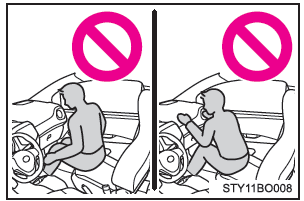
- Do not allow children to stand in front of the front passenger SRS airbag unit, or to sit on the front passenger's lap.
- Do not allow front seat occupants to hold objects on their laps.
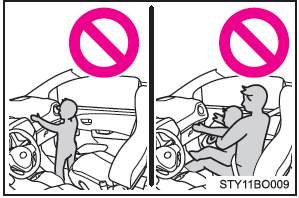
- Vehicles without SRS curtain airbags: Do not lean against the front door.
- Vehicles with SRS curtain airbags: Do not lean against the door, the roof side rail, or the front, side and rear pillars.
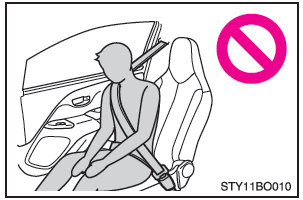
■ SRS Airbag Precautions
- Do not allow anyone to kneel on the front passenger seat facing the door, or to put their head or hands outside the vehicle.
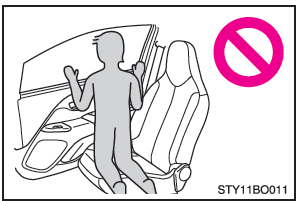
- Do not attach or place any object on parts such as the instrument panel or the center of the steering wheel.
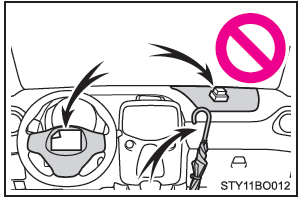
- Vehicles without SRS curtain airbags: Do not attach any object to parts such as the doors, windshield or windows.
- Vehicles with SRS curtain airbags: Do not attach any object in areas such as the doors, windshield, windows, front or rear pillars and roof side rails. (Except speed limit label)
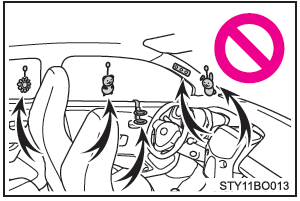
- Do not use seat accessories that cover the areas where the SRS side airbags inflate, as this could interfere with airbag inflation. These accessories could prevent the side airbags from operating correctly, disable the system, or cause accidental inflation of the airbags, resulting in serious or fatal injury.
- Do not strike or apply significant force to the surface of SRS airbag components.
■ SRS Airbag Precautions
- Do not touch any component immediately after the SRS airbags have deployed (inflated), as it may have reached high temperatures.
- If breathing is difficult after the SRS airbags have deployed, open a door or window if possible to allow fresh air in, or leave the vehicle if it is safe to do so. Wash off any residue as soon as possible to prevent skin irritation.
- If the areas where the SRS airbags are located, such as the center of the steering wheel and the front or rear pillar trim (vehicles with SRS curtain airbags), are damaged or cracked, have them replaced by any authorized Toyota dealer or repair shop, or another suitably qualified and equipped professional.
■ Modifications and Disposal of SRS Airbag System Components
Do not scrap the vehicle or carry out any of the following modifications without first consulting any authorized Toyota dealer or repair shop, or another suitably qualified and equipped professional.
This could cause the SRS airbags to malfunction or deploy (inflate) accidentally, resulting in serious or fatal injury.
- Installation, removal, disassembly and repair of SRS airbags
- Repairs, modifications, removal or replacement of the steering wheel, instrument panel, dashboard, seats or their trim, front, side and rear pillars, or roof side rails
- Repairs or modifications to the front fender, front bumper or passenger compartment side panel
- Installation of a protective grille (bull bar, kangaroo bar, etc.), snow plows or winches
- Modifications to the vehicle suspension system
- Installation of electronic devices such as two-way radios (RF transmitter) and CD players
■ If the SRS airbags deploy (inflate)
- Contact with a deployed (inflated) SRS airbag may cause scratches and minor abrasions.
- A loud noise and white dust are released.
- Vehicles without SRS curtain airbags: Some parts of the airbag module (steering wheel hub, airbag cover and inflator), as well as the front seats, may remain at a very high temperature for several minutes. The airbag itself may also have reached high temperatures.
- Vehicles with SRS curtain airbags: Parts of the airbag module (steering wheel hub, airbag cover and inflator), as well as the front seats, the front pillars, the rear pillars and the roof side rails, may remain hot for several minutes. The airbag itself may also have reached high temperatures.
- The windshield may crack.
■ Activation conditions of the SRS airbags (SRS front airbags)
- The SRS front airbags will activate if the severity of the impact exceeds the set threshold (force level equivalent to that generated in a frontal collision at approximately 20 - 30 km/h against a fixed, immovable or non-deformable barrier).
- If the vehicle strikes an object, such as a parked vehicle or a road sign that can move or deform on impact.
- If the vehicle is involved in a collision in which its front end "wedges" or passes under the underside of a truck.
- Depending on the type of collision, only the seat belt pretensioners may activate.
■ Activation conditions of the SRS airbags (SRS side airbags)
The SRS side airbags will activate if the severity of the impact exceeds the set threshold (force level equivalent to that generated when the passenger compartment of your vehicle is struck by a vehicle weighing approximately 1,500 kg traveling perpendicular to it at approximately 20 - 30 km/h).
■ Activation conditions of the SRS airbags (SRS side and curtain airbags [if equipped])
- The SRS side airbags and curtain airbags will activate if the severity of the impact exceeds the set threshold (force level equivalent to that generated when the passenger compartment of your vehicle is struck by a vehicle weighing approximately 1,500 kg traveling perpendicular to it at approximately 20 - 30 km/h).
- The SRS curtain airbags may also activate in a severe frontal collision.
■ Conditions in which the SRS airbags may activate (inflate) other than in a collision
The SRS front airbags and SRS curtain airbags (if equipped) may also activate if the underbody of the vehicle is subjected to a severe impact. Some examples are shown in the illustration.
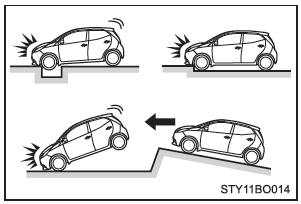
- Striking a curb, road edge or hard surface
- Falling into or jumping into a deep pothole
- Hard landing or vehicle drop
■ Types of collision that may not cause the SRS front airbags to activate
The SRS front airbags generally do not deploy if the vehicle is involved in a side or rear collision, if it rolls over, or if it is involved in a low-speed frontal impact. However, whenever a collision of any type causes sufficient forward deceleration of the vehicle, the SRS front airbags may activate.
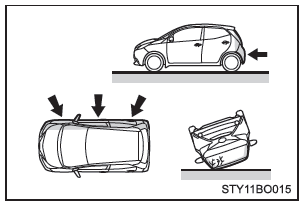
- Side collision
- Rear collision
- Vehicle rollover
■ Types of collision that may not cause the SRS airbags to activate (SRS side airbags or SRS side and curtain airbags [if equipped])
The SRS side airbags or SRS side and curtain airbags may not activate if the vehicle is involved in a side collision from an angle, or in a side collision that strikes body parts other than the passenger compartment.
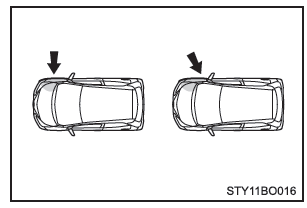
- Side collision affecting body parts other than the passenger compartment
- Side collision from an angle
The SRS side airbags generally do not deploy if the vehicle is involved in a side or rear collision, if it rolls over, or if it is involved in a low-speed side collision.
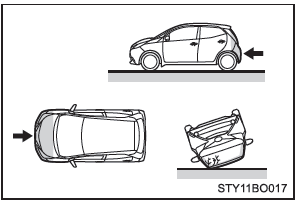
- Frontal collision
- Rear collision
- Vehicle rollover
The SRS curtain airbags generally do not deploy if the vehicle is involved in a rear collision, if it rolls over, or if it is involved in a low-speed side or frontal collision.
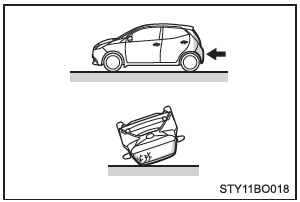
- Rear collision
- Vehicle rollover
■ When to contact an authorized Toyota dealer or repairer, or another suitably qualified and equipped professional
In the following cases, the vehicle must be inspected and/or repaired.
Contact an authorized Toyota dealer or repairer, or another suitably qualified and equipped professional, as soon as possible.
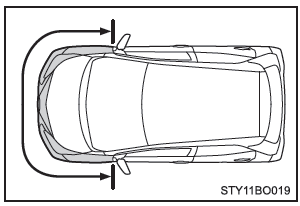
- One or more SRS airbags have deployed.
- The front of the vehicle is damaged or deformed, or it was involved in an accident not severe enough to deploy the SRS front airbags.
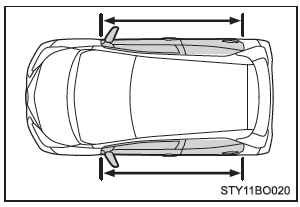
- A part of a door or the surrounding area is damaged or deformed, or the vehicle was involved in an accident not severe enough to deploy the SRS side airbags or the SRS side and curtain airbags.
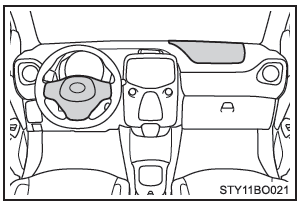
- The padded section of the steering wheel or the instrument panel near the front passenger airbag is scratched, cracked or otherwise damaged.
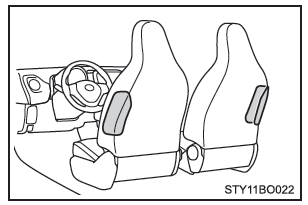
- The surface of a seat with a side airbag is scratched, cracked or otherwise damaged.
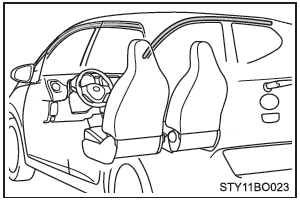
- Vehicles with SRS curtain airbags: The part of the front pillars, rear pillars or roof side rail moldings (trim) containing the curtain airbags is scratched, cracked or otherwise damaged.
Test yourself
A quick Toyota Aygo quiz: every answer comes with an explanation and a link to the manual page.