Tires
Replace or rotate the tires according to the scheduled maintenance and the degree of tread wear.
Tire Inspection
Check whether the tread wear indicators appear on the tires.
Also check that the tires show no signs of uneven wear, such as excessive wear on only one side of the tread.
If not rotated, check the condition and inflation pressure of the spare wheel.
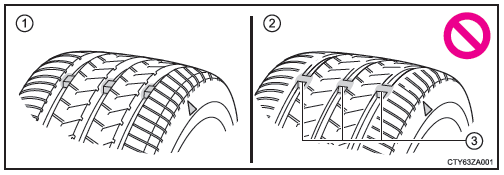
- New tread
- Worn tread
- Tread wear indicator
The location of the tread wear indicators is marked by a "TWI" or "Δ" symbol, etc., molded on the sidewall of each tire.
Replace the tires if the tread wear indicators appear across the tread.
Tire Rotation
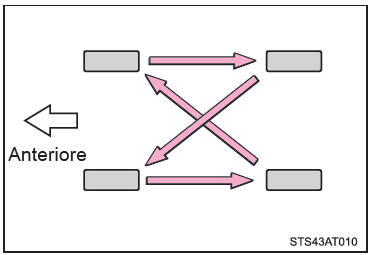
Rotate the tires in the order shown.
To achieve even tire wear and extend tire life, Toyota recommends rotating the tires approximately every 10,000 km (6,000 miles).
■ When to replace the vehicle's tires Tires must be replaced if:
- The tread wear indicators appear on a tire.
- A tire has damage such as cuts, splits, or cracks deep enough to expose the cord, or bulges that indicate internal damage.
- A tire keeps losing air or cannot be properly repaired because of the size or location of a cut or other damage.
If in doubt, contact any authorized Toyota dealer or repair shop, or another suitably qualified and equipped professional.
■ Tire age Every tire older than 6 years must be inspected by a qualified technician, even if it has never been used or has been used rarely, or shows no signs of damage.
■ Low-profile tires (vehicles with 165/60R15 tires) Compared with standard tires, low-profile tires generally wear faster and have reduced grip on snowy and/or icy roads. On such roads, use snow tires or snow chains and drive carefully at a speed suitable for the road and weather conditions.
■ If the tread on snow tires is less than 4 mm (0.16 in.) The snow tires are no longer effective.
Tire Pressure Warning System (if equipped)
The vehicle is equipped with a tire pressure warning system.
While the vehicle is in motion, the system monitors changes in the wheel speed signals sent by the wheel speed sensors of the brake control system.
It warns the driver if it detects low tire inflation pressure.
◆ Tire Pressure Warning System Initialization
■ When a tire is changed, the tire pressure warning system must be initialized Once the tire pressure warning system is initialized, the current tire inflation pressure is set as the reference value.
■ Initialization procedure
- Remember to perform the initialization after adjusting the tire inflation pressure. Also, make sure the tires are cold before performing the initialization or adjusting the tire inflation pressure.
- If the reset switch is pressed accidentally when initialization is not necessary, adjust the tire inflation pressure to the specified level when the tires are cold, and then repeat the initialization.
■ How to initialize the tire pressure warning system
- Park the vehicle in a safe place and turn the engine switch to the "LOCK" position (vehicles without the smart entry and start system), or turn it off (vehicles with the smart entry and start system).
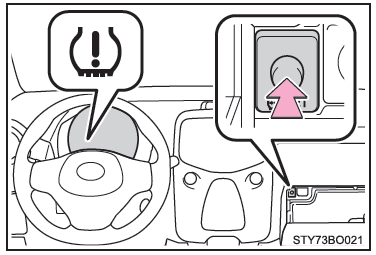
■ Situations in which the tire pressure warning system (if equipped) may not operate correctly
- This tire pressure warning system ensures correct operation when an OE (Original Equipment) tire is installed.
- The tire pressure warning system may not operate correctly under the following conditions.
- The vehicle uses non-standard tires or tires from other manufacturers.
- The vehicle uses tires of different sizes or manufacturers.
- The vehicle uses snow tires, the temporary spare tire (if equipped), or snow chains.
- The vehicle is driven at a speed lower than approximately 40 km/h.
- The vehicle is driven on slippery or uneven roads.
- In the event of a rapid loss of tire inflation pressure, for example after a tire blowout, the system may not function.
WARNING
■ When inspecting or replacing tires Observe the following precautions to avoid accidents.
Failure to observe these precautions could cause damage to drivetrain components and compromise handling characteristics, resulting in accidents with serious or fatal injuries.
- Do not fit tires of different brands, models or tread patterns.
Also, do not fit tires with significantly different tread wear.
■ When initializing the tire pressure monitoring system (if equipped) Do not press the tire pressure monitoring system reset switch without first adjusting the tire inflation pressure to the specified level. Otherwise, the tire pressure warning light may not come on when pressure is low, or it may come on when pressure is actually normal.
■ Tire maintenance (vehicles with tire pressure monitoring system) Every tire, including the spare tire (if equipped), should be checked monthly when cold and inflated to the pressure recommended by the manufacturer, as shown on the vehicle information placard or tire and loading information label. (If the vehicle has tires of a size different from those indicated on the vehicle information placard or tire and loading information label, determine the correct tire inflation pressure for the tires you are using.) The vehicle is equipped with an additional safety feature, the tire pressure monitoring system (TPMS). A low tire pressure indicator (tire pressure warning light) comes on when one or more tires are significantly under-inflated. Therefore, when the low tire pressure indicator (tire pressure warning light) comes on, stop and check the tires as soon as possible. Inflate them to the correct pressure if necessary. Driving on a severely under-inflated tire risks overheating of the tire and possible tire failure. Under-inflation also reduces fuel efficiency and tire life, and may affect handling and braking, possibly leading to loss of vehicle control.
Note that the TPMS (tire pressure monitoring system) does not replace proper tire maintenance. It is the driver's responsibility to maintain correct tire pressure, even if under-inflation has not reached the level that turns on the TPMS low tire pressure indicator (tire pressure warning light).
The vehicle is also equipped with a TPMS (tire pressure monitoring system) malfunction indicator, which signals a possible system malfunction.
The TPMS (tire pressure monitoring system) malfunction indicator is combined with the low tire pressure indicator (tire pressure warning light). If the system detects a malfunction, the indicator flashes for about one minute and then stays on. This sequence repeats at subsequent vehicle starts if the malfunction persists. If the malfunction indicator is on, the system may not be able to detect or signal low tire pressure as it normally should.
TPMS (tire pressure monitoring system) malfunctions may have various causes, for example fitting replacement or alternative tires or wheels to the vehicle that prevent the TPMS (tire pressure monitoring system) from operating correctly. Always check the TPMS (tire pressure monitoring system) malfunction indicator after replacing one or more tires or wheels to make sure the replacement or alternative tires or wheels allow the TPMS (tire pressure monitoring system) to operate correctly.
NOTE
■ Caution when fitting a different tire (vehicles with tire pressure monitoring system) When fitting tires of a different type, with different construction or tread, or made by another manufacturer, the tire pressure monitoring system may not operate correctly.
■ Driving on rough roads Take particular care when driving on roads with slippery surfaces or potholes.
These conditions may cause the tire inflation pressure to drop, reducing the tires' cushioning capacity. In addition, driving on rough roads may damage the tires, as well as the wheels and body.
■ Low-profile tires (vehicles with 165/60R15 tires) Low-profile tires may cause more damage to the wheels than standard tires when they strike the road surface. Be sure to observe the following:
- Make sure the tire inflation pressure is correct. If the tire pressure is too low, the tires may be damaged even more severely.
- Avoid potholes, uneven road surfaces, curbs, and other road hazards.
■ If the inflation pressure of any tire drops while driving Do not continue driving, to avoid damaging the tires and/or wheels.
Test yourself
A quick Toyota Aygo quiz: every answer comes with an explanation and a link to the manual page.