Precautions
PRECAUTION
HINT:
In the SRS airbag system, the parts listed below are collectively referred to as airbag sensors.- Airbag sensor assembly
- Front airbag sensor
- Door side airbag sensors
- No. 1 side airbag sensor
- Floor side airbag sensor
- No. 2 side airbag sensor
- Horn Button Assembly
- No. 1 instrument panel lower airbag assembly
- Instrument panel passenger side without door airbag assembly
- Curtain airbag assemblies
- Front seat airbag assemblies
- Front seat belt outer belt assemblies
- 3-point type rear seat belt outer belt assemblies*
- Rear seat airbag assemblies*
- Front right seat cushion airbag assembly*
- *: with occupant classification system
PRECAUTIONS FOR HANDLING SRS SYSTEM
(a) Failure to follow the correct order of service operations may cause the SRS to deploy accidentally during service, resulting in a serious accident. In addition, if an error is made during SRS service, the SRS may not function when needed. Before performing any service (removal or installation of parts, inspection or replacement), be sure to read the precautions below carefully, then strictly follow the procedures in the repair manual.
PRECAUTIONS FOR DISCONNECTING THE CABLE FROM THE NEGATIVE BATTERY TERMINAL
(a) SRS malfunctions are difficult to confirm, so diagnostic trouble codes (DTCs) are the most important source of information when troubleshooting. When troubleshooting the SRS, always check the DTCs before disconnecting the negative (-) battery terminal cable.
NOTICE:
After turning the ignition switch OFF, a waiting time may be required before disconnecting the cable from the negative (-) battery terminal. Therefore, be sure to read the precautions for disconnecting the cable from the negative (-) battery terminal before performing the work.
Click here
(b) Disconnecting the negative (-) battery terminal cable will erase the memory of various systems. Therefore, be sure to record the memory contents of each system before starting work. When work is complete, set each system back to its initial state.
GENERAL PRECAUTIONS
(a) Use a high-impedance voltmeter / ohmmeter (minimum 10 kΩ) to troubleshoot electrical circuits.
(b) Informational labels are attached to SRS parts. Follow the instructions on them.
(c) Never disassemble or attempt to repair SRS parts.
(d) If any SRS part is dropped, or if cracks, nicks or other defects are found, replace it with a new one.
(e) Never use SRS parts from another vehicle. When replacing parts, use new parts.
(f) Do not expose any SRS part directly to high temperatures or open flames.
(g) If the vehicle has been involved in a minor collision and the SRS has not deployed, the SRS parts must be inspected before the vehicle is used again.
(h) Do not apply grease, detergent, oil or water to SRS parts. If this occurs, wipe it off immediately with a dry cloth.
(i) When deploying or storing SRS parts, avoid locations with high temperature (ambient temperature of 93 °C or higher for an airbag and 80 °C or higher for a pretensioner) and high humidity, and keep them away from electrical noise.
(j) Do not stack or place anything on SRS parts.
(k) When scrapping a vehicle or SRS part, deploy it using the SST before scrapping. Deploy SRS parts in a location free of electrical noise.
HINT:
- Horn Button Assembly
Click here
- No. 1 instrument panel lower airbag assembly
Click here
- Instrument panel passenger side without door airbag assembly
Click here
- Curtain airbag assemblies
Click here
- Front seat airbag assemblies
Click here
- Front right seat cushion airbag assembly*
- Front seat belt outer belt assemblies
Click here
- 3-point type rear seat belt outer belt assemblies* Rear seat airbag assemblies*
- *: with occupant classification system
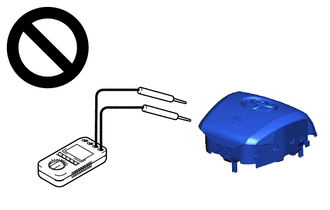
(l) Never measure the resistance of SRS parts.
CAUTION:
Never measure the resistance of SRS parts, as the current from the tester may cause the SRS parts to deploy.
PRECAUTIONS FOR SCRAPPING SRS PARTS (NOT DEPLOYED)
(a) Before deploying any SRS part for scrapping, carefully read and follow all environmental and hazardous materials regulations. Deploying for scrapping may be considered hazardous material treatment.
(b) Never scrap an SRS part that has not been deployed.
(c) Deploy SRS parts outdoors on a flat surface in a safe location where neighbors will not be disturbed.
(d) Since SRS parts produce a loud noise when deployed, be sure to notify neighbors before deploying.
(e) Before deploying SRS parts, always use the specified SST and keep people at least 10 m (32.8 ft) away.
(f) Accidental deployment of SRS parts may occur due to static electricity. To prevent this, be sure to touch a bare metal surface to discharge static electricity before handling SRS parts.
(g) Do not point the deployment side of the airbag downward when deploying it.
PRECAUTIONS FOR SCRAPPING SRS PARTS (DEPLOYED)
(a) Since SRS components become very hot after deployment, wait at least 30 minutes to allow them to cool sufficiently before disposal.
(b) Do not pour water, etc. on deployed SRS components.
(c) Wear gloves and protective goggles when handling deployed SRS components.
(d) When disposing of deployed SRS components, seal them in a thick, transparent plastic bag.
(e) Always wash your hands with water after disposing of deployed SRS components.
PRECAUTIONS FOR HORN BUTTON ASSEMBLY, NO. 1 INSTRUMENT PANEL LOWER AIRBAG ASSEMBLY, INSTRUMENT PANEL PASSENGER AIRBAG ASSEMBLY WITHOUT DOOR, CURTAIN AIRBAG ASSEMBLY, REAR SEAT AIRBAG ASSEMBLY, RIGHT FRONT SEAT CUSHION AIRBAG ASSEMBLY AND FRONT SEAT AIRBAG ASSEMBLY
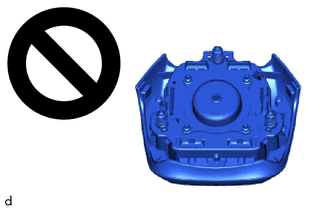
(a) Make sure the airbag deployment side faces upward, even when the airbag is temporarily removed during service.
CAUTION:
Always place a new or reinstalled airbag with the deployment surface facing upward. Placing the airbag with the deployment surface facing downward may cause a serious accident if the airbag deploys.
PRECAUTIONS FOR FRONT SEAT OUTER BELT ASSEMBLY (3-POINT TYPE WITH PRETENSIONER) AND REAR SEAT OUTER BELT ASSEMBLY (WITH PRETENSIONER)
(a) Do not touch the area around the retractor, even when the front seat outer belt assembly is temporarily removed during service.
CAUTION:
If the pretensioner deploys accidentally while the front seat outer belt assembly is retracted, operation may cause a serious accident.
PRECAUTIONS FOR SPIRAL CABLE SUB-ASSEMBLY WITH SENSOR
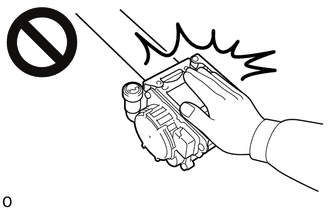
(a) Do not replace the spiral cable sub-assembly with sensor when the battery is connected and the ignition switch is ON.
(b) Do not turn the spiral cable sub-assembly with sensor without locking the installed steering wheel assembly, with the battery connected and the ignition switch in the ON position.
(c) Make sure the steering wheel assembly is installed and aligned with the vehicle's centerline when checking the steering angle sensor.
(d) When turning the spiral cable sub-assembly with sensor, be sure to press the interlock to release the interlock mechanism.
(e) Make sure the spiral cable sub-assembly with sensor is in the neutral position when installing it and when removing and installing the steering wheel assembly.
Click here
CAUTION:
If the steering wheel assembly is turned without the spiral cable sub-assembly with sensor in the neutral position, the cable may break.
PRECAUTIONS FOR AIRBAG SENSORS
(a) Perform a diagnostic system check.
Click here
(b) If SRS components are deployed (including when only an airbag or pretensioner is deployed) as a result of a collision, be sure to replace all sensors in the damaged areas (all those requiring repair) and the airbag sensor assembly.
(c) Visually inspect the airbag sensors in undamaged areas for any defects.
(1) Defects include:
- Cracks in the sensor housing
- Nicks in the sensor housing
- Chips in the sensor housing
- Cracks or other damage to the connector
- Damage to the serial number (except side door airbag sensor)
OK:
There are no defects.
If a defect is found, or if an airbag sensor has detected a severe collision, replace the airbag sensor with a new one.
PRECAUTIONS WHEN REPLACING AIRBAG SENSOR ASSEMBLY
(a) When replacing the airbag sensor assembly, perform zero point calibration for the yaw and acceleration sensor.
Click here
PRECAUTIONS FOR SIDE DOOR AIRBAG SENSOR
(a) Do not modify the front door in a way that may affect the internal pressure of the front door.
(b) Prevent foreign objects from entering the side door airbag sensor, as they may affect the sensor's pressure detection performance.
(c) When painting the front door, remove or apply protective tape over the side door airbag sensor to prevent paint from adhering to it.
(d) Make sure the front door weatherstrips are properly installed. If the front door sealing decreases, the pressure detection performance of the side door airbag sensor may be affected. Repair or replace parts as necessary.
PRECAUTIONS FOR WIRE HARNESS AND CONNECTOR
(a) All wire harnesses in the engine compartment, except unexposed harnesses, are yellow.
(b) Special connectors are used, so handle them with care.
WHEN SERVICING A DAMAGED VEHICLE
(a) Before performing electric welding on the vehicle, remove the SRS components around the repair area.
CAUTION:
Be sure to remove the SRS components as necessary to prevent them from deploying accidentally.
(b) Before starting repairs, remove the airbag sensor assemblies if they may be subjected to impact during the repair work.
(c) Never expose an airbag sensor directly to high temperatures.
(d) Since SRS components become very hot after deployment, make sure that all wire harnesses and connectors around the SRS components are not damaged.
CONDITIONS REQUIRING SRS COMPONENT INSPECTION
(a) When the vehicle is damaged in a collision, even if the SRS components have not deployed.
(b) When SRS system DTCs are output.
IGNITION SWITCH TERMS
(a) The type of ignition switch used differs depending on the vehicle specifications. The terms in the table below are used in this section.
Term | Ignition Switch (Position) | Engine Switch (Condition) |
|---|---|---|
Ignition Switch in OFF position |
LOCK |
OFF (Locked) |
Ignition Switch in ACC position |
ACC |
ON (ACC) |
Ignition Switch in ON position |
ON |
ON (IG) |
Starting the engine |
START |
ON (Starting) |
CAUTION / NOTICE FOR REPLACING INSTRUMENT CLUSTER ASSEMBLY
(a) When replacing the instrument cluster assembly, replace it with a new part. If an instrument cluster assembly installed in another vehicle is used, the recorded information will not match the information transmitted by the vehicle, and a DTC may be stored.