The ECM uses signals from the output shaft speed sensor and input speed sensor to detect the actual gear position (1st, 2nd, 3rd, 4th, 5th or 6th gear).
Then the ECM compares the actual gear with the shift schedule in the ECM memory to detect mechanical problems of the shift solenoid valves, valve body and automatic transmission (clutch, brake, gear, etc.).
DTC Code
DTC Detection Condition
Trouble Area
P0756
S2 stuck ON malfunction*1:
Shifting to 3rd and 5th gears is impossible.
The ECM determines there is a malfunction when the following conditions are both met (2-trip detection logic):
(a) When the ECM directs the transmission to switch to 5th gear, the actual gear is shifted to 6th.
(b) When the ECM directs the transmission to switch to 6th gear, the actual gear is shifted to 6th.
Gear positions in the event of a solenoid valve mechanical problem:
ECM gear shift command
1st
2nd
3rd
4th
5th
6th
*1: Actual gear position under S2 stuck ON malfunction
1st
2nd
2nd
4th
6th
6th
*2: Actual gear position under S2 stuck OFF malfunction
3rd
3rd
3rd
4th
5th
5th
MONITOR DESCRIPTION
This DTC indicates a "stuck ON malfunction" or "stuck OFF malfunction" of the shift solenoid valve S2.
The ECM commands gear shifts by turning the shift solenoid valves ON/OFF. When the gear position commanded by the ECM and the actual gear position are not the same, the ECM illuminates the MIL and stores the DTC.
MONITOR STRATEGY
Related DTCs
P0756: Shift solenoid valve S2/Functional check
Required sensors/Components
Shift solenoid valve S2
Frequency of operation
Continuous
Duration
0.4 seconds
MIL operation
2 driving cycles
Sequence of operation
None
TYPICAL ENABLING CONDITIONS
All
The monitor will run whenever the following DTCs are not present
P0717 (Turbine speed sensor circuit)
P0722 (Output Speed Sensor circuit)
P0710, P0712, P0713, P2740, P2742, P2743 (ATF temperature sensor circuit)
Spark advance from max. retard timing by KCS control
0° crankshaft angle or more
Engine
Starting
Calculated load value
7.75% or more (A/C off)
7.75% or more (A/C on)
Input speed/output speed (NT/NO)
NT: Input (Turbine) speed
NO: Internal counter shaft speed
3.30 to 7.50
or
1.91 to 2.35
or
1.28 to 1.53
or
0.93 to 1.07
or
0.65 to 0.79
or
0.51 to 0.65
OFF Malfunction (A)
ECM selected gear
1st
Vehicle speed
2 km/h or more and less than 40 km/h
Engine speed - Turbine speed (NE - NT)
50 rpm or more
OFF Malfunction (B)
ECM selected gear
6th
Vehicle speed
2 km/h or more
Throttle valve opening angle
5% or more at 2000 rpm
(Conditions vary with engine speed)
ON Malfunction (A)
ECM selected gear
5th
Vehicle speed
2 km/h or more
Throttle valve opening angle
5% or more at 2000 rpm
(Conditions vary with engine speed)
ON Malfunction (B)
ECM selected gear
6th
Vehicle speed
2 km/h or more
Throttle valve opening angle
5% or more at 2000 rpm
(Conditions vary with engine speed)
TYPICAL MALFUNCTION THRESHOLDS
OFF malfunction is detected when OFF malfunction (A) and (B) are detected.
OFF Malfunction (A)
Turbine speed / Output speed (NT / NO)
1.28 or more, and 1.53 or less
(This means actual gear is 3rd)
OFF Malfunction (B)
Turbine speed / Output speed (NT / NO)
0.65 or more, and 0.79 or less
(This means actual gear is 5th)
ON Malfunction is detected when ON malfunction (A) and (B) are detected.
ON Malfunction (A)
Turbine speed / Output speed (NT / NO)
0.51 or more, and 0.65 or less
(This means actual gear is 6th)
ON Malfunction (B)
Turbine speed / Output speed (NT / NO)
0.51 or more, and 0.65 or less
(This means actual gear is 6th)
NOTICE:
Perform the universal trip to clear permanent DTCs (See page ).
1. ACTIVE TEST
HINT:
Using the Techstream to perform Active Tests allows relays, VSVs, actuators and other items to be operated without removing any parts. This non-intrusive functional inspection can be very useful because intermittent operation may be discovered before parts or wiring is disturbed. Performing Active Tests early in troubleshooting is one way to save diagnostic time. Data List information can be displayed while performing Active Tests.
(a) Warm up the engine.
(b) Turn the ignition switch off.
(c) Connect the Techstream to the DLC3.
(d) Turn the ignition switch to ON.
(e) Turn the Techstream on.
(f) Enter the following menus: Powertrain / Engine and ECT / Active Test.
(g) According to the display on the Techstream, perform the Active Test.
HINT:
While driving, the shift position can be forcibly changed with the Techstream.
Comparing the shift position commanded by the Active Test with the actual shift position enables you to confirm the problem (See page ).
Engine and ECT
Tester Display
Test Part
Control Range
Diagnostic Note
Control the Shift Position
Operate shift solenoid valves and set each shift position
Press "→" button: Shift up
Press "←" button: Shift down
Possible to check operation of the shift solenoid valves.
[Vehicle Condition]
50 km/h or less
HINT:
This test can be conducted when the vehicle speed is 50 km/h or less.
The 4th to 5th and 5th to 6th up-shifts must be performed with the accelerator pedal released.
The 6th to 5th and 5th to 4th down-shifts must be performed with the accelerator pedal released.
Do not operate the accelerator pedal for at least 2 seconds after shifting and do not shift successively.
The shift position commanded by the ECM is shown in the Data List display on the Techstream.
The shift solenoid valve S2 turns ON/OFF normally when the shift lever is in D.
ECM gear shift command
1st
2nd
3rd
4th
5th
6th
Shift solenoid valve S2
ON
ON
OFF
OFF
OFF
ON
PROCEDURE
CHECK DTC OUTPUT (IN ADDITION TO DTC P0756)
(a) Connect the Techstream to the DLC3.
(b) Turn the ignition switch to ON.
(c) Turn the Techstream on.
(d) Enter the following menus: Powertrain / Engine and ECT / Trouble Codes.
(e) Read the DTCs using the Techstream.
Result
Result
Proceed to
Only P0756 is output
A
P0756 and other DTCs are output
B
HINT:
If any other codes besides P0756 are output, perform troubleshooting for those DTCs first.
B
GO TO DTC CHART
A
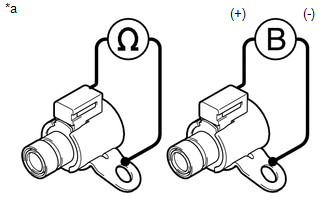
INSPECT SHIFT SOLENOID VALVE S2
(a) Remove shift solenoid valve S2.
(b) Measure the resistance according to the value(s) in the table below.